
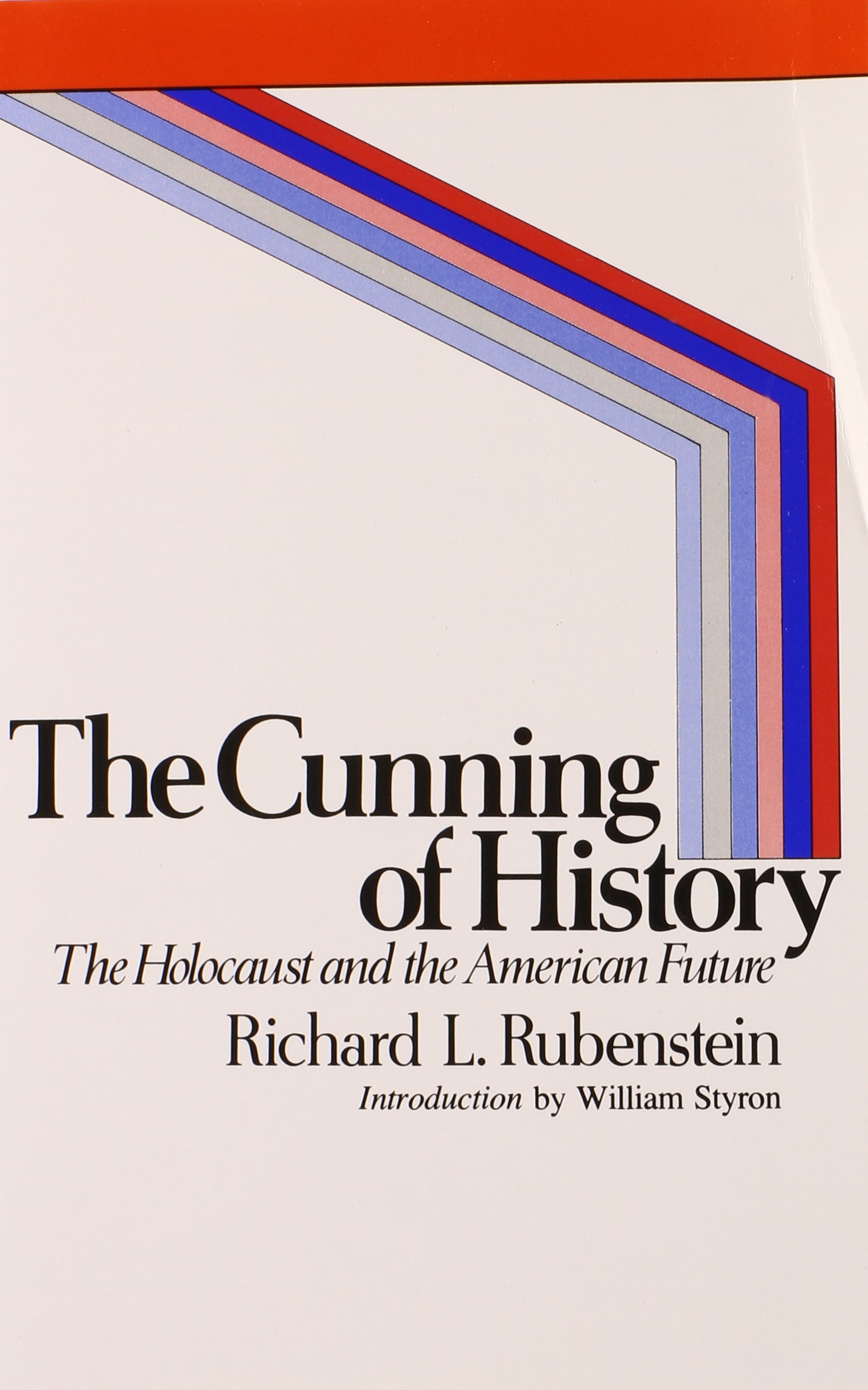
The Cunning of History: The Holocaust as Slavery's Ultimate Embodiment and the Sleeping Virus in Civilization
$12.51
| Brand | Richard L. Rubenstein |
| Merchant | Amazon |
| Category | Books |
| Availability | Available Date |
| SKU | 0061320684 |
| Age Group | ADULT |
| Condition | NEW |
| Gender | UNISEX |
| Google Product Category | Media > Books |
| Product Type | Books > Subjects > History > World > Jewish > Holocaust |
About this item
The Cunning of History: The Holocaust as Slavery's Ultimate Embodiment and the Sleeping Virus in Civilization
With an Introduction by William Styron Theologian Richard L. Rubenstein writes of the Holocaust, why it happened, why it happened when it did, and why it may happen again and again. "Few books possess the power to leave the reader with the feeling of awareness that we call a sense of revelation. The Cunning of History seems to me to be one of these . . . Rubenstein is forcing us to reinterpret the meaning of Auschwitz—especially, though not exclusively, from the standpoint of its existence as part of a continuum of slavery that has been engrafted for centuries onto the very body of Western civilization. Therefore, in the process of destroying the myth and the preconception, he is making us see that that encampment of death and suffering may have been more horrible than we had ever imagined. It was slavery in its ultimate embodiment. He is making us understand that the etiology of Auschwitz—to some, a diabolical, perhaps freakish excrescence, which vanished from the face of the earth with the destruction of the crematoria in 1945—is actually embedded deeply in a cultural tradition that stretches back to the Middle Passage from the coast of Africa, and beyond, to the enforced servitude in ancient Greece and Rome. Rubenstein is saying that we ignore this linkage, and the existence of the sleeping virus in the bloodstream of civilization, at risk of our future." — William Styron, from the Introduction. Richard Rubenstein writes of the holocaust, why it happened, why it happened when it did, and why it may happen again and again. The Cunning of History By Richard E. Rubenstein HarperCollins Publishers, Inc. Copyright © 2007 Richard E. Rubenstein All right reserved. ISBN: 9780061320682 Chapter One Why should anyone bother to reflect once again on the extermination of Europe's Jews by the Germans thirty years ago? The event is over and done. The world has witnessed a plethora of new horrors since that time. And, given the global threat of overpopulation, it will probably witness the death of even greater numbers by famine in the near future. Why not consign the story to the dustbin of history and be done with it? Part of the answer lies in the fact that the popular imagination will not let the Nazi period die. People still continue to be fascinated by Hitler, Himmler, and the SS. Books about the Nazis continue to appear. They are bought in large numbers by a curious public. The Nazi period also continues to be a subject of great interest for the movies and television. Much of the popular interest is undoubtedly perverse. Some people use the Nazi story as a vehicle to express their own fantasies of sadistic domination of their peers, a domination they could never achieve in real life. Others may have an unsettling need for total submission that can more safely be expressed in fantasy than reality. Yet, in spite of the perverse fascination, there is a sound basis for the interest in the period. The passing of time has made it increasingly evident that a hitherto unbreachable moral and political barrier in the history of Western civilization was successfully overcome by the Nazis in World War Il and that henceforth the systematic, bureaucratically administered extermination of millions of citizens or subject peoples will forever be one of the capacities and temptations of government. Whether or not such a temptation is ever again exercised, the mere fact that every modern government possesses such power cannot but alter the relations between those who govern and those who are governed. This power must also alter the texture of foreign relations. According to Max Weber, "The state is a human community that (successfully) claims the monopoly of the legitimate use of force within a given territory." I Auschwitz has enlarged our conception of the state's capacity to do violence. A barrier has been overcome in what for millennia had been regarded as the permissible limits of political action. The Nazi period serves as a warning of what we can all too easily become were we faced with a political or an economic crisis of overwhelming proportions. The public may he fascinated by the Nazis; hopefully, it is also warned by them. In studying the Holocaust, the extermination of Europe's Jews, it is necessary to recognize that our feelings may be strongly aroused. Both the Nazis and their victims elicit some very complicated emotional responses from most people. These feelings are important but they can add to our difficulties in arriving at an understanding of what took place. In order to understand the Holocaust, it is necessary to adopt a mental attitude that excludes all feelings of sympathy or hostility towards both the victims and the perpetrators. This is a methodological procedure and, admittedly, an extremely difficult one. Nevertheless, this bracketing is necessary, not only because of the emotions aroused by the Nazis, but also because of the ambivalent reactions Jews inevitably arouse in Wes
| Brand | Richard L. Rubenstein |
| Merchant | Amazon |
| Category | Books |
| Availability | Available Date |
| SKU | 0061320684 |
| Age Group | ADULT |
| Condition | NEW |
| Gender | UNISEX |
| Google Product Category | Media > Books |
| Product Type | Books > Subjects > History > World > Jewish > Holocaust |
Similar Products










Compare with similar items

Cats & Food Coloring Book: Bold & Easy S... |

Big Fun Kitten Coloring Book for Kids: 5... |
300 Mind-Tickling Riddles: Fun and Diffi... |

30 Days of Affirmations: Press Pass Paus... |
|
|---|---|---|---|---|
| Price | $7.99 | $5.68 | $8.95 | $19.99 |
| Brand | Amelia Kelsey | Nikita Pecheritsa | Activity Volt | Romonica Davis |
| Merchant | Amazon | Amazon | Amazon | Amazon |
| Availability | In Stock | In Stock | In Stock | In Stock |