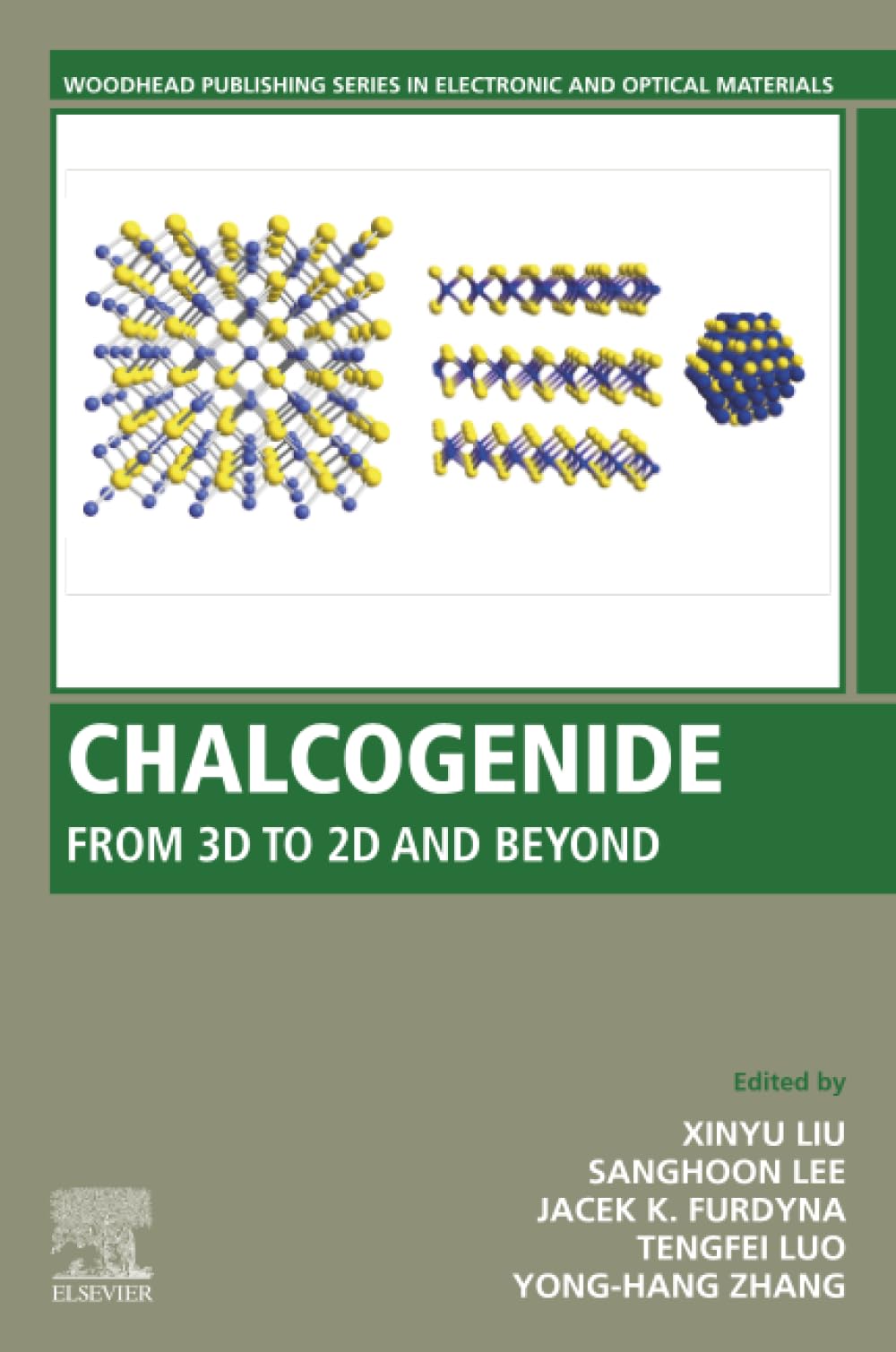
Chalcogenide: From 3D to 2D and Beyond (Woodhead Publishing Series in Electronic and Optical Materials)
$187.50
| Brand | Xinyu Liu |
| Merchant | Amazon |
| Category | Books |
| Availability | In Stock |
| SKU | 0081026870 |
| Age Group | ADULT |
| Condition | NEW |
| Gender | UNISEX |
| Google Product Category | Media > Books |
| Product Type | Books > Subjects > Engineering & Transportation > Engineering > Electrical & Electronics > Electronics |
About this item
Chalcogenide: From 3D to 2D and Beyond (Woodhead Publishing Series in Electronic and Optical Materials)
Chalcogenide: From 3D to 2D and Beyond reviews graphene-like 2D chalcogenide systems that include topological insulators, interesting thermoelectric structures, and structures that exhibit a host of spin phenomena that are unique to 2D and lower-dimensional geometries. The book describes state-of-the-art materials in growth and fabrication, magnetic, electronic and optical characterization, as well as the experimental and theoretical aspects of this family of materials. Bulk chalcogenides, chalcogenide films, their heterostructures and low-dimensional chalcogenide-based quantum structures are discussed. Particular attention is paid to findings that are relevant to the continued search for new physical phenomena and new functionalities. Finally, the book covers the enormous opportunities that have emerged as it has become possible to achieve lower-dimensional chalcogenide structures by epitaxial techniques. Provides readers with foundational information on the materials growth, fabrication, magnetic, electronic and optical characterization of chalcogenide materials - Discusses not only bulk chalcogenides and chalcogenide thin films, but also two-dimensional chalcogenide materials systems - Reviews the most important applications in optoelectronics, photovoltaics and thermoelectrics Reviews the chalcogenide family of materials, with examples from emerging fields, such as spintronics, valleytronics, topological insulators, superconductors, and more Chalcogenide Semiconductors describes the state-of-the-art materials growth and fabrication; magnetic, electronic, and optical characterization, as well as experimental and theoretical aspects of this family of materials. Bulk chalcogenides, chalcogenide films, their heterostructures, as well as low-dimensional chalcogenide-based quantum structures are discussed. Particular attention is paid to findings that are relevant to the continued search for new physical phenomena and new functionalities. The book first reviews several classes of bulk (3D) chalcogenide compounds, with special focus on II-VI and IV-VI systems that play key roles in such important fields as IR detectors, diluted magnetic semiconductors, photovoltaics, gamma ray detectors, and early advances in short-wavelength lasers. Then the volume covers the enormous opportunities that emerged as it became possible to achieve lower-dimensional chalcogenide structures by epitaxial techniques on the one hand, and by bottom-up chemistry on the other. Chalcogenide Semiconductors reviews graphene-like 2D chalcogenide systems that include topological insulators, interesting thermoelectric structures, and structures that exhibit a host of spin phenomena that are unique to 2D and lower-dimensional geometries. Chalcogenide Semiconductors is suitable for researchers in materials science, condensed matter physics, quantum informatics, and device engineering. Xinyu Liu is currently a Research Associate Professor at the University of Notre Dame conducting research on spin-based processes in semiconductors and their nanostructures. Prior to his current role, he worked at the University of Notre Dame as a post-doc and research assistant, focusing on magnetic semiconductors and ferromagnetic semiconductor materials. Sanghoon Lee joined the Electrical Materials Engineering Department at Kwangwoon University as a faculty member (2000). At Kwangwoon University he founded the “spin functional semiconductor research center. In 2001 he joined Korea University as an Assistant Professor and was promoted to the rank of Professor in 2008. His current research focuses on the spin related phenomena in semiconductor nanostructures, which include magnetic semiconductor materials growth, characterization of spin property, and semiconductor spin devices. For the last few years, he has served as the Department Chair and the Director of the BK21 plus project. Jacek Furdyna is the Marquez Professor of Physics at the University of Notre Dame. Since the 1960s he has been studying semiconductors with special expertise on epitaxially grown semiconductors and their quantum structures. For the totality of his scientific accomplishments he was awarded honorary doctorates by Warsaw University in October 2002 and by Purdue University in May 2007. In 2009 he was awarded the Nicolaus Copernicus Medal by the Polish Academy of Sciences. Dr. Luo joined Aerospace and Mechanical Engineering in 2012 as an assistant professor after finishing his postdoctoral research in MIT. He received his Ph.D. in Mechanical Engineering from Michigan State University and B.S. in Energy and Power Engineering from Xi’an Jiaotong University. Dr. Luo’s research focuses on understanding fundamentals of nanoscale heat and mass transfer using computational and experimental techniques and applying the knowledge to the fields of renewable energy, microelectronics thermal management and water treatment. Dr. Yong Zhang is a scientist in the field of High entropy alloys (HEAs
| Brand | Xinyu Liu |
| Merchant | Amazon |
| Category | Books |
| Availability | In Stock |
| SKU | 0081026870 |
| Age Group | ADULT |
| Condition | NEW |
| Gender | UNISEX |
| Google Product Category | Media > Books |
| Product Type | Books > Subjects > Engineering & Transportation > Engineering > Electrical & Electronics > Electronics |
Similar Products










Compare with similar items

The Baby Skincare Book: The Ultimate Gui... |

Appalachian Whispers: Tales from the Bac... |

Sylvia... |

Labrador Notebook: Black, Yellow, and Ch... |
|
|---|---|---|---|---|
| Price | $24.99 | $23.50 | $12.99 | $7.25 |
| Brand | Jamie Danielle East | B Howl | J N Hills | YM and SM Designs |
| Merchant | Amazon | Amazon | Amazon | Amazon |
| Availability | In Stock | In Stock | In Stock | In Stock |