
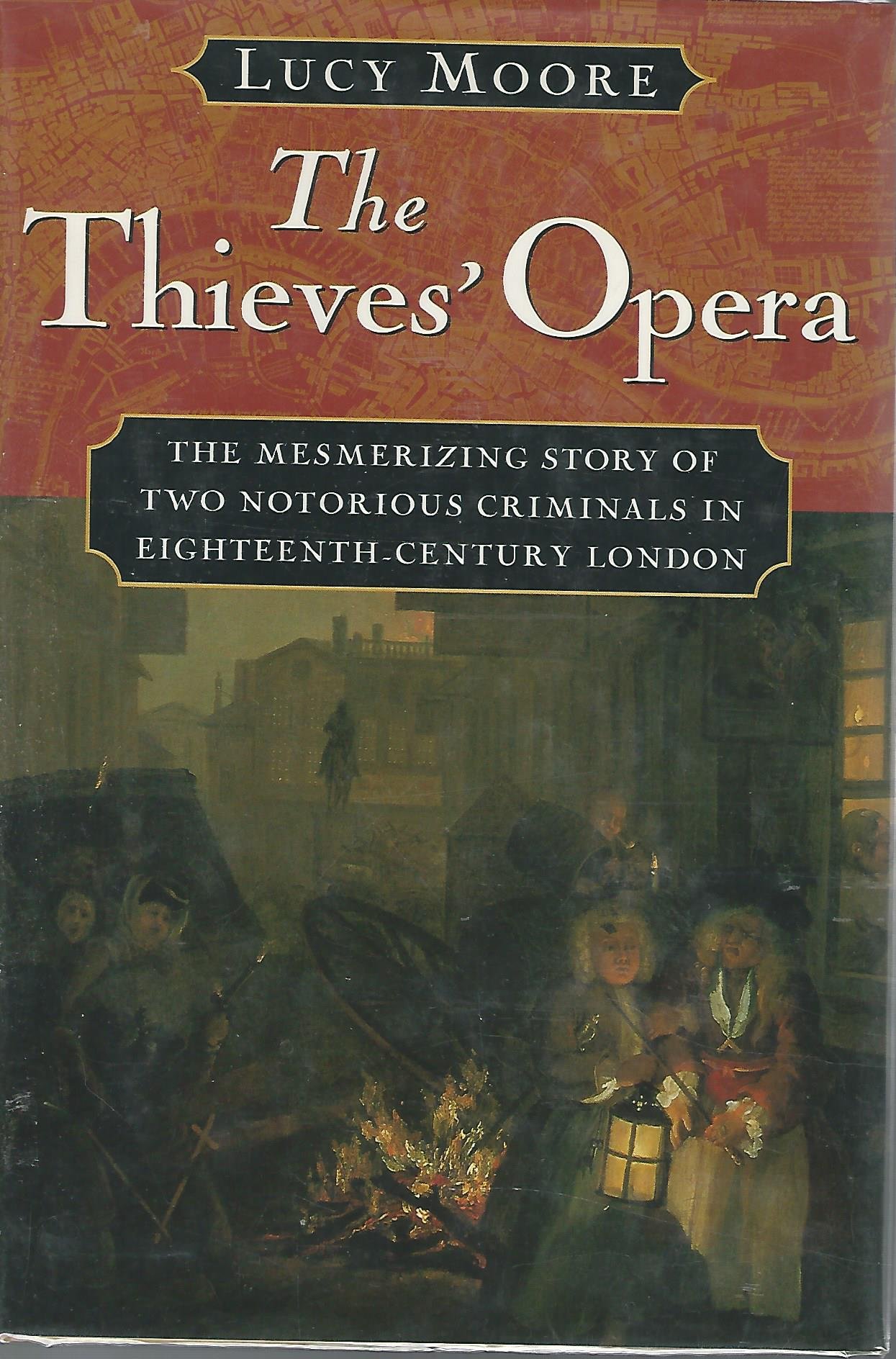
The Thieves' Opera: The Mesmerizing Story of Two Notorious Criminals in Eighteenth-Century London
$16.25
| Brand | Lucy Moore |
| Merchant | Amazon |
| Category | Books |
| Availability | In Stock Scarce |
| SKU | 0151003645 |
| Age Group | ADULT |
| Condition | NEW |
| Gender | UNISEX |
| Google Product Category | Media > Books |
| Product Type | Books > Subjects > Politics & Social Sciences > Social Sciences > Criminology |
About this item
The Thieves' Opera: The Mesmerizing Story of Two Notorious Criminals in Eighteenth-Century London
Portrays the rivalry between two of Georgian London's most popular thieves, Jonathan Wild, who dominated London's underworld, and Jack Sheppard, who refused to work for Wild, was imprisoned repeatedly, and became a celebrated folk hero. 25,000 first printing. Set against a backdrop of crumbling buildings--the result of hasty, cheap efforts at "urban renewal" after the Great Fire of 1666--and beautifully illustrated with William Hogarth's moralistic woodcuts, The Thieves' Opera charts the meteoric rise and fall of two of early-18th-century London's more colorful characters. The ruthless "lawman" Jonathan Wild was an early mastermind of organized crime who operated more or less within the boundaries of official approval; the slippery, mischievous Jack Sheppard had a knack for prison escapes and defiance of pompous authority that made him a sort of burglar-hero among the commoners of London. Lucy Moore shows how Wild became London's unofficial "Thief-Taker General." Working under the auspices of London's lackadaisical officialdom, he made his career returning stolen goods to their proper owners for a fee; unknown to the victims, he negotiated directly with the robbers and often oversaw the original thefts. He discouraged competition, with punishments and reprisal that evoke contemporary Mob hits. On the other side of the coin is Sheppard, who lacked the ambition of Wild, but performed his crimes with a flair that in many cases robbed his victims of even the desire to hold a grudge against him. Moore excels at supplying crucial illuminations of early-18th-century London street life with descriptions of coffee houses and public plazas so vivid you feel you've visited them. She emancipates the era from the quaint, manneristic drawing-room notions of ritualized emotions and unrequited love portrayed by modern-day "historical" fiction and film. Moore's London is filthy, chaotic, and hellish, a black den thick with thieves and "protected" by agents of law barely more scrupulous. With its large cast of cutpurses, highwaymen, footpads, prostitutes, and jailers (and jailed), The Thieves' Opera evokes more the Wild West of 19th-century America than it does refined British society. --Tjames Madison Early-18th-century London was not the place to be for those who might have liked to avoid high-crime areas. One Frenchman observed that "the excessive clemency of English laws gave room for abundance of ill actions that would not else be committed.... There is much less danger at being wicked at London than at Paris." In this milieu, English historian Moore's debut book follows the convergent paths of Jonathan Wild, a thief-taker (a sort of bounty hunter who played both sides of the law, charging crime victims for recovering goods that thieves working for him had stolen), and Jack Sheppard, a thief who refused to be a part of Wild's stable and, once imprisoned, made more than one daring jailbreak. Although their feud is at the center of Moore's work, the reader never really comes to know these historical protagonists that well. Nevertheless, this remains an engaging and original social history. Recommended for larger true-crime or popular history collections.?Jim G. Burns, Ottumwa, Copyright 1998 Reed Business Information, Inc. Moore exposes the seamy underbelly of Georgian society by reviewing the lives of two infamous thieves and con artists. The author places Jonathan Wild and Jack Sheppard firmly in historical context by commencing with an introduction to the geographical, economic, and social realities of eighteenth-century London. The lack of an effective police force, the enormous gulf that existed between social classes, and the often cruel and impersonal nature of a large city in an essentially rural society all contributed to the proliferation of organized criminal activity in London during the first quarter of the eighteenth century. Jonathan Wild, architect of one of the most notorious and successful theft rings, not only arranged for the hijacking of valuable items from the aristocracy, but also sold them back to his victims through his ingeniously organized fencing operation. At the other end of the criminal spectrum, Jack Sheppard, a rebellious petty thief with an individualistic nature, became something of a folk hero when he refused to work in or cooperate with Wild's illicit fraternity. Margaret Flanagan This nifty popular history spotlights the interrelated careers of the Georgian era's two most notorious good-for-nothings: Jonathan Wild and Jack Sheppard. We've all heard about the London of Swift and Defoe in all its fashionable tawdriness: the endemic gin drinking, the crime, and the depravity. But many readers will be surprised to learn that, lacking an organized police force, wronged citizens of this time were themselves responsible for bringing criminals to trial. Master of this thieves' universe was Wild, a ``past-master in the art of self-promotion,'' arrogant, egotistical, the subject of a
| Brand | Lucy Moore |
| Merchant | Amazon |
| Category | Books |
| Availability | In Stock Scarce |
| SKU | 0151003645 |
| Age Group | ADULT |
| Condition | NEW |
| Gender | UNISEX |
| Google Product Category | Media > Books |
| Product Type | Books > Subjects > Politics & Social Sciences > Social Sciences > Criminology |
Similar Products










Compare with similar items

The Best Spiritual Writing 2010... |

HO HO HO Christmas Scissors Skills: Cut ... |
Graphic Image Joy of Cooking Coffee Tabl... |

Crucifixion of an Ofsted Inspector... |
|
|---|---|---|---|---|
| Price | $39.97 | $8.99 | $150.00 | $11.57 |
| Brand | Philip Zaleski | Qubby Store | Graphic Image | Angry Ex-Teacher |
| Merchant | Amazon | Amazon | bedbathbeyond | Amazon |
| Availability | In Stock Scarce | In Stock | In Stock | In Stock |