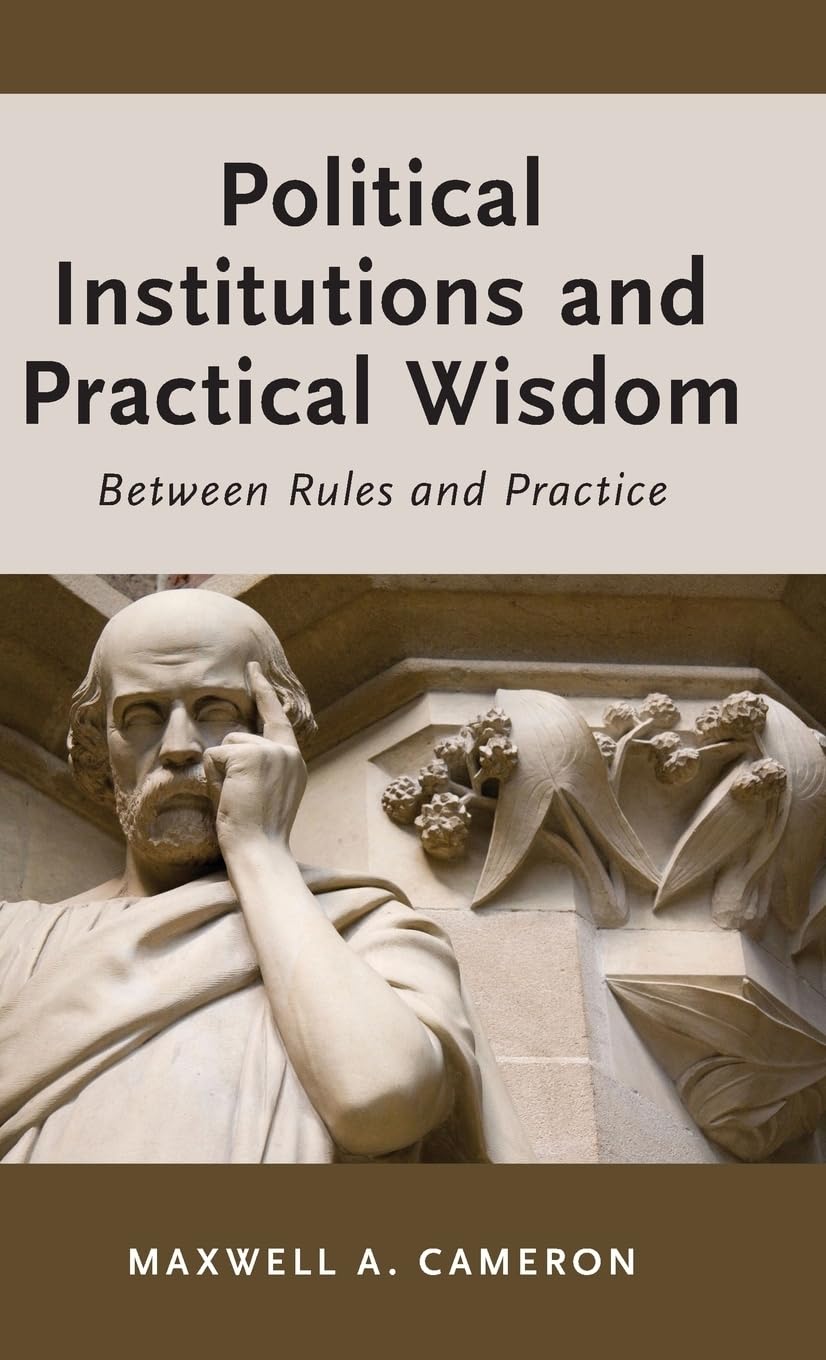
Political Institutions and Practical Wisdom: Between Rules and Practice
$80.89
| Brand | Maxwell A. Cameron |
| Merchant | Amazon |
| Category | Books |
| Availability | Leadtime |
| SKU | 0190694335 |
| Age Group | ADULT |
| Condition | NEW |
| Gender | UNISEX |
About this item
Political Institutions and Practical Wisdom: Between Rules and Practice
Societies create rules that govern our practices. Such rules can only be effective, however, if the intermediaries between rules and practices--institutions--harness the skill, knowledge, and motivation of practitioners. Yet, everywhere institutions seem to be failing. Over-reliance on rules and incentives has not only corrupted the intrinsic motivations that arise from practice, it has also promoted the spread of competitive utility maximizing and thereby discouraged the kind of moral agency necessary for institutions to work well. In Political Institutions and Practical Wisdom , Maxwell Cameron takes this basic insight as his starting point to argue that the rapid spread of the tenets of a neoliberal political-economic philosophy in our era has contributed to the erosion of institutional capacity. The book contributes to an emerging field of social science research grounded in the Aristotelian idea of phronesis, or practical wisdom. Drawing on a wide range of examples, Cameron not only shows how good institutions depend on wise practitioners, he argues that contemporary democratic institutions are being assaulted by excessive partisanship and the hollowing-out of democratic deliberation, by the corrupting effects of money in politics, and by the use of neoliberal techniques of governance that are designed to foster competition rather than the pursuit of common goods. At once a valuable guide to designing effective institutions and a trenchant critique of contemporary institutional failure, Political Institutions and Practical Wisdom promises to reshape our understanding of one of the most basic building blocks of contemporary social and political life. "Flaws in institutional performance are seen by Cameron as arising from the lack of practical wisdom and moral judgment of practitioners. The book draws from the tradition of virtue ethics starting with Aristotle, i.e., virtue meaning excellence in the classical Greek sense. Institutions thus depend on wise and moral practitioners to perform well. To this end, Cameron argues for more deliberation and compromise in democracy; moderate partisanship, not hyper-partisanship; weaker executives and stronger legislatures (separation of powers more generally); and more public goods. The book assesses several situations of applying practical wisdom to specific political challenges. It draws on an impressive range of readings and has a very thorough bibliography and a helpful glossary. This is mainly a work of political theory, but it provides quite useful context for American politics and comparative politics." -- A. Siaroff, The University of Lethbridge, CHOICE "Maxwell Cameron shows that a revitalized political science can lead to practical wisdom that serves laudable ideals, even in a neoliberal age where market value reigns supreme. In clear and compelling prose, Cameron shows that we can create usable knowledge in service of better politics. It's an uplifting breath of fresh air, much needed given our current malaise." - Sanford Schram, Professor of Political Science, Hunter College "In the tradition of Aristotle, Cameron astutely explores the statespersonship needed to create institutions that encourage human flourishing. Dismayed by the hyper-partisanship that increasingly corrodes contemporary political institutions, Cameron turns a bright light on the importance of wise practitioners: legislators and policymakers who have the virtues and the skills to encourage meaningful deliberation, reflection and compromise." - Kenneth E. Sharpe , William R. Kenan, Jr. Professor of Political Science, Swarthmore College "Observing that democracies carry the seeds of their own destruction, Max Cameron urges the cultivation of phronesis-an ethical position distinct from 'utility maximization' and Kantian virtue-as a way to rethink our political institutions, the methods we use to study them, and what we should demand of our leaders and of ourselves as citizens." - Jane S. Jaquette , Professor Emerita, Occidental College "Flaws in institutional performance are seen by Cameron as arising from the lack of practical wisdom and moral judgment of practitioners. The book draws from the tradition of virtue ethics starting with Aristotle, i.e., virtue meaning excellence in the classical Greek sense. Institutions thus depend on wise and moral practitioners to perform well. To this end, Cameron argues for more deliberation and compromise in democracy; moderate partisanship, not hyper-partisanship; weaker executives and stronger legislatures (separation of powers more generally); and more public goods. The book assesses several situations of applying practical wisdom to specific political challenges. It draws on an impressive range of readings and has a very thorough bibliography and a helpful glossary. This is mainly a work of political theory, but it provides quite useful context for American politics and comparative politics." -CHOICE, A. Siaroff, The University of Le
| Brand | Maxwell A. Cameron |
| Merchant | Amazon |
| Category | Books |
| Availability | Leadtime |
| SKU | 0190694335 |
| Age Group | ADULT |
| Condition | NEW |
| Gender | UNISEX |
Similar Products










Compare with similar items

Cozy and Cute Crime Scenes Coloring Book... |
Study Guide: The Odyssey by Homer (Super... |

3-3 to 46: ZONE IT!... |

Guitar Songbook for Kids: 55 Fun & Easy ... |
|
|---|---|---|---|---|
| Price | $8.99 | $11.95 | $29.99 | $12.95 |
| Brand | Chillax Mind | SuperSummary | Robert Rubel | Justin L. Thomas |
| Merchant | Amazon | Amazon | Amazon | Amazon |
| Availability | In Stock | In Stock | In Stock | In Stock |