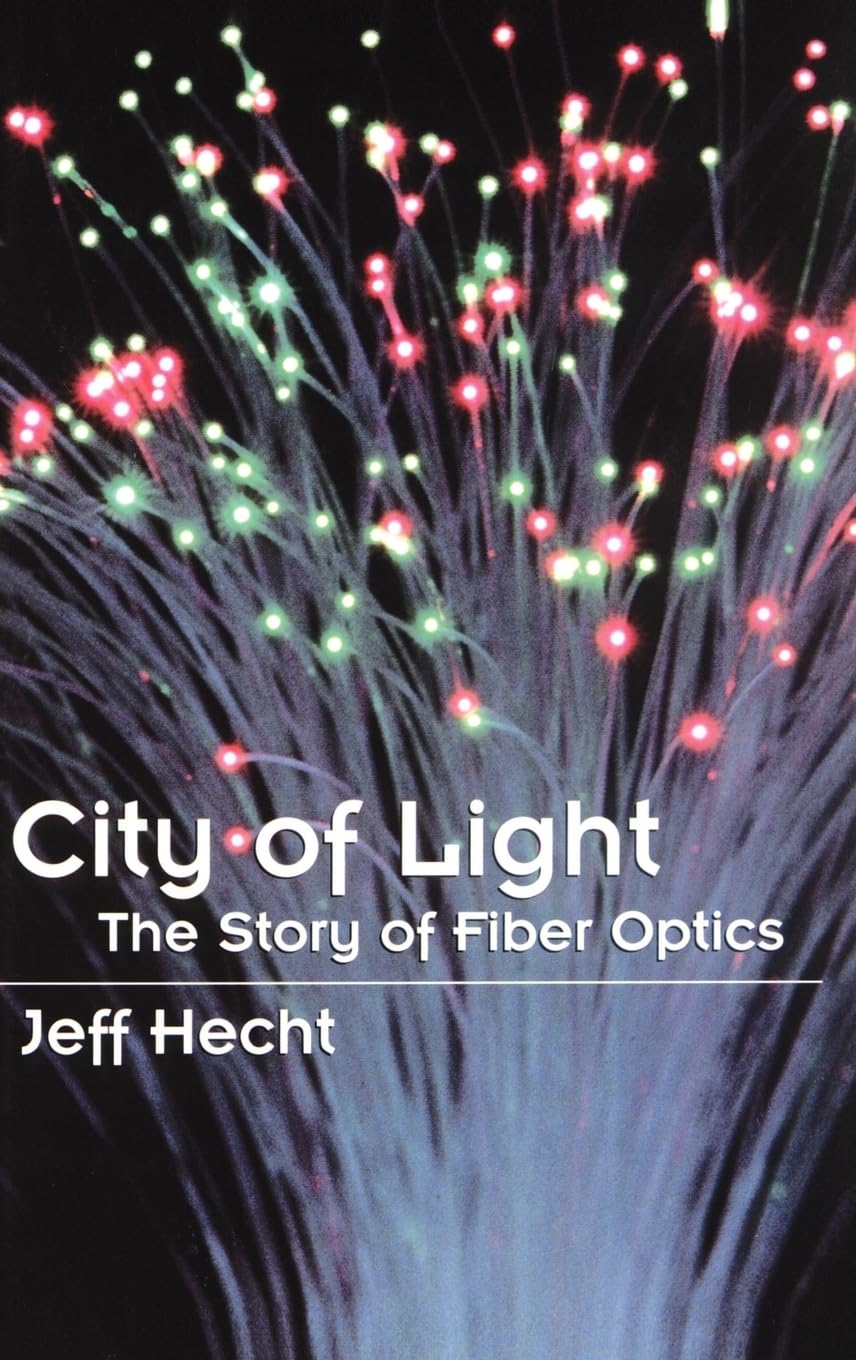
City of Light: The Story of Fiber Optics (Sloan Technology)
$39.25
| Brand | Jeff Hecht |
| Merchant | Amazon |
| Category | Books |
| Availability | In Stock Scarce |
| SKU | 0195108183 |
| Age Group | ADULT |
| Condition | NEW |
| Gender | UNISEX |
| Google Product Category | Media > Books |
| Product Type | Books > Subjects > Engineering & Transportation > Engineering > Electrical & Electronics > Fiber Optics |
About this item
City of Light: The Story of Fiber Optics (Sloan Technology)
City of Light tells the story of fiber optics, tracing its transformation from 19th-century parlor trick into the foundation of our global communications network. Written for a broad audience by a journalist who has covered the field for twenty years, the book is a lively account of both the people and the ideas behind this revolutionary technology. The basic concept underlying fiber optics was first explored in the 1840s when researchers used jets of water to guide light in laboratory demonstrations. The idea caught the public eye decades later when it was used to create stunning illuminated fountains at many of the great Victorian exhibitions. The modern version of fiber optics--using flexible glass fibers to transmit light--was discovered independently five times through the first half of the century, and one of its first key applications was the endoscope, which for the first time allowed physicians to look inside the body without surgery. Endoscopes became practical in 1956 when a college undergraduate discovered how to make solid glass fibers with a glass cladding. With the invention of the laser, researchers grew interested in optical communications. While Bell Labs and others tried to send laser beams through the atmosphere or hollow light pipes, a small group at Standard Telecommunication Laboratories looked at guiding light by transparent fibers. Led by Charles K. Kao, they proposed the idea of fiber-optic communications and demonstrated that contrary to what many researchers thought glass could be made clear enough to transmit light over great distances. Following these ideas, Corning Glass Works developed the first low-loss glass fibers in 1970. From this point fiber-optic communications developed rapidly. The first experimental phone links were tested on live telephone traffic in 1977 and within half a dozen years long-distance companies were laying fiber cables for their national backbone systems. In 1988, the first transatlantic fiber-optic cable connected Europe with North America, and now fiber optics are the key element in global communications. The story continues today as fiber optics spread through the communication grid that connects homes and offices, creating huge information pipelines and replacing copper wires. The book concludes with a look at some of the exciting potential developments of this technology. Computers you notice. They sit on your desk and hum, ever smaller, ever faster, and always obsolete if bought longer ago than last week. But the equally impressive technology that turns millions of terminals into a global network is less obvious. The phone line that comes into your house probably still pushes electrons through metal. But not far away, the signal will join millions of others relayed down fiber optic cables by laser. Jeff Hecht's fascinating account of this undersung technology goes back 150 years to find the origins of fiber optics. Then he chronicles the many ingenious and determined engineers who fashioned it into a technology that festoons the globe with cables carrying pulses of photons. It was harder than pioneering copper links because supplanting an existing technology needs more persuasion than establishing the first one. And there was competition from the satellite industry, as well as unexpected setbacks, such as sharks who ignored copper but chewed fiber optic cables. Hecht tells a good tale, combining a light journalistic touch with a scholarly knowledge of the industry he has covered for over two decades. The story is not over yet, but this is a rich account of how we got this far in a technology that really has fueled a revolution. --Jon Turney, Amazon.co.uk An engineer by training, New Scientist correspondent Hecht explores the history of fiber optics in this interesting and far-reaching study. Beginning in Victorian Europe, his chronology traces the complex but fascinating drama of one of the key elements in today's global telecommunications explosion. Critical attention is given to the diverse group of participants actively working on fiber optics over the past 150 years, revealing the sometimes fortuitous steps to scientific discovery. This readable, well-documented, and scholarly text includes an informative glossary of names and a concise reference to fiber-optic development. Highly recommended for all public and academic libraries.ADayne Sherman, Southeastern Louisiana Univ., Hammond Copyright 1999 Reed Business Information, Inc. "In this deft history, Hecht, a writer for the British weekly New Scientist , shows how the illuminated fountains that thrilled crowds at the great 19th-century exhibitions convinced scientists that light can be guided along narrow tubes. In our century, scientists used these tubes of light first to look inside the human body and then, as the physics of wave transmission were better understood, to transmit audio and optical information. Hecht explains which technological advances have made fiber optics the bac
| Brand | Jeff Hecht |
| Merchant | Amazon |
| Category | Books |
| Availability | In Stock Scarce |
| SKU | 0195108183 |
| Age Group | ADULT |
| Condition | NEW |
| Gender | UNISEX |
| Google Product Category | Media > Books |
| Product Type | Books > Subjects > Engineering & Transportation > Engineering > Electrical & Electronics > Fiber Optics |
Similar Products

![Numerical Mathematics & Computing by Cheney,E. Ward; Kincaid,David R.. [2007,6th Edition.] Hardcover](https://m.media-amazon.com/images/I/21GU-FLT7SL._UY200_SCLZZZZZZZ__.jpg)







Compare with similar items

Sports Moms Guide to Making Dinner on th... |

Image Transformation Therapy Advanced Sc... |

Jon Englund, Your Real Estate Consultant... |

Stilettos and Shanks... |
|
|---|---|---|---|---|
| Price | $16.99 | $50.00 | $6.95 | $9.99 |
| Brand | Casey Lewis | Dr. Robert Miller | Jon Englund | Cindy Lea Casperson |
| Merchant | Amazon | Amazon | Amazon | Amazon |
| Availability | In Stock | In Stock | In Stock | In Stock |