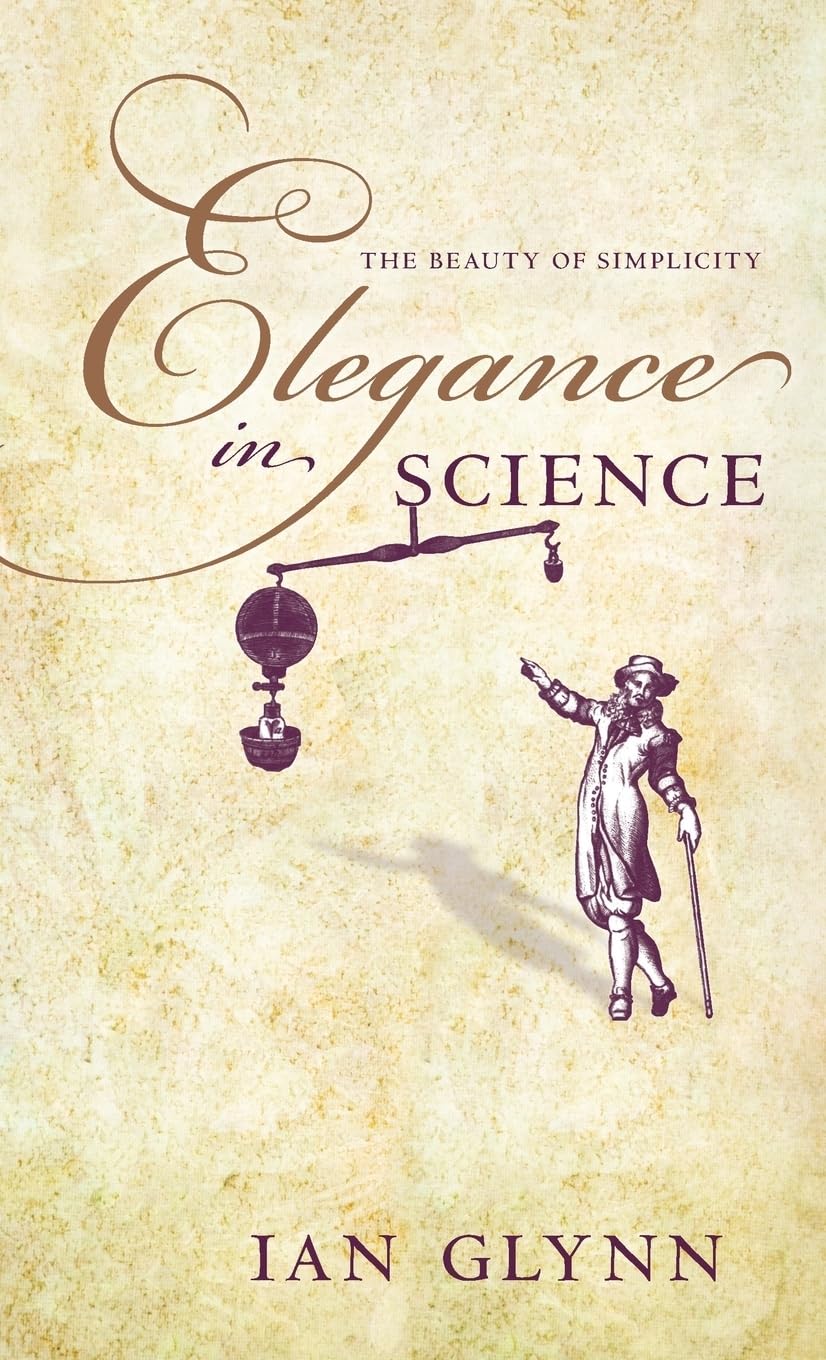
Elegance in Science: The beauty of simplicity
$24.82
| Brand | Ian Glynn |
| Merchant | Amazon |
| Category | Books |
| Availability | Unknown Availability |
| SKU | 0199578621 |
| Age Group | ADULT |
| Condition | NEW |
| Gender | UNISEX |
| Material | Cellulose-based or similar non-woven material |
About this item
Elegance in Science: The beauty of simplicity
We usually associate a sense of elegance with art or fashion design, poetry or dance, but the idea of elegance is surprisingly important in science as well. The use of the term is most apparent in the "elegant proofs" of mathematics--which Bertrand Russell once described as "capable of a stern perfection such as only the greatest art can show"--but as Ian Glynn reveals in this fascinating new book, the idea of elegance is essential to scientists working in all fields. Glynn draws on a wide range of examples that demonstrate the elegance of science, from Pythagoras' theorem and Archimedes' proof to Kepler's Laws, the experiments that demonstrated the nature of heat, and the several extraordinary episodes that led to Watson and Crick's discovery of the structure of DNA. Scientists often share a sense of admiration and excitement on hearing of an elegant solution to a problem, an elegant theory, or an elegant experiment. For scientists, as for artists, elegance implies beauty, simplicity, clarity, and proportion; the elegant solution has a kind of stunning and unalterable rightness that inspires wonder and awe. The idea of elegance may seem strange in a discipline that prides itself on objectivity, but only if science is regarded as a dull activity of counting and measuring. It is, of course, far more than that, and Glynn shows precisely how and why elegance is a fundamental aspect of the beauty and imagination involved in scientific activity. An elegant solution may not always be a correct one, Glynn cautions, but elegance is deeply related to important philosophical issues of inference and best explanation. Written with the same clarity and elegant simplicity it describes, Elegance in Science explores an often overlooked but profoundly important aspect of scientific discovery. Product Description We usually associate a sense of elegance with art or fashion design, poetry or dance, but the idea of elegance is surprisingly important in science as well. The use of the term is most apparent in the "elegant proofs" of mathematics--which Bertrand Russell once described as "capable of a stern perfection such as only the greatest art can show"--but as Ian Glynn reveals in this fascinating new book, the idea of elegance is essential to scientists working in all fields. Glynn draws on a wide range of examples that demonstrate the elegance of science, from Pythagoras' theorem and Archimedes' proof to Kepler's Laws, the experiments that demonstrated the nature of heat, and the several extraordinary episodes that led to Watson and Crick's discovery of the structure of DNA. Scientists often share a sense of admiration and excitement on hearing of an elegant solution to a problem, an elegant theory, or an elegant experiment. For scientists, as for artists, elegance implies beauty, simplicity, clarity, and proportion; the elegant solution has a kind of stunning and unalterable rightness that inspires wonder and awe. The idea of elegance may seem strange in a discipline that prides itself on objectivity, but only if science is regarded as a dull activity of counting and measuring. It is, of course, far more than that, and Glynn shows precisely how and why elegance is a fundamental aspect of the beauty and imagination involved in scientific activity. An elegant solution may not always be a correct one, Glynn cautions, but elegance is deeply related to important philosophical issues of inference and best explanation. Written with the same clarity and elegant simplicity it describes, Elegance in Science explores an often overlooked but profoundly important aspect of scientific discovery. Amazon.com Exclusive: A Q&A with Ian Glynn, Author of Elegance in Science Author Ian Glynn Q: Can you please define “elegance” as it relates to your book? A: I spend the first chapter of the book discussing mathematical or scientific proofs, or theories or experiments, which are generally regarded as elegant, sometimes contrasting them with those that are not. Looking at the overall picture it becomes clear that elegant proofs or theories or experiments possess most or all of the following features: They are simple, ingenious, concise and persuasive; they often have an unexpected quality, and they are very satisfying. Once one has understood the argument behind the proof or theory or experiment, it can be seen at a glance, and one has no doubts about its validity. Perhaps the most surprising member in this list of features is the “unexpected quality;” so let me give an example. When Thomas Henry Huxley read Darwin’s account of his theory of evolution by natural selection his comment was “How extremely stupid not to have thought of that!” Q: Is there a particular message that you hope the reader takes from your book? A: I believe that too much science teaching is almost wholly impersonal, and that discussion of the way critical problems were solved by the elegant theories or experiments of particular scientists
| Brand | Ian Glynn |
| Merchant | Amazon |
| Category | Books |
| Availability | Unknown Availability |
| SKU | 0199578621 |
| Age Group | ADULT |
| Condition | NEW |
| Gender | UNISEX |
| Material | Cellulose-based or similar non-woven material |
Similar Products









Compare with similar items

Coffee Table, 31.49'' Small Living Room ... |

The Complete Guide to Hunting, Butcherin... |

Rap History for Kids: Learn as you Rhyme... |

Aprenda a escribir y leer el alfabeto he... |
|
|---|---|---|---|---|
| Price | $86.49 | $28.00 | $7.99 | $7.99 |
| Brand | Garvee | Random House | Jose I Salaverria | ossama akorball |
| Merchant | bedbathbeyond | sportsmanswarehouse | Amazon | Amazon |
| Availability | In Stock | In Stock | In Stock | In Stock |