
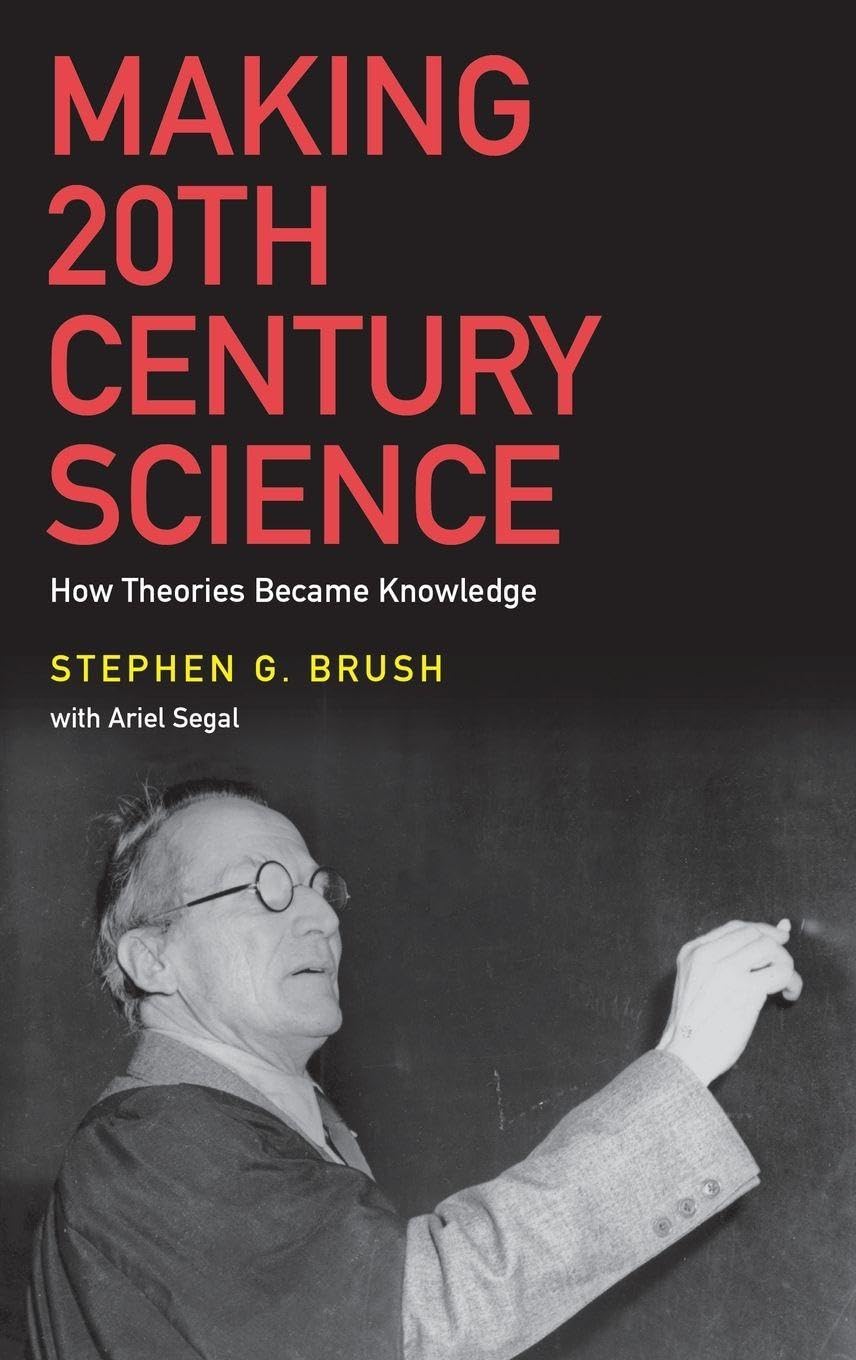
Making 20th Century Science: How Theories Became Knowledge
$40.81
| Brand | Stephen G. Brush |
| Merchant | Amazon |
| Category | Books |
| Availability | In Stock Scarce |
| SKU | 0199978158 |
| Age Group | ADULT |
| Condition | NEW |
| Gender | UNISEX |
| Google Product Category | Media > Books |
| Product Type | Books > Subjects > Science & Math > History & Philosophy |
About this item
Making 20th Century Science: How Theories Became Knowledge
Historically, the scientific method has been said to require proposing a theory, making a prediction of something not already known, testing the prediction, and giving up the theory (or substantially changing it) if it fails the test. A theory that leads to several successful predictions is more likely to be accepted than one that only explains what is already known but not understood. This process is widely treated as the conventional method of achieving scientific progress, and was used throughout the twentieth century as the standard route to discovery and experimentation. But does science really work this way? In Making 20th Century Science , Stephen G. Brush discusses this question, as it relates to the development of science throughout the last century. Answering this question requires both a philosophically and historically scientific approach, and Brush blends the two in order to take a close look at how scientific methodology has developed. Several cases from the history of modern physical and biological science are examined, including Mendeleev's Periodic Law, Kekule's structure for benzene, the light-quantum hypothesis, quantum mechanics, chromosome theory, and natural selection. In general it is found that theories are accepted for a combination of successful predictions and better explanations of old facts. Making 20th Century Science is a large-scale historical look at the implementation of the scientific method, and how scientific theories come to be accepted. "It is rare to find a historical work of science that encompasses the wide range of ideas this erudite volume does. ... Including useful diagrams, copius notes, a select biography, and an index of cited authors, this is an intruiging volume. Highly recommended." -- Choice "The breadth of this work reflects the expertise of the author, who is a scientist converted to historian of science in the late 1960s and who has been a prolific author in history since then, with works covering history of chemistry, physics, and biology. ... Brush's book is a good and useful reading for everybody interested in learning something about the workings of current science, but, for the same reasons, it is almost mandatory for those dealing with science education." -- Science & Education A large-scale historical look at the implementation of the scientific method, and how scientific theories come to be accepted. Stephen G. Brush studied chemistry and physics (at Harvard and Oxford) and did research in theoretical physics at the Lawrence Livermore Laboratory. His group at Livermore showed that a gas of electrons (ignoring quantum effects) could condense to a solid at low temperatures and high densities. Inspired by a graduate seminar with Thomas Kuhn at Harvard, he also conducted research in history of science, and switched to that field full-time in 1968. He has published historical works on the kinetic theory of gases, planetary physics, and other topics.
| Brand | Stephen G. Brush |
| Merchant | Amazon |
| Category | Books |
| Availability | In Stock Scarce |
| SKU | 0199978158 |
| Age Group | ADULT |
| Condition | NEW |
| Gender | UNISEX |
| Google Product Category | Media > Books |
| Product Type | Books > Subjects > Science & Math > History & Philosophy |
Similar Products










Compare with similar items

Parrot Paradise Adult Coloring Book: A C... |

EXERCISE BOOK FOR TEENS: Unleash Your Fu... |

Beric the Briton: A Story of the Roman I... |

Encyclopedia of Lip Blushing. Part 1: Pe... |
|
|---|---|---|---|---|
| Price | $6.99 | $12.00 | $10.95 | $75.00 |
| Brand | Pal Hampa | SMITH HART | G. A. Henty | Maya Zarova |
| Merchant | Amazon | Amazon | Amazon | Amazon |
| Availability | In Stock | In Stock | In Stock | In Stock |