
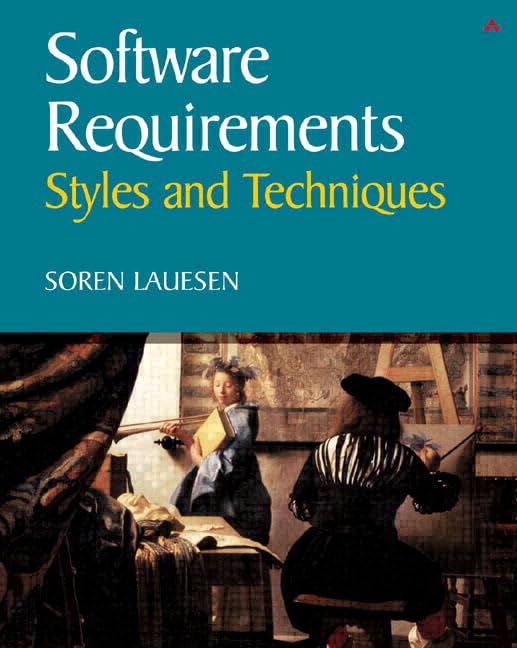
Software Requirements: Styles and Techniques
$52.95
| Brand | Soren Lauesen |
| Merchant | Amazon |
| Category | Books |
| Availability | In Stock Scarce |
| SKU | 0201745704 |
| Age Group | ADULT |
| Condition | NEW |
| Gender | UNISEX |
| Google Product Category | Media > Books |
| Product Type | Books > Subjects > Computers & Technology > Programming > Software Design, Testing & Engineering > Software Development |
About this item
Software Requirements: Styles and Techniques
Most IT systems fail to meet expectations. They don't meet business goals and don't support users efficiently. Why? Because the requirements didn't address the right issues. Writing a good requirements specification doesn't take more time. This book shows how it is done - many times faster and many times smarter. This book covers many aspects of requirements. Styles: Traditional and more cost/effective ways of expressing requirements. Techniques: Ways of gathering, verifying, and maintaining requirements; ways of getting commitment from the stakeholders and support - yet limit - innovation; ways of ensuring that you meet your business goals. It discusses the styles and techniques useful for different project types, for instance software developed specifically for the customer, software bought off-the shelf and adapted for the customer (COTS), and software developed for a broad market. The book illustrates everything through real-life examples. It also deals with difficult requirements, for instance how to specify ease-of-use, how to specify very complex computations, and how to deal with 200 reports that the old system has, and the new system may or may not need. The book shows two complete, real-life specifications and large parts of several others. It also has exercises and figures for presentation. Suitable for most any IT professional who wants to build better software, Software Requirements: Styles and Techniques offers a surprisingly readable textbook-style treatment of software engineering's numerous attempts to get it right with defining requirements. Surveying nearly every conceivable style of defining requirements, yet remaining thoroughly practical, this book can let your organization do more with its requirements documents, which is a good step to creating software that succeeds better with your users. Though everyone in software design knows about requirements, actual examples have usually remained shrouded in secrecy whether out of concern over client or intellectual property confidentiality. One considerable strength of this title is that the author has seen many good and bad requirements documents and has included here several complete samples for a Danish shipyard and two hospital systems. The book begins by describing several dozen types of requirements styles, along with the advantages (and disadvantages) of each. Each requirements style differs by notation (text-based, graphical, or using Unified Modeling Language), level of audience (for nontechnical or technical users), focus (data, functional, performance, and usability), and whether it's used early or late in the project development cycle. While the author highlights those conventions that have worked best based on his extensive industry experience and research, each type of notational style gets due coverage. Sample requirements for a hotel-booking application anchor these early sections. Not surprisingly, requirements are often hard to ascertain. The author's very thorough chapter on nearly 20 techniques to elicit requirements from users (using interviews, focus groups, and the like) is a real standout. Throughout this title, he offers plenty of advice on tracing requirements so that you can prove your software meets all user expectations. This text concludes with an extensive requirements document for a system used to track shipping repairs for a Danish shipyard, two systems for hospitals, and a membership database for a European political organization. Reading Software Requirements will likely convince you that you can do better with your requirements documents. Though there is no one best way, certain types of requirements work for certain situations better than others. This text can help you choose. Certain to be mandatory reading for serious software analysts, this title can also benefit virtually anyone who works with software design documents. Its clear presentation style, remarkably devoid of jargon, helps make this book a great resource for a wide range of readers, whether or not they have a background in traditional software engineering. --Richard Dragan Topics covered: Introduction to requirements, domain and product-level requirements, requirements for different project types, traditional, fast, and two-step approaches to defining requirements, types of data requirements (data models, dictionaries, data expressions, and virtual windows), types of functional requirements (including context diagrams, event and function lists, feature requirements, screens and prototypes, task descriptions, scenarios and use cases), functional details (including tables and decision tables), Unified Modeling Language diagrams used with requirements (including state, activity, class, collaboration, and sequence diagrams), requirements for product integration (for nontechnical and technical audiences), defining quality requirements, specifying accuracy, performance, and usability; security and maintainability requirements, product
| Brand | Soren Lauesen |
| Merchant | Amazon |
| Category | Books |
| Availability | In Stock Scarce |
| SKU | 0201745704 |
| Age Group | ADULT |
| Condition | NEW |
| Gender | UNISEX |
| Google Product Category | Media > Books |
| Product Type | Books > Subjects > Computers & Technology > Programming > Software Design, Testing & Engineering > Software Development |
Similar Products










Compare with similar items

'Artisan-Made Spring-Inspired 100-Page A... |

Mystic Animals: Folk Art Inspired Colour... |

For You, I Hope... |

Fates Parallel Vol. 6: A Xianxia/Wuxia I... |
|
|---|---|---|---|---|
| Price | $59.99 | $9.99 | $11.95 | $24.99 |
| Brand | NOVICA | Colours Unleashed | Ken Rohlf | Darktechnomancer |
| Merchant | Novica | Amazon | Amazon | Amazon |
| Availability | In Stock | In Stock | In Stock | In Stock |