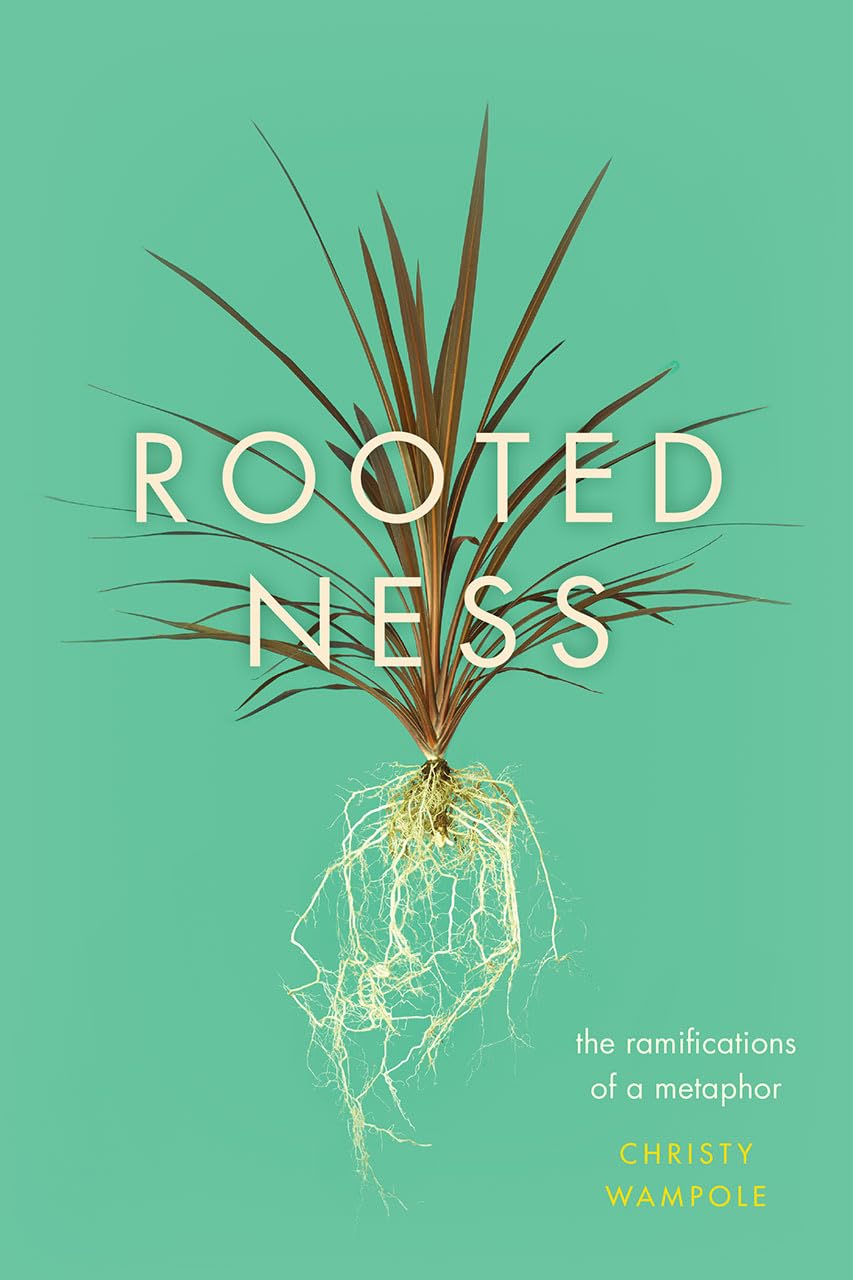
Rootedness: The Ramifications of a Metaphor
$53.09
| Brand | Christy Wampole |
| Merchant | Amazon |
| Category | Books |
| Availability | Leadtime |
| SKU | 022631765X |
| Age Group | ADULT |
| Condition | NEW |
| Gender | UNISEX |
| Google Product Category | Media > Books |
| Product Type | Books > Subjects > Literature & Fiction > History & Criticism > Regional & Cultural > European > French |
About this item
Rootedness: The Ramifications of a Metaphor
People have long imagined themselves as rooted creatures, bound to the earth—and nations—from which they came. In Rootedness , Christy Wampole looks toward philosophy, ecology, literature, history, and politics to demonstrate how the metaphor of the root—surfacing often in an unexpected variety of places, from the family tree to folk etymology to the language of exile—developed in twentieth-century Europe. Wampole examines both the philosophical implications of this metaphor and its political evolution. From the root as home to the root as genealogical origin to the root as the past itself, rootedness has survived in part through its ability to subsume other compelling metaphors, such as the foundation, the source, and the seed. With a focus on this concept’s history in France and Germany, Wampole traces its influence in diverse areas such as the search for the mystical origins of words, land worship, and nationalist rhetoric, including the disturbing portrayal of the Jews as an unrooted, and thus unrighteous, people. Exploring the works of Martin Heidegger, Simone Weil, Jean-Paul Sartre, Paul Celan, and many more, Rootedness is a groundbreaking study of a figure of speech that has had wide-reaching—and at times dire—political and social consequences. “Theoretically vigorous, critically elegant, and impressively well informed, this is a wonderful exploration of the root metaphor and the notion of rootedness in Western culture and, more particularly, in twentieth-century France and Germany. With assurance and verve, Wampole illuminates such figures as Paul Celan, Edouard Glissant, Jean Paulhan, and Simone Weil.” -- Gerald Prince, University of Pennsylvania “Wampole convincingly shows that rootedness is a pervasive literary, political, and philosophical theme that keeps resurfacing in a host of connected contemporary issues, including questions of nationhood in the globalized, multicultural context of identity politics; ideas of memory and tradition in immigrant cultures; and dialectics of localism and universalism in the postcolonial world. Students and scholars alike will benefit from this book.” -- Elie During, University of Paris Ouest–Nanterre “ Rootedness is original, compelling, and ambitious in scope. This is an exemplary work of scholarship in its breadth and depth, not only as an investigation into a number of major works of European literature and thought, but also as an exploration of the human relationship to the other living beings that inhabit the earth.” -- Alison James, University of Chicago Christy Wampole is assistant professor of French at Princeton University. Rootedness The Ramifications of a Metaphor By Christy Wampole The University of Chicago Press Copyright © 2016 The University of Chicago All rights reserved. ISBN: 978-0-226-31765-6 Contents Acknowledgments, Introduction, 1 Welcome to the Rhizosphere, 2 Radical Poetry, 3 Roots and Transcendence, 4 Saving Europe from Itself: Weil's Enracinement and Heidegger's Bodenständigkeit, 5 Sartre, Phenomenology, and the Root, 6 Etymology and Essence: The Primeval Power of Word Roots The Etymological Obsession, 7 From Rhizome to Vegetal Democracy The Cryptic Rhizome of Deleuze and Guattari, Bibliography, Index, CHAPTER 1 Welcome to the Rhizosphere The day after Hurricane Sandy hit the East Coast of the United States on October 29, 2012, the entire region was strewn with uprooted trees. A walk in a nature preserve near my town in New Jersey took me past fallen, decades-old trees and their jutting roots. When trees this massive fall, they take with them a thick circumference of land, leaving holes that fill quickly with water. The roots I saw were never deep; they were gnarled and weblike, proliferating horizontally in an erratic network. Roots generally reveal traces of themselves at the base of trees, but merely to signal the extent of their unseen-ness. We are able to scrutinize roots only when they are decontextualized, exposed by weather, age, disease, or human transplantation. Catching sight of a full root happens only in instances of violence, infirmity, or death. This could account in part for the metaphorical darkness of our associations with the root, compounded by the literal darkness of its subterranean dwelling space. Roots commune with the dead. Their composition is reliant on decomposition. Botanists have given the name rhizosphere to the area of soil around the roots of plants, their subterranean dwelling. We will enter the rhizosphere now together. This first chapter provides a broad overview of the way the root has been imagined. There are a few basic patterns of its metaphorization: root as home, root as genealogical origin, root as miniature person, root as the past, and root as a severable connection to any phenomenon, particularly the environment. Carl Jung and Gaston Bachelard recognized its power as a subconscious image, but the root is clearly a figure for the subconsc
| Brand | Christy Wampole |
| Merchant | Amazon |
| Category | Books |
| Availability | Leadtime |
| SKU | 022631765X |
| Age Group | ADULT |
| Condition | NEW |
| Gender | UNISEX |
| Google Product Category | Media > Books |
| Product Type | Books > Subjects > Literature & Fiction > History & Criticism > Regional & Cultural > European > French |
Similar Products










Compare with similar items

Zippy travels to northeast... |

Study Guide: Borges and I by Jorge Luis ... |

Jesus Loves Julian: A Personalized Chris... |

Fox Catches a Wave (My First I Can Read)... |
|
|---|---|---|---|---|
| Price | $4.17 | $8.95 | $9.99 | $15.20 |
| Brand | Katie McManus | SuperSummary | Spirit Script Press | Corey R. Tabor |
| Merchant | Amazon | Amazon | Amazon | Amazon |
| Availability | In Stock Scarce | In Stock | In Stock | In Stock |