
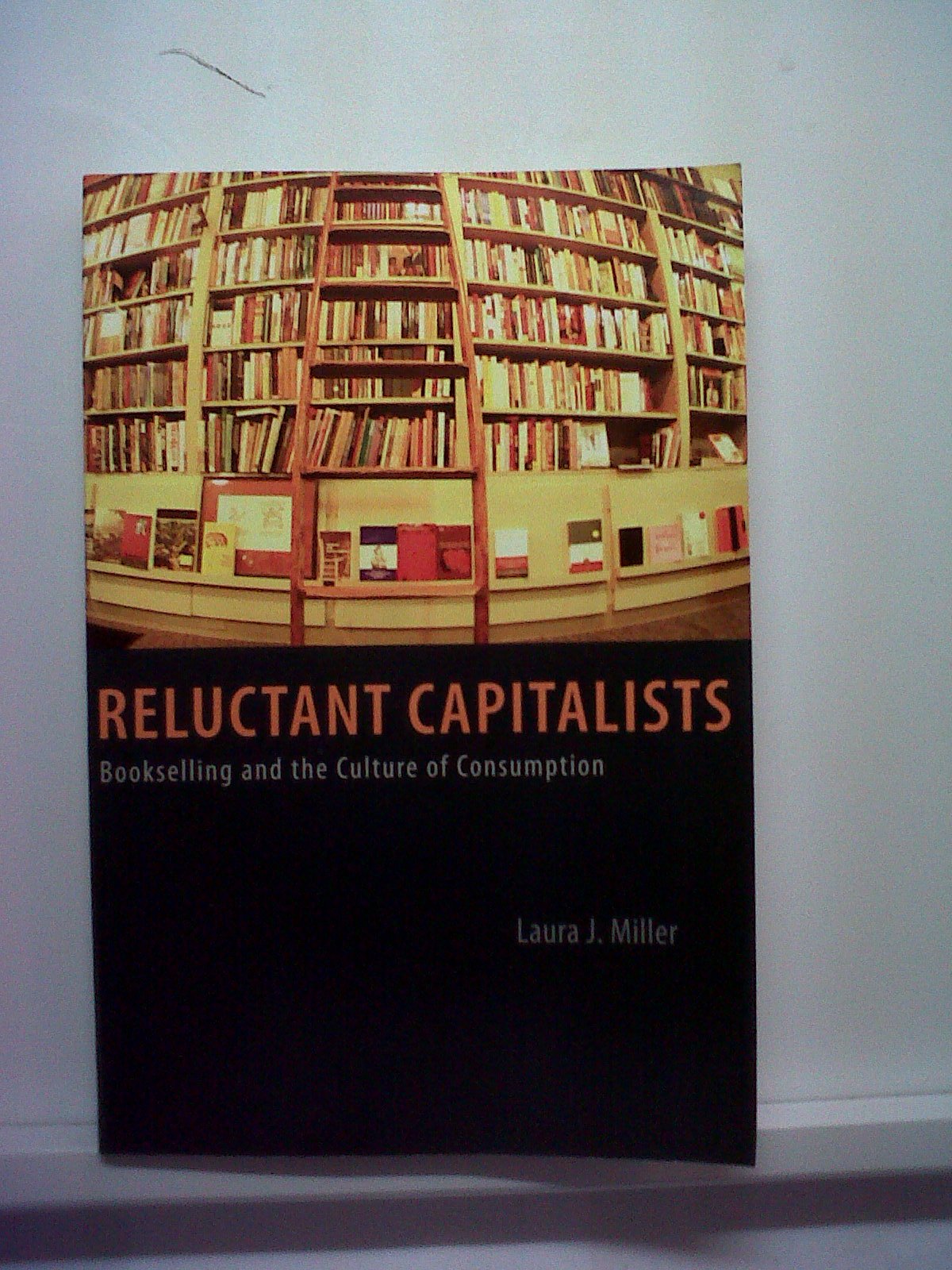
Reluctant Capitalists: Bookselling and the Culture of Consumption
$30.13
| Brand | Laura J. Miller |
| Merchant | Amazon |
| Category | Books |
| Availability | In Stock |
| SKU | 0226525910 |
| Age Group | ADULT |
| Condition | NEW |
| Gender | UNISEX |
About this item
Reluctant Capitalists: Bookselling and the Culture of Consumption
Over the past half-century, bookselling, like many retail industries, has evolved from an arena dominated by independent bookstores to one in which chain stores have significant market share. And as in other areas of retail, this transformation has often been a less-than-smooth process. This has been especially pronounced in bookselling, argues Laura J. Miller, because more than most other consumer goods, books are the focus of passionate debate. What drives that debate? And why do so many people believe that bookselling should be immune to questions of profit? In Reluctant Capitalists, Miller looks at a century of book retailing, demonstrating that the independent/chain dynamic is not entirely new. It began one hundred years ago when department stores began selling books, continued through the 1960s with the emergence of national chain stores, and exploded with the formation of “superstores” in the 1990s. The advent of the Internet has further spurred tremendous changes in how booksellers approach their business. All of these changes have met resistance from book professionals and readers who believe that the book business should somehow be “above” market forces and instead embrace more noble priorities. Miller uses interviews with bookstore customers and members of the book industry to explain why books evoke such distinct and heated reactions. She reveals why customers have such fierce loyalty to certain bookstores and why they identify so strongly with different types of books. In the process, she also teases out the meanings of retailing and consumption in American culture at large, underscoring her point that any type of consumer behavior is inevitably political, with consequences for communities as well as commercial institutions. "Chain superstores, notes Laura J. Miller's fascinating new study "Reluctant Capitalists: Bookselling and the Culture of Consumption," are the latest manifestation of a centuries-old struggle between bookselling Davids and Goliaths-a battle over where Americans actually shop versus stores with, Miller tartly notes, 'a style of retailing that Americans at least profess to miss.'" -- Paul Collins "Voice Literary Supplement" (05/23/2006) "Books are different. Commodities, to be sure. Bought and sold, no doubt. Yet in the world of commerce, books retain a certain mystique. That regard has held true, traditionally, for booksellers as well, notes Laura J. Miller, a Brandeis University sociologist. In Reluctant Capitalists: Bookselling and the Culture of Consumption, she uses the bookstore wars between independents and big chains to explore the ambivalence toward business values in the world of books and wider concerns about consumption and highly 'rationalized' systems of retailing. Traditional booksellers felt stressed long before the first of the 'superstores.' From the end of the 19th century to the 1960s, Ms. Miller writes, department stores took a heavy chunk of bookstore sales. Five-and-dimes and similar outlets also joined in, putting pressure on bookshops and making one commentator in 1954 fume that booksellers 'must now compete with everything from delicatessens to whore houses.' A major jolt would come with the expansion of chain stores in the 1970s and 80s. Early on, writes Ms. Miller, chain bookstores tended to be small sites in mall locations with a focus on popular titles. Their discounts, previously rare in bookshops, threatened independents, but they had little in the way of selection. With superstores, things changed. The first superstores, opened by Crown Books in 1990, seem modest by later standards: 6,000 to 8,000 square feet, with 30,000 to 40,000 titles. By 2002 Borders stores carried 62,000 to 209,000 titles. Tracing the chains' growth, Ms. Miller shows how they centralized and standardized selection, ordering, and other procedures while attracting a new public previously intimidated bybookstores. Among her topics are the standardized design of superstores, with their mix of gentility and flash and their tactics of display. Just as in supermarkets, prime positions are for sale. Publishers with big marketing budgets, she says, can purchase good real estate for their titles, such as on the end of a row of shelves facing the aisle. While some books are promoted, others, especially those more esoteric or from smaller presses, may end up as 'wallpaper, ' there to create ambience but not pushed to sell. Ms. Miller describes how independent booksellers, still feeling a mission along with the pinch, have fought back by transforming the American Booksellers Association into a champion for independents, pursuing lawsuits against trade practices they claim favor the big chains, and seeking support from an often fickle reading public."--Nina C. Ayoub, Chronicle of Higher Education -- Nina C. Ayoub "Chronicle of Higher Education" (05/12/2006) "From beginning to end, this book is a pleasure to read." Reluctant Capitalists" is the first good history of American book
| Brand | Laura J. Miller |
| Merchant | Amazon |
| Category | Books |
| Availability | In Stock |
| SKU | 0226525910 |
| Age Group | ADULT |
| Condition | NEW |
| Gender | UNISEX |
Similar Products










Compare with similar items

Simplezas del Alma: Coloquios Poéticos (... |

Architecture and Structures of Conscious... |

The Essential Cocktail Book... |

Graphic Image Story of Football Coffee T... |
|
|---|---|---|---|---|
| Price | $5.00 | $15.00 | $98.00 | $135.00 |
| Brand | Gudrun Straube Ríos | John Lobell | Graphic Image | Graphic Image |
| Merchant | Amazon | Amazon | bedbathbeyond | bedbathbeyond |
| Availability | In Stock | In Stock | In Stock | In Stock |