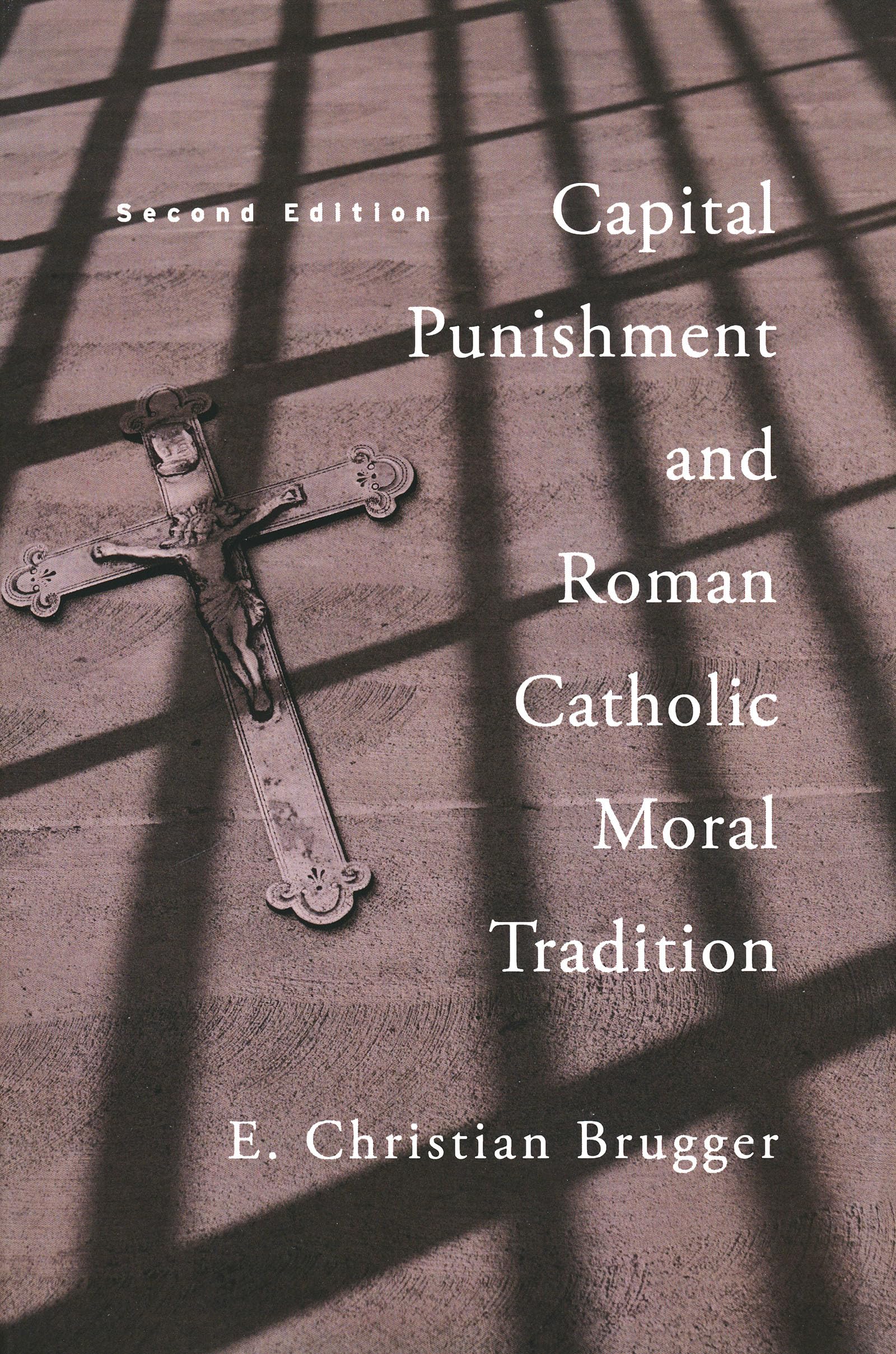
Capital Punishment and Roman Catholic Moral Tradition, Second Edition
$29.00
| Brand | E. Christian Brugger |
| Merchant | Amazon |
| Category | Books |
| Availability | In Stock Scarce |
| SKU | 0268022410 |
| Age Group | ADULT |
| Condition | NEW |
| Gender | UNISEX |
About this item
Capital Punishment and Roman Catholic Moral Tradition, Second Edition
Why is the Catholic Church against the death penalty? This second edition of Brugger’s classic work Capital Punishment and Roman Catholic Moral Tradition traces the doctrinal path the Church has taken over the centuries to its present position as the world’s largest and most outspoken opponent of capital punishment. The pontificate of John Paul II marked a watershed in Catholic thinking. The pope taught that the death penalty is and can only be rightly assessed as a form of self-defense. But what does this mean? What are its implications for the Church’s traditional retribution-based model of lethal punishment? How does it square with what the Church has historically taught? Brugger argues that the implications of this historic turn have yet to be fully understood. In his new preface, Brugger examines the contribution of the great Polish pope’s closest collaborator and successor in the Chair of Peter, Pope Benedict XVI, to Catholic thinking on the death penalty. He argues that Pope Benedict maintained the doctrinal status quo of his predecessor’s teaching on capital punishment as self-defense, with detectable points of reluctance to draw attention to nontraditional implications of that teaching. "Destined to become a primary resource on the complex moral question of capital punishment, this book is the culmination of many years of extensive scholarship by Brugger...Impressive, scholarly, and authoritative, this is recommended for large university libraries."― Library Journal "E. Christian Brugger demonstrates how the Catholic position on capital punishment has shifted not only from yes to virtually never, but also from the category of just retribution to the category of a society's legitimate self-defense."― Commonweal “[Brugger] very skillfully describes the intellectual and sociological changes which have assembled to alter the course of the Church’s approach to capital punishment.” ― American Catholic Studies “This book ranks as one of the clearest and most elegant statements of Catholic moral teaching on the death penalty. This volume should be included in every Catholic college library or seminary, and will be a valuable addition to all graduate libraries.” ― Choice E. Christian Brugger is the J. Francis Cardinal Stafford Professor of Moral Theology at St. John Vianney Theological Seminary. For over three decades an international effort has been afoot to restrict the death penalty throughout the world, with a view to abolishing it. Statistics testify to the success of this effort. As of January 2003, more than half the countries of the world had abolished the death penalty in law or practice,2 while in 1965 “abolitionist” countries numbered only about thirty. Among the largest and most outspoken participants in this effort has been the Roman Catholic Church. A leader in this effort has been Pope John Paul II, who, with the publication of his 1995encyclical Evangelium Vitae , initiated a reevaluation of the morality of capital punishment in the Catholic Church. By his repeated pleas on behalf of the condemned and his general admonitions to Christians and nonChristians alike, the pope has made every effort to minimize the infliction of the death penalty in the modern world, as an expression of commitment to the dignity of the human person. The Catholic Church has not always opposed the death penalty with such force. From its earliest days, up to and including the first half of the twentieth century, it has maintained a relatively confident, consistent, and coordinated defense of the right of the state to kill criminals. Visible signs of change in this regard can be seen as early as the 1950s, when mainstream Catholic writers and individual members of the hierarchy began to take public stands in opposition to the death penalty. The momentum increased―albeit gradually―in the 1960s. And in the 1970s the floodgates burst. Since then, literally hundreds of public statements opposing the death penalty―more perhaps than in the previous centuries combined―have been published by members of the Catholic hierarchy on a local, national, and international level. Given the Church’s traditional teaching on the subject, the writings of the last decades of the twentieth century, particularly of the 1990s, are bound to prompt a number of questions. Is the Catholic Church for or against the death penalty? Under what circumstances, if any, may the death penalty be legitimately inflicted? What is responsible for the recent turn toward abolishing the death penalty by Catholics? What are the philosophical and theological constituents of the Church’s present position? What is the relationship of that position to the traditional teaching on the subject? What are its implications for other forms of Catholic moral teaching, particularly in the tradition of justifiable violence? Is it reasonable to refer to it as a “doctrinal development” over and above the traditional position? If so, by what mode or modes has the dev
| Brand | E. Christian Brugger |
| Merchant | Amazon |
| Category | Books |
| Availability | In Stock Scarce |
| SKU | 0268022410 |
| Age Group | ADULT |
| Condition | NEW |
| Gender | UNISEX |
Similar Products







Compare with similar items

Portable Band Sealer Pink 14" x 6 1/2" x... |

Halloween 3 Coloring Book... |

DECEIVED -Book 1... |

Storyteller,'Red Hand Woven Cotton Bookm... |
|
|---|---|---|---|---|
| Price | $375.00 | $6.99 | $10.00 | $17.99 |
| Brand | ClearBags | Little-Mann | IRENE NIGHT | NOVICA |
| Merchant | clearbags | Amazon | Amazon | Novica |
| Availability | In Stock | In Stock | In Stock | In Stock |