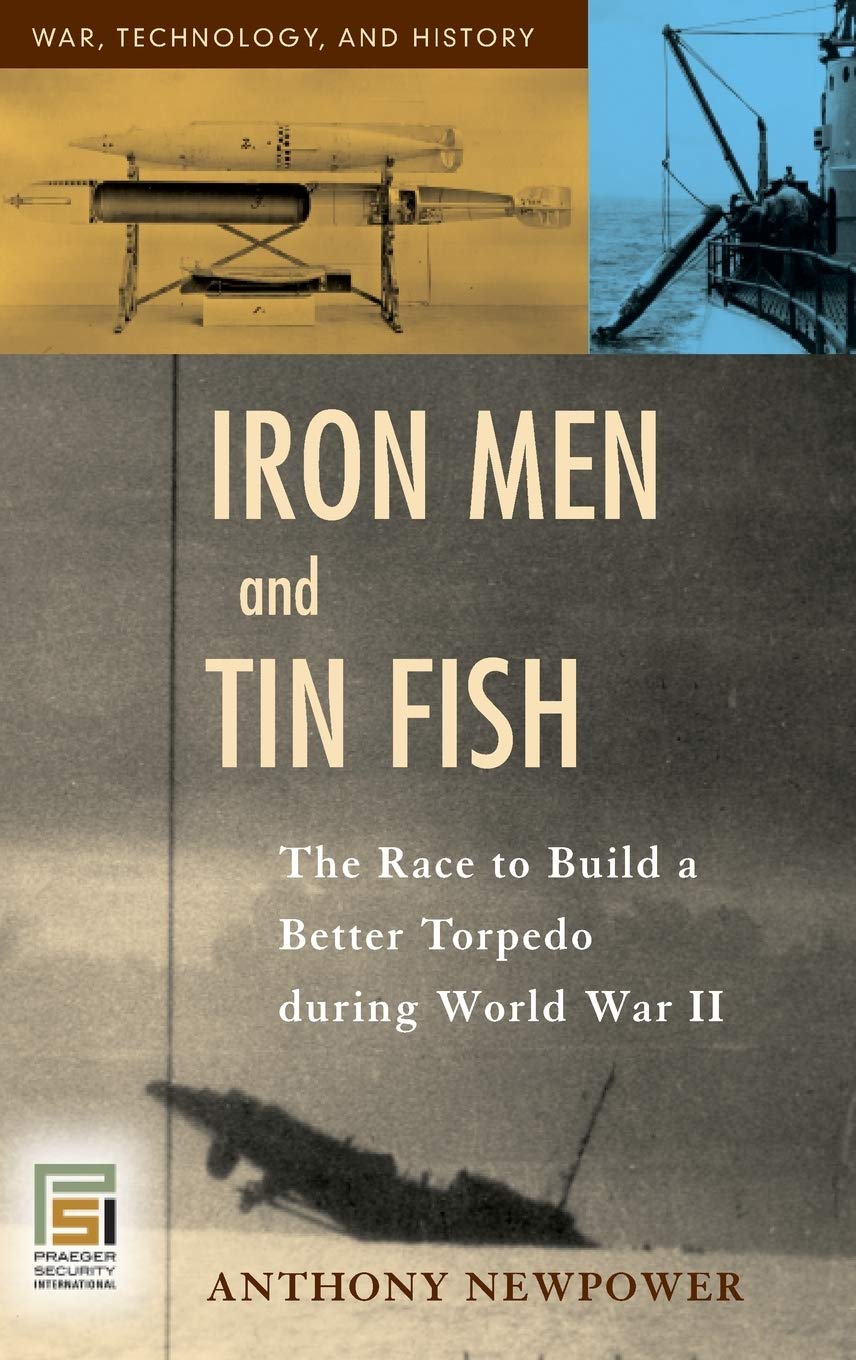
Iron Men and Tin Fish: The Race to Build a Better Torpedo during World War II (War, Technology, and History)
$55.00
| Brand | Anthony Newpower |
| Merchant | Amazon |
| Category | Books |
| Availability | In Stock Scarce |
| SKU | 027599032X |
| Age Group | ADULT |
| Condition | NEW |
| Gender | UNISEX |
| Material | Cellulose-based or similar non-woven material |
| Google Product Category | Media > Books |
| Product Type | Books > Subjects > History > Military > Weapons & Warfare > Conventional |
About this item
Iron Men and Tin Fish: The Race to Build a Better Torpedo during World War II (War, Technology, and History)
From the American entry into World War II until September 1943, U.S. submarines experienced an abnormally high number of torpedo failures. These failures resulted from three defects present in the primary torpedo of the day, the Mark XIV. These defects were a tendency to run deeper than the set depth, the frequent premature detonation of the Mark 6 magnetic influence exploder, and the failure of the contact exploder when hitting a target at the textbook ninety-degree angle. Ironically, despite using a completely independent design, the Germans experienced the same three defects. The Germans, however, fixed their defects in six months, while it took the Americans twenty-two months. Much of the delay on the American side resulted from the denial of senior leaders in the operational forces and in the Navy's Bureau of Ordnance (BuOrd) that the torpedo itself was defective. Instead, they blamed crews for poor marksmanship or lack of training. In the end, however, the submarine force itself overcame the bureaucratic inertia and correctly identified and fixed the three problems on their own, proving once again the industry of the average American soldier or sailor. From the American entry into World War II until September 1943, U.S. submarines experienced an abnormally high number of torpedo failures. These failures resulted from three defects present in the primary torpedo of the day, the Mark XIV. These defects were a tendency to run deeper than the set depth, the frequent premature detonation of the magnetic influence exploder, and the failure of the contact exploder when hitting a target at the textbook 90-degree angle. Ironically, despite using a completely independent design, the Germans experienced the same three defects. The Germans, however, fixed their defects in six months, while it took the Americans 22 months. Much of the delay on the American side resulted from the denial of senior leaders in the operational forces and in the Navy's Bureau of Ordnance (BuOrd) that the torpedo itself was defective. Instead, they blamed crews for poor marksmanship or lack of training. In the end, however, the submarine force itself overcame the bureaucratic inertia and correctly identified and fixed the three problems on their own, proving once again the industry of the average American soldier or sailor. Contrary to the interpretations of most submarine historians, this book concludes that BuOrd did not sit idly by while torpedoes failed on patrol after patrol. BuOrd acknowledged problems from early in the war, but their processes and their tunnel vision prevented them from realizing that the weapon sent to the fleet was grossly defective. One of World War II's forgotten heroes, Admiral Lockwood drove the process for finding and fixing the three major defects. This is first book that deals exclusively with the torpedo problem, building its case out of original research from the archives of the Bureau of Ordnance, the Chief of Naval Operations, Vice Admiral Lockwood's personal correspondence, and records from the British Admiralty at the National Archives of the United Kingdom. These sources are complemented by correspondence and interviews with men who actually participated in the events. “In the most comprehensive analysis of the topic to date, Newpower chronicles US torpedo problems, showing that they lasted until submariners simply stopped using the magnetic explorers. (Britain and Germany had abandoned them by 1941.) Officers in Australia conducted experiments that finally convinced BurOrd officials that depth regulators were defective. Newport Torpedo Station engineers then redesigned the depth regulators, and officers in Hawai'i solved the contact exploder problem on their own by redesigning the firing pin. Recommended. All levels/libraries.” ― Choice “Anthony Newpower has done excellent work. Backed by dedicated research that yielded astute studies of naval bureaucracy in early years of the war, Iron Men and Tin Fish casts new and refreshing light on popular perceptions of the MK 14 torpedo controversy.” ― Proceedings “A former naval officer examines the technical details and military politics behind the torpedoes developed by the United States, Germany, Britain, and Japan during 1941 and 1942 in response to navigation and detonation failures. The investigation focuses on the Mark 14 torpedo and relies on Bureau of Ordnance archives along with submarine veteran interviews.” ― SciTech Book News Anthony Newpower is a graduate of the U.S. Naval Academy and a former naval officer. Newpower has lectured on submarine warfare at Southern Methodist University and is currently studying in the Honors program in Naval Warfare at the American Military University. ROBERT M. CITINO is Assistant Professor of History at Lake Erie College.
| Brand | Anthony Newpower |
| Merchant | Amazon |
| Category | Books |
| Availability | In Stock Scarce |
| SKU | 027599032X |
| Age Group | ADULT |
| Condition | NEW |
| Gender | UNISEX |
| Material | Cellulose-based or similar non-woven material |
| Google Product Category | Media > Books |
| Product Type | Books > Subjects > History > Military > Weapons & Warfare > Conventional |
Similar Products










Compare with similar items

Anywhere Is Possible: The Ultimate Guide... |

Arde mi corazón: Cómo recuperar tu amor ... |

The Christmas Lantern... |
The Deployment Journal for Kids... |
|
|---|---|---|---|---|
| Price | $49.99 | $13.39 | $28.03 | $23.00 |
| Brand | Andre Spence | María José Rivera | George Stager III | Ashlyn Miller |
| Merchant | Amazon | Amazon | Amazon | Amazon |
| Availability | In Stock | In Stock | In Stock | In Stock |