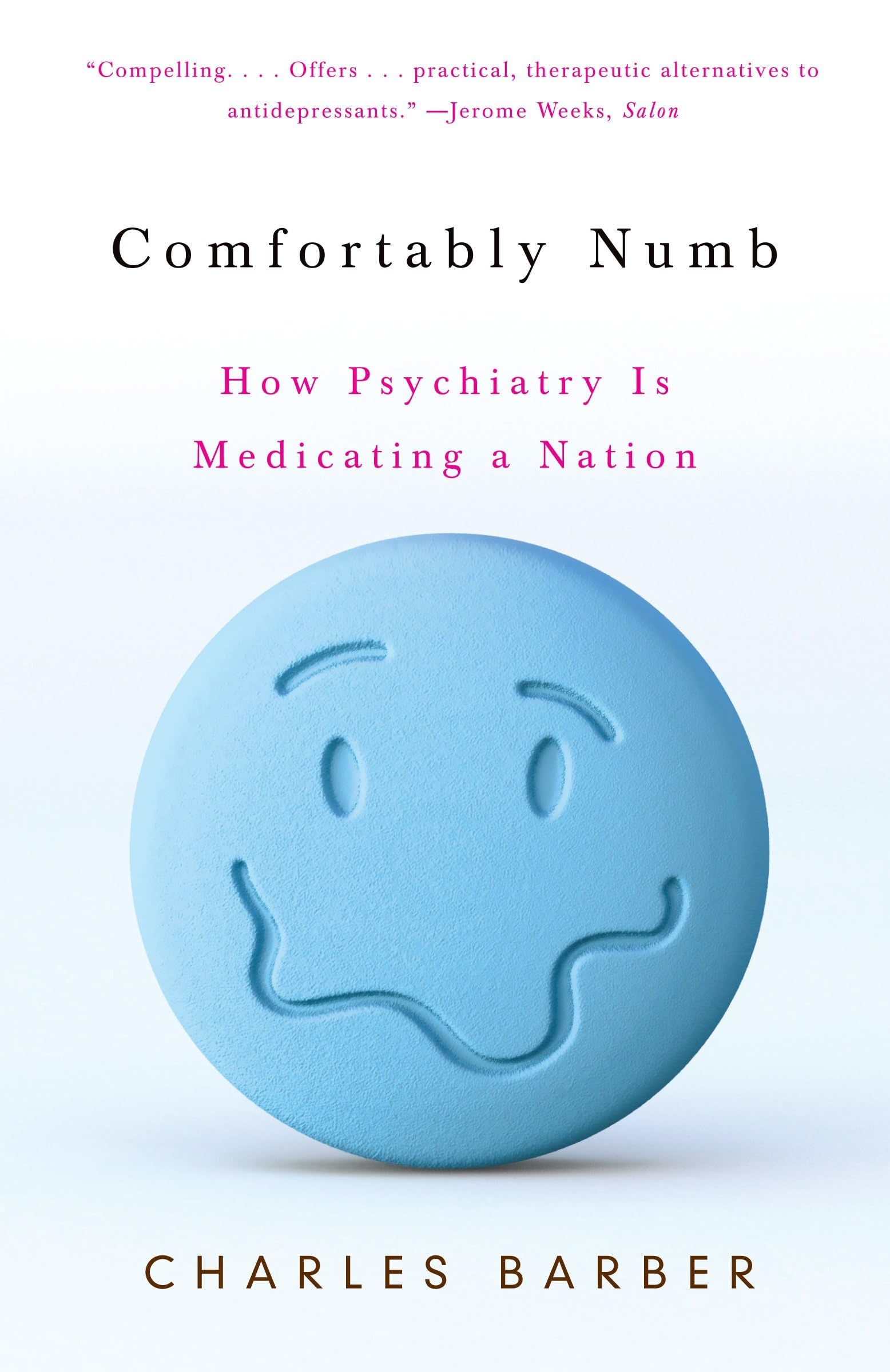
Comfortably Numb: How Psychiatry Is Medicating a Nation
$15.95
| Brand | Charles Barber |
| Merchant | Amazon |
| Category | Books |
| Availability | In Stock |
| SKU | 0307274950 |
| Color | White |
| Age Group | ADULT |
| Condition | NEW |
| Gender | UNISEX |
| Google Product Category | Media > Books |
| Product Type | Books > Subjects > Health, Fitness & Dieting > Psychology & Counseling > Psychopharmacology |
About this item
Comfortably Numb: How Psychiatry Is Medicating a Nation
American doctors dispense approximately 230 million antidepressant prescriptions every year, more than any other class of medication. Charles Barber explores this disturbing phenomenon, examining the ways in which pharmaceutical companies first create the need for a drug and then rush to fill it. Most importantly, he convincingly argues that, without an industry to promote them, non-pharmaceutical approaches are tragically overlooked in favor of an instant cure for all emotional difficulties.Compulsively readable and urgently relevant, Comfortably Numb is an unprecedented account of the impact of psychiatric medications on American culture and on Americans themselves. “Compelling. . . . Offers something several of the other books don't: practical, therapeutic alternatives to antidepressants.” —Jerome Weeks, Salon “By any measure, this is an Important Book. . . . Perhaps it will play a role, however small, in convincing both medicators and the medicated to rely less on pharmaceuticals and more on the long-term therapy of human compassion.” — The Harford Courant “Arrives in our pill-happy midst not a moment too soon.” — The New York Observer “Passionate yet fair-minded. . . . Barber asks the critical question of whether Americans are crazier that the rest of the world or whether we have simply developed a crazy dependency on legal drugs.” —Susan Jacoby, author of The Age of American Unreason “A fine, informed writer on cultural history as well as neuroscience, psychotherapy, and economics, Barber convincingly argues against the overprescription of psychiatric drugs in the United States and sums up the history of U.S. psychiatry from the asylum to the community to glitzy but still elementary neuroscience. A blockbuster essential for all libraries.”— Library Journal (starred review)“A sharply critical look at the way antidepressants are marketed and prescribed in the United States . . . Barber articulately and persuasively counsels that it’s time to abandon the quick-fix, pop-a-pill approach.”— Kirkus “ Comfortably Numb chronicles the extraordinary psychopharmaceuticalization of everyday life that has arisen in recent years and appears to be growing apace. Barber marks out the inconvenient truths on our path to emotional climate change but also offers alternatives to readers who wish to avoid pharmageddon.”—David Healy, author of Let Them Eat Prozac Charles Barber was educated at Harvard and Columbia and worked for ten years in New York City shelters for the homeless and mentallly ill. The title essay in his first book, Songs from the Black Chair , won a 2006 Pushcart Prize. His work has appeared in The New York Times , among other publications, and on NPR. He is a lecturer in psychiatry at the Yale University School of Medicine and lives in Connecticut with his family. In 1988, almost by accident, I began working with homeless people suffering from mental illness in New York City. This was meant to be a short-term vocation, a year at most. But for the next fourteen years, I worked with the homeless mentally ill in Manhattan in a variety of settings–first on the streets, then in shelters, then in supportive residential programs. All of my clients suffered from, as the psychiatric textbooks put it, “severe and persistent mental illness.” That is, they were diagnosed with various forms of schizophrenia, extreme mood complications such as bipolar disorder and major depression, and a range of personality disorders. Most of my clients had been or were addicted to some combination or other of alcohol, heroin, crack, cocaine, benzodiazepines, and PCP. A very large percentage had chronic physical ailments like diabetes, HIV, and hepatitis. Despite the rather remarkable burden of their collective afflictions, my clients were also often engaging, interesting, and without exception astonishingly resilient. To quell their unruly moods and their troublesome delusions and hallucinations, my patients were taking all manner of psychiatric medications. Some of these medications had been around since the 1950s and 1960s–mood stabilizers like lithium, antipsychotics such as Haldol and Thorazine–while others, at the time, were brand-new, with strange and exotic names like Prozac, Paxil, and Zoloft. Each year over the course of the 1990s, new psychiatric medications were introduced and consumed en masse by my clients. Some of these new medications arrived with great fanfare and extremely high expectations. In particular, a class of agents called “atypical antipsychotics”–Risperdal, Clozaril, and Zyprexa are the best known–had been shown in early clinical studies to be far superior to the Haldols and the Thorazines. Overnight, it seemed, almost all patients were converted to these new drugs, as well as new-generation antidepressants and mood stabilizers. It was not at all unusual for my clients to be taking three, four, five, or six different types of psychiatric drugs in a given day–a combination not unlike the numb
| Brand | Charles Barber |
| Merchant | Amazon |
| Category | Books |
| Availability | In Stock |
| SKU | 0307274950 |
| Color | White |
| Age Group | ADULT |
| Condition | NEW |
| Gender | UNISEX |
| Google Product Category | Media > Books |
| Product Type | Books > Subjects > Health, Fitness & Dieting > Psychology & Counseling > Psychopharmacology |
Similar Products








Compare with similar items

Words of Wisdom To The Graduate: Graduat... |

Requiem For A Soldier: A Vietnam Story... |

Sight Word Fluency for Early Readers: Si... |
My Mind is My Greatest Enemy and My Dear... |
|
|---|---|---|---|---|
| Price | $14.99 | $15.99 | $10.99 | $5.00 |
| Brand | Sheila H. Elora | Harris L. Kligman | Brenda Tejeda M.S.Ed | Tajeira d Thomas |
| Merchant | Amazon | Amazon | Amazon | Amazon |
| Availability | In Stock | In Stock | In Stock | In Stock |