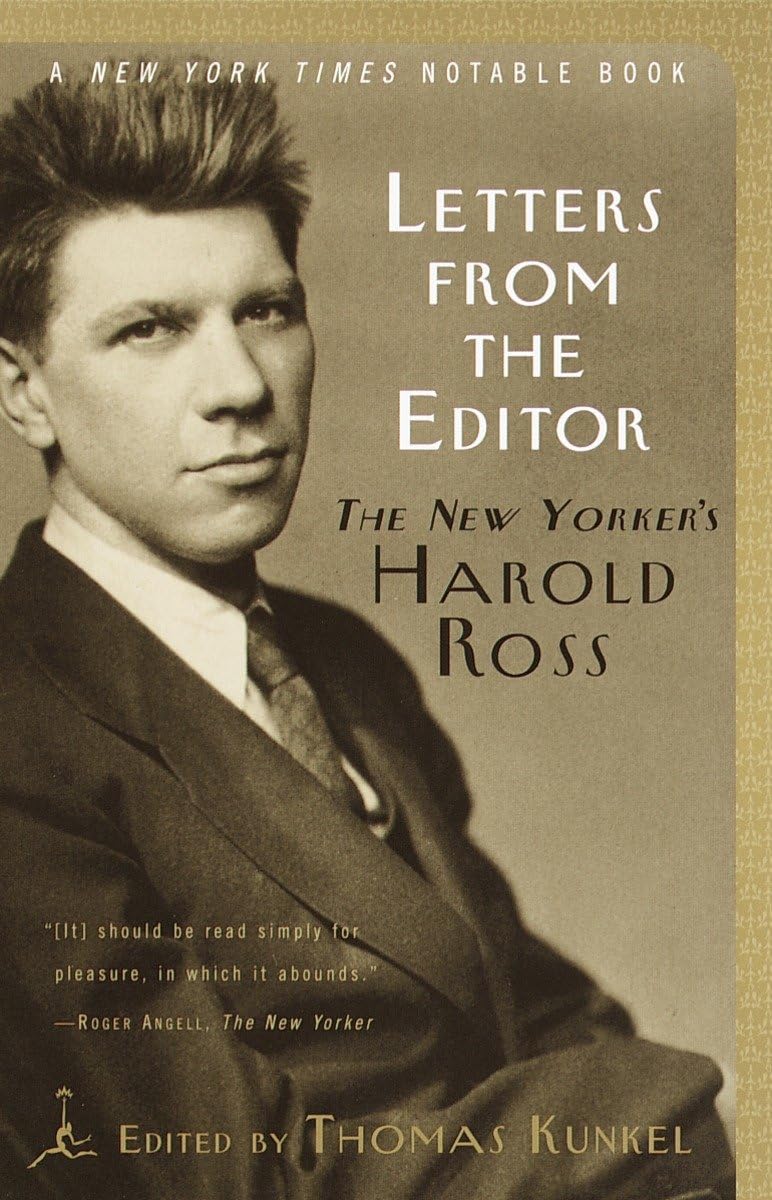
Letters from the Editor: The New Yorker's Harold Ross (Modern Library Classics)
$15.13
| Brand | Thomas Kunkel |
| Merchant | Amazon |
| Category | Books |
| Availability | In Stock |
| SKU | 0375756949 |
| Color | Multicolor |
| Age Group | ADULT |
| Condition | NEW |
| Gender | UNISEX |
| Google Product Category | Media > Books |
| Product Type | Books > Subjects > Biographies & Memoirs > Arts & Literature > Authors |
About this item
Letters from the Editor: The New Yorker's Harold Ross (Modern Library Classics)
These exhilarating letters—selected and introduced by Thomas Kunkel, who wrote Genius in Disguise , the distinguished Ross biography—tell the dramatic story of the birth of The New Yorker and its precarious early days and years. Ross worries about everything from keeping track of office typewriters to the magazine's role in wartime to the exact questions to be asked for a "Talk of the Town" piece on the song "Happy Birthday." We find Ross, in Kunkel's words, "scolding Henry Luce, lecturing Orson Welles, baiting J. Edgar Hoover, inviting Noel Coward and Ginger Rogers to the circus, wheedling Ernest Hemingway— offering to sell Harpo Marx a used car and James Cagney a used tractor, and explaining to restaurateur-to-the-stars Dave Chasen, step by step, how to smoke a turkey." These letters from a supreme editor tell in his own words the story of the fierce, lively man who launched the world's most prestigious magazine. Thomas Kunkel is the author of a biography of Ross, Genius in Disguise , and Enormous Prayers . He works at the University of Maryland College of Journalism and lives in Burtonsville, Maryland. Researching a biography is often compared to detective work, and certainly much sleuthing must transpire before the first word ever slips from the writer's fingertips. Even so, I find this analogy altogether too grim, not only for its criminal overtones but for its suggestion of a kind of purposeful slogging on the part of the pursuer. For most biographers there is more sheer joy in the exercise than that; it is less a life-or-death pursuit than an open-ended game of hide-and-seek. Some writers find their quarry, others never do. The serendipity is part of the fun. As for me, I found Harold Wallace Ross in Room 328 of the New York Public Library. True, he had been dead for more than forty years. But Ross, founding editor and guiding spirit of The New Yorker magazine, is loudly, reprovingly alive in the tens of thousands of letters packed away in a hundred or more archival containers. Before I ever got into the magazine’s archives, now kept at the library, I had formed a strong impression of Ross, one gleaned from dozens of interviews with those who knew him, from the memoirs of others, and from the sundry correspondence of his that I had unearthed in other collections. But nothing prepared me for the sheer personality that bounded from these musty gray boxes like a freed genie. In less than an hour's eavesdropping I encountered my man scolding Henry Luce, lecturing Orson Welles, baiting J. Edgar Hoover, inviting Noel Coward and Ginger Rogers to the circus, wheedling Ernest Hemingway ("Are you ever going to write any short stories again? My God"), offering to sell Harpo Marx a used car and James Cagney a used tractor, and explaining to restaurateur-to-the-stars Dave Chasen, step by step, how to smoke a turkey. There’s so much of that kind of thing in the files that one could get the impression Ross had little time to run his magazine. But of course Ross ran The New Yorker utterly, relentlessly, and largely in the same way he juggled his demanding social life—with a copious stream of letters, memoranda, telegrams, even scrawled notes to his staff and contributors. The editor's dispatches spill over with ideas, explanations, tips, gossip, suggestions, and occasionally apologies. He was not above haranguing or begging for material; "God damn it, write something!" was a familiar Rossian benediction. At other times he offered advice. "Don't waste your time and words on letters," he once said to St. Clair McKelway. "You don't get paid for them." He imparted this, naturally, in a letter. The letters reprinted here, then, represent but a sampler of the available material, and they are intended in that vein. Which is to say they convey an honest sense of the man, his droll outlook, the way he lived an eventful but messy life, and, most important, the way he directed the magazine that remains his legacy. Ross, as the reader will see, was propelled by boundless energy and interests. He seemed to know everyone of his day worth knowing, and led an existence far larger than seems possible today. Letter writing was at the core of that existence, as much a part of Ross as his unruly hair or the double-wide gap in his front teeth. A turn-of-the-century child of the frontier, son of an immigrant miner and a prim prairie schoolmarm, Ross was always something of a nineteenth-century figure even as he guided the twentieth century's most literate magazine. Corresponding, like smoking and swearing, was a habit Ross acquired early and never relinquished. He was born in 1892 in Aspen, Colorado, when the place was a shabby silver-mining outpost. After silver crashed, the Rosses moved to Salt Lake City, Utah. From boyhood Harold exhibited an organic restlessness, both intellectual and physical. He devoured the stories of Jack London and the romantic exploits of war correspondents such as Richard Harding Davis, and perhaps
| Brand | Thomas Kunkel |
| Merchant | Amazon |
| Category | Books |
| Availability | In Stock |
| SKU | 0375756949 |
| Color | Multicolor |
| Age Group | ADULT |
| Condition | NEW |
| Gender | UNISEX |
| Google Product Category | Media > Books |
| Product Type | Books > Subjects > Biographies & Memoirs > Arts & Literature > Authors |
Similar Products






Compare with similar items

AMA-CPM™ Exam Prep Study Guide (Brian E.... |

Inked Adonis (Litvinov Bratva)... |

aPHR Study Guide 2026-2027: 1100 Questio... |

2026 Easy Word Fill In Puzzles Book For ... |
|
|---|---|---|---|---|
| Price | $49.99 | $19.99 | $29.99 | $7.99 |
| Brand | Brian E. Porter | Nicole Fox | Hayden Osei | Linda S. Bowie |
| Merchant | Amazon | Amazon | Amazon | Amazon |
| Availability | In Stock | In Stock | In Stock | In Stock |