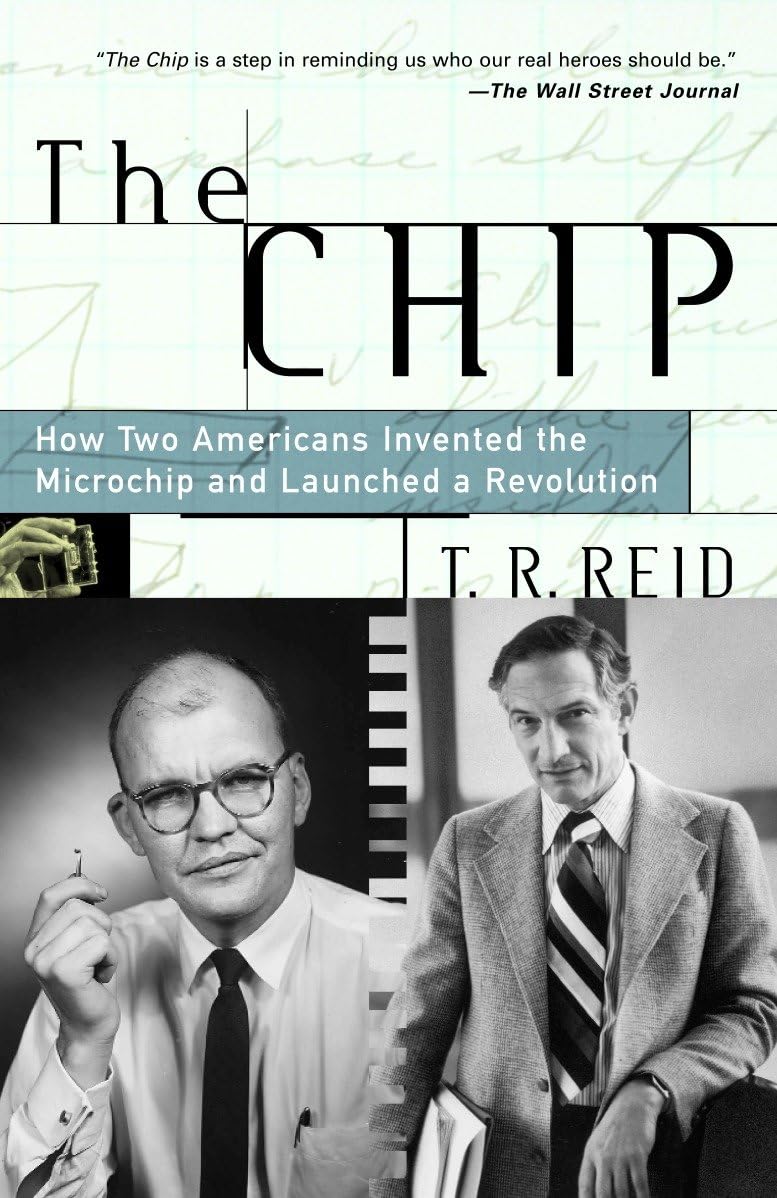
The Chip : How Two Americans Invented the Microchip and Launched a Revolution
$18.00
| Brand | T.R. Reid |
| Merchant | Amazon |
| Category | Books |
| Availability | Available Date |
| SKU | 0375758283 |
| Color | Multicolor |
| Age Group | ADULT |
| Condition | NEW |
| Gender | UNISEX |
| Google Product Category | Media > Books |
| Product Type | Books > Subjects > Engineering & Transportation > Engineering > Electrical & Electronics > Circuits |
About this item
The Chip : How Two Americans Invented the Microchip and Launched a Revolution
Barely fifty years ago a computer was a gargantuan, vastly expensive thing that only a handful of scientists had ever seen. The world’s brightest engineers were stymied in their quest to make these machines small and affordable until the solution finally came from two ingenious young Americans. Jack Kilby and Robert Noyce hit upon the stunning discovery that would make possible the silicon microchip, a work that would ultimately earn Kilby the Nobel Prize for physics in 2000. In this completely revised and updated edition of The Chip , T.R. Reid tells the gripping adventure story of their invention and of its growth into a global information industry. This is the story of how the digital age began. They're everywhere, but where did they come from? Silicon chips drive just about everything that sucks power, from toys to heart monitors, but their inventors aren't nearly as widely known as Edison and Ford. Journalist T.R. Reid has thoroughly updated The Chip , his 1985 exploration of the life work of inventors Jack Kilby and Robert Noyce, to reflect the colossal shift toward smarter gadgets that has taken place since then. Satisfying as both biography and basic science text, the book perfectly captures the independence and near-obsessive problem-solving talents of the two men. Though ultimately only one of them (Noyce) ended up with legal rights to the invention, they shared a respect for each other that persisted throughout their careers. Since Kilby won the 2000 Nobel Prize for Physics for his work, the story is all the more compelling and intriguing over 40 years after the invention. Reid's work uncovers human dimensions we'd never expect to see from 1950s engineering research. --Rob Lightner Since Reid wrote about the integrated circuit in 1985, a Nobel Prize has been awarded for the device, one of its inventors has died, and the computer revolution has changed the world. It's time for an update. What most attracted Reid to the subject was the total obscurity of the inventors--rivals Jack Kilby and Robert Noyce--compared with the ubiquity of their invention. After a run through the history of electronics, from the vacuum tube to the solid-state amplifier, Reid delineates the electronics landscape Kilby and Noyce surveyed as young engineers in the mid-1950s. Blocking progress was the "tyranny of numbers," so named because circuits were limited in size and reliability by the need for hand soldering. Kilby and Noyce independently devised the solution: manufacturing all the components of a circuit directly from a single block of semiconducting material. Their success begat patent fights, piles of dough for Kilby's Texas Instruments and Noyce's Intel, trade disputes with Japan, and in 2000 the Nobel Prize for Kilby. Reid covers it all with verve and clarity. Gilbert Taylor Copyright © American Library Association. All rights reserved Barely fifty years ago a computer was a gargantuan, vastly expensive thing that only a handful of scientists had ever seen. The world's brightest engineers were stymied in their quest to make these machines small and affordable until the solution finally came from two ingenious young Americans. Jack Kilby and Robert Noyce hit upon the stunning discovery that would make possible the silicon microchip, a work that would ultimately earn Kilby the Nobel Prize for physics in 2000. In this completely revised and updated edition of The Chip, T.R. Reid tells the gripping adventure story of their invention and of its growth into a global information industry. This is the story of how the digital age began. T.R. Reid is the author of five books in English and two in Japanese. Through his reporting for The Washington Post , his syndicated weekly column, and his light-hearted commentary from around the world for National Public Radio, he has become one of America’s best-known foreign correspondents. Reid lives in London. Chapter 1 THE MONOLITHIC IDEA The idea occurred to Jack Kilby at the height of summer, when everyone else was on vacation and he had the lab to himself. It was an idea, as events would prove, of literally cosmic dimensions, an idea that would be honored in the textbooks with a name of its own: the monolithic idea. The idea would eventually win Kilby the Nobel Prize in Physics. This was slightly anomalous, because Jack had no training whatsoever in physics; the Royal Swedish Academy of Sciences was willing to overlook that minor detail because Jack's idea did, after all, change the daily life of almost everyone on earth for the better. But all that was in the future. At the time Kilby hit on the monolithic idea-it was July 1958-he only hoped that his boss would let him build a model and give the new idea a try. The boss was still an unknown quantity. It had been less than two months since Jack Kilby arrived in Dallas to begin work at Texas Instruments, and the new employee did not yet have a firm sense of where he stood. Jack had been delighted and flattered when Wil
| Brand | T.R. Reid |
| Merchant | Amazon |
| Category | Books |
| Availability | Available Date |
| SKU | 0375758283 |
| Color | Multicolor |
| Age Group | ADULT |
| Condition | NEW |
| Gender | UNISEX |
| Google Product Category | Media > Books |
| Product Type | Books > Subjects > Engineering & Transportation > Engineering > Electrical & Electronics > Circuits |
Similar Products






Compare with similar items
The Making of a Generalist: An Independe... |

Cat's Christmas: Simple and Bold Colorin... |
What If, Pig?... |

Florida Travel Guide 2024: Everything yo... |
|
|---|---|---|---|---|
| Price | $15.75 | $9.99 | $9.86 | $10.99 |
| Brand | Vikram Mansharamani | Kiersten Meyer | Linzie Hunter | Bobby L. Knowles |
| Merchant | Amazon | Amazon | Amazon | Amazon |
| Availability | In Stock Scarce | In Stock | In Stock Scarce | In Stock |