
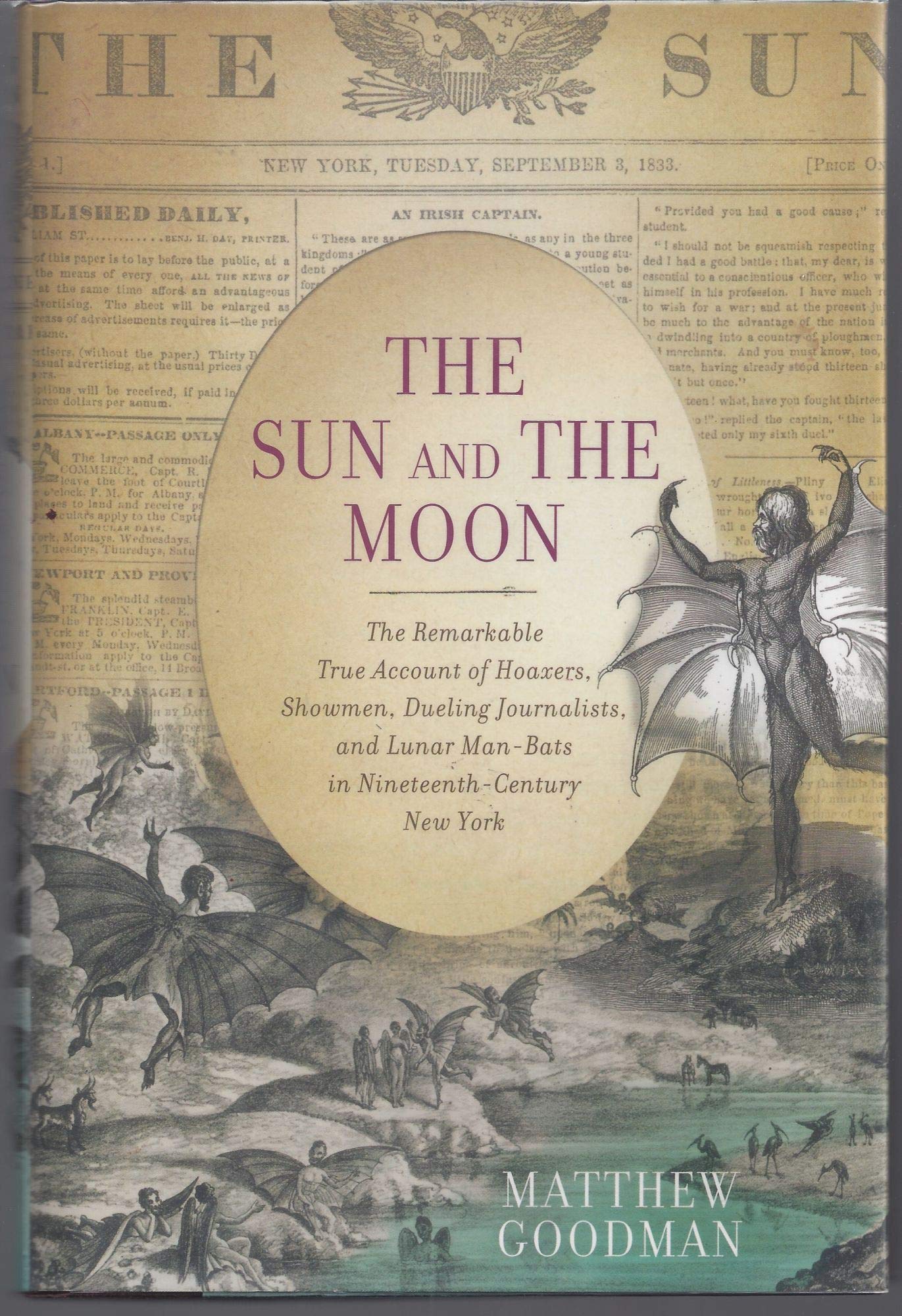
The Sun and the Moon: The Remarkable True Account of Hoaxers, Showmen, Dueling Journalists, and Lunar Man-Bats in Nineteenth-Century New York
$25.86
| Brand | Matthew Goodman |
| Merchant | Amazon |
| Category | Books |
| Availability | In Stock Scarce |
| SKU | 0465002579 |
| Age Group | ADULT |
| Condition | NEW |
| Gender | UNISEX |
| Google Product Category | Media > Books |
| Product Type | Books > Subjects > History > Americas > United States > State & Local |
About this item
The Sun and the Moon: The Remarkable True Account of Hoaxers, Showmen, Dueling Journalists, and Lunar Man-Bats in Nineteenth-Century New York
The Sun and the Moon tells the delightful, entertaining, and surprisingly true story of how in the summer of 1835 a series of articles in the Sun , the first of the city's penny papers,” convinced the citizens of New York that the moon was inhabited. Six articles, purporting to reveal the lunar discoveries made by a world-famous British astronomer, described the life found on the moonincluding unicorns, beavers that walked upright, and, strangest of all, four-foot-tall flying man-bats. The series quickly became the most widely circulated newspaper story of the era. And the Sun , a brash working-class upstart less than two years old, had become the most widely read newspaper in the world. Told in richly novelistic detail, The Sun and the Moon brings the raucous world of 1830s New York City vividly to lifethe noise, the excitement, the sense that almost anything was possible. The book overflows with larger-than-life characters, including Richard Adams Locke, author of the moon series (who never intended it to be a hoax at all); a fledgling showman named P.T. Barnum, who had just brought his own hoax to New York; and the young writer Edgar Allan Poe, who was convinced that the moon series was a plagiarism of his own work. An exhilarating narrative history of a city on the cusp of greatness and a nation newly united by affordable newspapers, The Sun and the Moon may just be the strangest true story you've ever read. Goodman ( Jewish Food ), "Food Maven" columnist for the Forward , encapsulates the enterprising city of New York's schemes and social fabric in an account of the penny newspaper, The Sun 's 1835 series purporting to document life on the moon. Assisted by his own talents for fiction writing, Goodman shows how this new working-class organ, by printing fabrications rather than facts (as well as by pioneering the penny per copy press), became the most widely read newspaper in the world. Using magazines, memoirs, and guidebooks of the period, Goodman maintains that the radical English expatriate editor Richard Adams Locke devised the so-called moon hoax to satirize the claims of religious astronomers who believed that God had created extraterrestrial life. This is a rollicking read, perhaps better at conveying a lyrical feel for the time and place than for its scholarly analysis (for which see Sean Wilentz's Chants Democratic: New York City and the Rise of the American Working Class, 1788–1850 ). Lengthy biographical accounts of P.T. Barnum and Edgar Allan Poe, introduced in part to evince how deception and plagiarism characterized the period, while interesting, are extraneous and little related to the main story. Gracefully worded, footnoted, and with a bibliography, this book's appeal nevertheless is more to the general reader than to the academic. Recommended for public libraries.—Frederick J. Augustyn Jr., Library of Congress Copyright © Reed Business Information, a division of Reed Elsevier Inc. All rights reserved. Benjamin Day was the publisher of the New York Sun in the early 1800s who famously quipped,”If a dog bites a man, that’s not news. But if a man bites a dog, that’s news.” Day and his paper provide journalist Goodman with an entry point into the New York City of 1835—crowded, filthy, filled with cholera and crime, and alive with possibility for hucksters of all sorts. Goodman showcases a series of articles published by the Sun in the summer of 1835 that purported to describe life on the moon, filled with flying man-bats. He takes off from these articles and their success (papers sold out so fast that starving newsboys were kept in oysters and good lodgings for weeks) to a description of 1835 New York. Connections are fairly flimsy, and this lacks the narrative drive of The Devil in the White City or Seabiscuit. Still, if the book fails as creative nonfiction, it still tells an intriguing story and reveals some fascinating facts about nineteenth-century New York. --Connie Fletcher Matthew Goodman ’s nonfiction writing has appeared in The Forward , The American Scholar , Harvard Review , Brill’s Content , and The Utne Reader . He is the author of Jewish Food: The World at Table . He lives in Brooklyn with his wife and children.
| Brand | Matthew Goodman |
| Merchant | Amazon |
| Category | Books |
| Availability | In Stock Scarce |
| SKU | 0465002579 |
| Age Group | ADULT |
| Condition | NEW |
| Gender | UNISEX |
| Google Product Category | Media > Books |
| Product Type | Books > Subjects > History > Americas > United States > State & Local |
Similar Products









Compare with similar items

Whiskey Cocktails Coffee Table Book... |

Relax Mental Health Journal: Daily Self-... |
The Decolonial Imaginary: Writing Chican... |

Quiero ir a la republica dominicana (Spa... |
|
|---|---|---|---|---|
| Price | $100.00 | $9.24 | $16.50 | $8.99 |
| Brand | Graphic Image | Jayden Howell | Emma Pérez | CI Liftoff |
| Merchant | bedbathbeyond | Amazon | Amazon | Amazon |
| Availability | In Stock | In Stock | In Stock Scarce | In Stock |