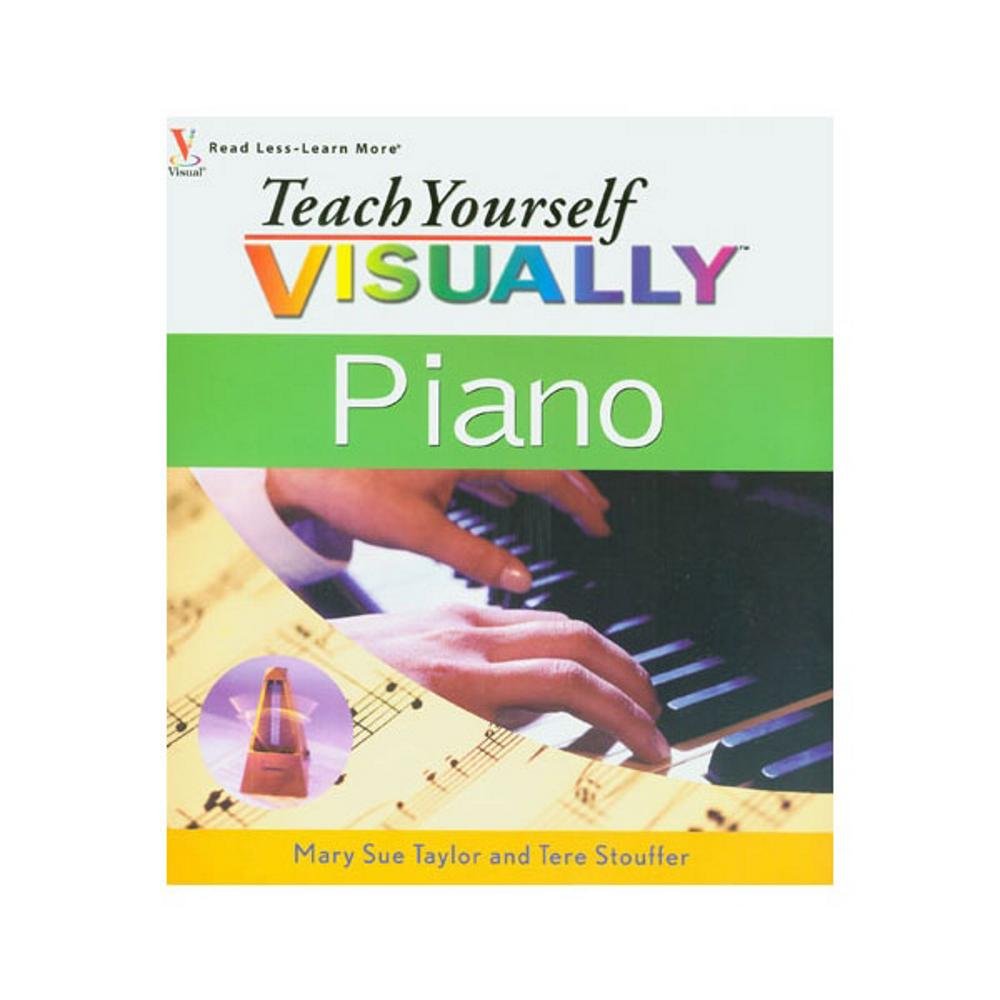
Teach Yourself Visually Piano
$42.77
| Brand | Mary Sue Taylor |
| Merchant | Amazon |
| Category | Books |
| Availability | In Stock Scarce |
| SKU | 0471749907 |
| Age Group | ADULT |
| Condition | NEW |
| Gender | UNISEX |
| Google Product Category | Media > Books |
| Product Type | Books > Subjects > Arts & Photography > Music > Instruments > Piano & Keyboards |
About this item
Teach Yourself Visually Piano
Want to go beyond "Chopsticks?" This visual guide to tickling the ivories will show you the way. By Chapter 2, you'll be playing simple pieces and practicing scales. You'll progress from getting familiar with notes, symbols, and keys to playing basic chords and reading music like a pro. Without getting bogged down in boring theory, you'll learn what you need to know and enjoy playing as you go! Whether you like Bach or rock, jazz or country, golden oldies or new age, you'll love learning to play the fun, visual way. Concise two-page lessons show you all the crucial skills and are ideal for quick review Each skill, chord, or technique is clearly described - Concise and understandable instructions accompany each photo - Detailed color photos demonstrate proper fingering technique - Helpful tips provide additional guidance Mary Sue Taylor has taught beginning piano, jazz, improvisation, chord study, and other related topics to a diverse array of students since 1956. She has also filled her share of musical requests, having played piano in the Atlanta area since 1954. Over the years, she has dusted the keys of nearly every piano in the Atlanta area, from formal society clubs to dim, smoke-filled jazz bars to the hottest house parties. She lives in Roswell, Georgia, with her husband, Jimmy. Tere Stouffer is a freelance author and editor who has now broken into the double digits—this is her tenth book. She lives in Knoxville, Tennessee, with her chocolate Lab, Maxine, who kept her feet warm on many a late winter night spent working on this manuscript. Teach Yourself VISUALLY Piano By Mary Sue Taylor John Wiley & Sons Copyright © 2006 Mary Sue Taylor All right reserved. ISBN: 978-0-471-74990-5 Chapter One The Piano To activate sound on a piano, you press a key, which releases a small hammer that strikes a string. The string then vibrates with sound, which is called a note . To reduce this vibration and soften the sound, you press on a pedal. The History of the Piano 4 The Sounding Board 5 Pedals 6 The Keyboard 8 Playing Position, Posture, and Hand Position 14 The History of the Piano The piano was invented in the early eighteenth century by Bartolomeo Cristofori of Florence, Italy. Cristofori's job was to design and maintain the keyboard instruments used in the court of Prince Ferdinand de' Medici. John Brent of Philadelphia built the first piano in the United States in 1774. Cristofori was a maker of harpsichords and clavichords (the two predecessors of the piano), so it is reasonable that his instrument would be similar to these instruments, but-instead-capable of softness and loudness. Harpsichords are neither soft nor loud; nor can they produce much of a sustained tone. This is because the strings of the harpsichord are plucked with quills or plectra. Clavichords are more like pianos, in that the strings are struck with metal tangents. The tone produced by a clavichord, however, is soft. Cristofori's invention used hammers to hit the strings. Depending on the pianist's touch at the keyboard, a key could be pressed lightly (producing a soft tone), or struck with enough force that it produced a loud tone. And, unlike both the harpsichord and the clavichord, a tone could be sustained on the piano, depending on the pianist's desire. Cristofori's original name for the piano was gravicembalo col piano e forte , which means "harpsichord with soft and loud." Cristofori's invention soon became known as the fortepiano , which distinguished the eighteenth-century instrument from its predecessors and today's piano, the full name of which is the pianoforte . Cristofori's early fortepiano had one relatively thin string per note and was much softer than today's pianos. By Mozart's time, it had two strings per note and the hammers were covered in leather. A German organ builder named Gottfried Silbermann began making fortepianos in the 1730s. He is responsible for adding a forerunner of today's damper pedal, which you will be learning about later in this chapter. The eighteenth-century fortepiano keyboard often didn't look the way the piano's keyboard looks today. Many fortepianos had keyboards that resembled the keyboard of the harpsichord of the time, in which the white keys were black and the black keys were white. In the nineteenth century, the piano underwent many changes. The frame changed from wood to iron, enabling strings to become thicker and strung with more tension without breaking. (String breakage had been a problem: Beethoven was constantly hitting keys with such force that strings broke.) More strings were added and more octaves. You'll learn about octaves later in this book. The hammers were covered with felt to achieve better tone quality from the new steel strings. At this point, let's leave the subject of the history of the piano and look at how today's piano is constructed. The Sounding Board The piano's sounding board, an internal part of the piano that y
| Brand | Mary Sue Taylor |
| Merchant | Amazon |
| Category | Books |
| Availability | In Stock Scarce |
| SKU | 0471749907 |
| Age Group | ADULT |
| Condition | NEW |
| Gender | UNISEX |
| Google Product Category | Media > Books |
| Product Type | Books > Subjects > Arts & Photography > Music > Instruments > Piano & Keyboards |
Similar Products







Compare with similar items

My Heart Has Been in it from the Start... |

Autumn Coziness Coloring Book: Large Pri... |

Calm & Color: Mindfulness Coloring Book ... |

El Mundo del Fútbol - Colorea a los Ídol... |
|
|---|---|---|---|---|
| Price | $28.99 | $7.99 | $9.99 | $5.99 |
| Brand | Steve Larsen | Adriana Lay | The Joy of Coloring | Paula Johanna |
| Merchant | Amazon | Amazon | Amazon | Amazon |
| Availability | In Stock | In Stock | In Stock | In Stock |