
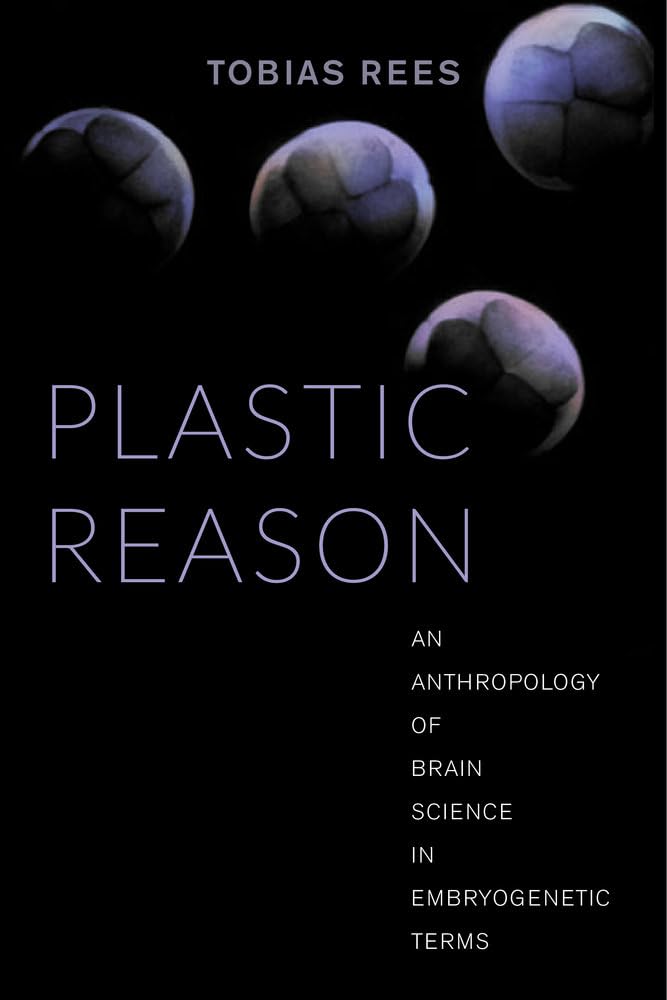
Plastic Reason: An Anthropology of Brain Science in Embryogenetic Terms
$34.95
| Brand | Tobias Rees |
| Merchant | Amazon |
| Category | Books |
| Availability | In Stock |
| SKU | 0520288130 |
| Age Group | ADULT |
| Condition | NEW |
| Gender | UNISEX |
About this item
Plastic Reason: An Anthropology of Brain Science in Embryogenetic Terms
Throughout the twentieth century, neuronal researchers knew the adult human brain to be a thoroughly fixed and immutable cellular structure, devoid of any developmental potential. Plastic Reason is a study of the efforts of a few Parisian neurobiologists to overturn this rigid conception of the central nervous system by showing that basic embryogenetic processes—most spectacularly the emergence of new cellular tissue in the form of new neurons, axons, dendrites, and synapses—continue in the mature brain. Furthermore, these researchers sought to demonstrate that the new tissues are still unspecific and hence literally plastic, and that this cellular plasticity is constitutive of the possibility of the human. Plastic Reason , grounded in years of fieldwork and historical research, is an anthropologist’s account of what has arguably been one of the most sweeping events in the history of brain research—the highly contested effort to consider the adult brain in embryogenetic terms. A careful analysis of the disproving of an established truth, it reveals the turmoil that such a disruption brings about and the emergence of new possibilities of thinking and knowing. "One of the most engaging and quirky anthropological monographs I have read in recent years." ― Dialectical Anthropology “ Plastic Reason deftly tracks how the notion of ‘plasticity’ gathered persuasive force among a community of neuroscientists in France. Conducting and composing his ethnography through a series of conversational encounters with brain researchers, Tobias Rees elegantly illustrates how science is made in rhetoric, debate, and practice. In accounts of neural plasticity, he argues, novel notions of ‘human nature’ as unfixed, mobile, and open may be emerging.”—Stefan Helmreich, Professor of Anthropology, MIT “ Plastic Reason deftly tracks how the notion of ‘plasticity’ gathered persuasive force among a community of neuroscientists in France. Conducting and composing his ethnography through a series of conversational encounters with brain researchers, Tobias Rees elegantly illustrates how science is made in rhetoric, debate, and practice. In accounts of neural plasticity, he argues, novel notions of ‘human nature’ as unfixed, mobile, and open may be emerging.”—Stefan Helmreich, Professor of Anthropology, MIT Tobias Rees is Associate Professor of Anthropology with a dual appointment in the Department of Social Studies of Medicine at McGill University. Plastic Reason An Anthropology of Brain Science in Embryogenetic Terms By Tobias Rees UNIVERSITY OF CALIFORNIA PRESS Copyright © 2016 The Regents of the University of California All rights reserved. ISBN: 978-0-520-28813-3 Contents Illustrations, ix, The Ground of the Argument, xi, Note on Technical Terms, xv, Acknowledgments, xix, On Growth and Form, 1, 1. ENTRY, 3, 2. RELATIONAL, 15, 3. CONCEPTUAL, 59, 4. NOCTURNAL, 95, 5. EXPERIMENTAL, 143, 6. ETHICAL, 191, 7. LETTING GO, 223, Coda: Plasticity after 2003, 231, Notes, 235, Bibliography, 281, Index, 315, CHAPTER 1 Entry Il s'agit de prouver que les phénomènes du développement n existent pas seulement dans l'état embryonnaire, mais qu'ils se poursuivent dans l'état adulte. CLAUDE BERNARD The beauty of fieldwork is its unpredictability. What one will discover, if anything at all, cannot be known in advance. The challenge is to submit to the outside, to become part of a foreign milieu, to drown in it — and to stay alert to the unforeseen story that is gradually emerging. The unforeseen story that has been emerging in the course of my fieldwork among Parisian neurobiologists, that intrigued me and involved me and carried me away in unexpected directions, was the story of what I came to call plastic reason — the story of the sometimes intensely contested effort by people such as Brigitte Lesaffre and Alain Prochiantz to prove that was a "silent embryogenesis" keeps the adult human brain plastic. In this introduction I trace how I became a part of this story, this effort, and to provide a first sketch of what is at stake in it. UNFORESEEN I had never planned to do work on the brain, let alone its retained embryogenetic plasticity. When I arrived in Paris in early 2002, I wanted to study French biology. To be more precise, I had prepared to inquire into the belated emergence of French — as compared to American or British — biotechnology. Why was there this delay in France? I had wondered whether it had something to do with the late and controversial French institutionalization of molecular cell biology. Could it be that the belated emergence of biotechnology was a reflection of the predominance, in France, of a different, a nonmolecular biology? Different not just in its conception of the living but also in its practice? In addition, I hoped to explore the relationship between two things often said to have no relationship at all: life and science. "Science," Max Weber famously quoted Tolstoy
| Brand | Tobias Rees |
| Merchant | Amazon |
| Category | Books |
| Availability | In Stock |
| SKU | 0520288130 |
| Age Group | ADULT |
| Condition | NEW |
| Gender | UNISEX |
Similar Products










Compare with similar items

Soundbite: The Admissions Secret that Ge... |

Alexis Smith... |

Graphic Image Julia Child Mastering Art ... |

Unicorn Kitty... |
|
|---|---|---|---|---|
| Price | $14.19 | $37.99 | $140.00 | $6.99 |
| Brand | Sara Harberson | Peter Shelley | Graphic Image | Megan Johnson |
| Merchant | Amazon | Amazon | bedbathbeyond | Amazon |
| Availability | In Stock | In Stock | In Stock | In Stock |