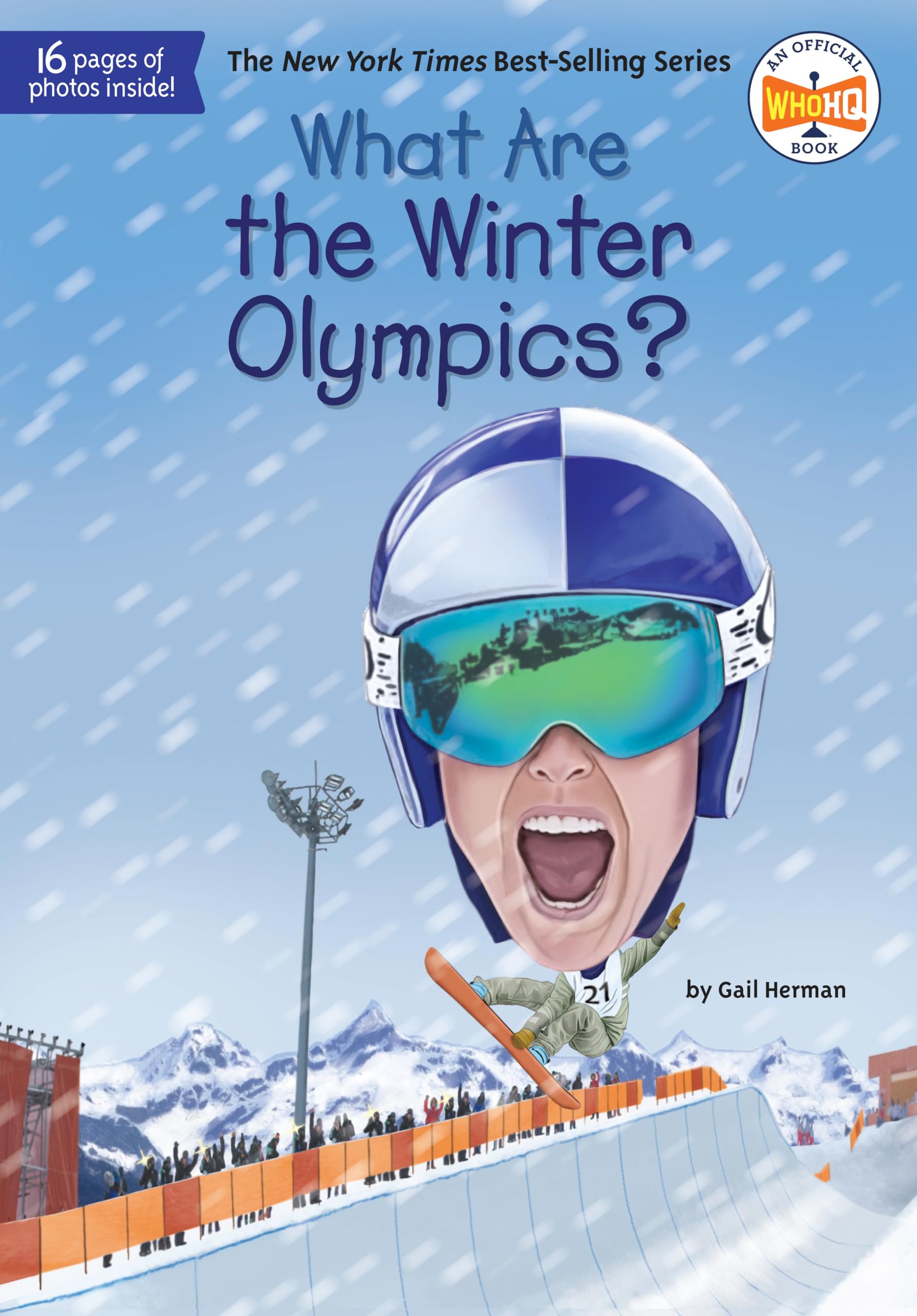
What Are the Winter Olympics? (What Was?)
$15.99
| Brand | Gail Herman |
| Merchant | Amazon |
| Category | Books |
| Availability | In Stock |
| SKU | 0593093771 |
| Color | Sky/Pale blue |
| Age Group | ADULT |
| Condition | NEW |
| Gender | UNISEX |
| Material | Cellulose-based or similar non-woven material |
| Google Product Category | Media > Books |
| Product Type | Books > Subjects > Children's Books > Sports & Outdoors > Olympics |
About this item
What Are the Winter Olympics? (What Was?)
Grab your skis, ice skates, and snowboard and learn how the Winter Olympic Games became a worldwide phenomenal event watched by millions. Although fans the world over have been fascinated by the modern Summer Olympics since 1896, the Winter Olympics didn't officially begin until 1924. The event celebrates cold-weather sports, displaying the talents of skiers, ice skaters, hockey players, and, most recently, snowboarding. Like its summer counterpart, the Winter Games are dedicated to bringing together the world's top athletes to honor their talents and see who gets to stand on the medal podium. Gail Herman covers it all in a wonderful read--the highs, such as the 1980 US hockey team's unexpected gold medal grab, as well as the lows, including the Tonya Harding-Nancy Kerrigan figure-skating scandal in 1994. Includes 80 black-and-white illustrations and a 16-page photo insert. Gail Herman has written several biographies and nonfiction books, including Who Is Wayne Gretzky? , What Is the World Series? , What Is Climate Change? , and What Is the Stanley Cup? What Are the Winter Olympics? It was the 2018 Winter Olympics, held in PyeongChang, South Korea. At Phoenix Snow Park, the American snowboarder Shaun White waited for his run. No one thought he’d win. White grew up by the beach in San Diego. He’d always loved skateboarding and decided he could use those skills for snowboarding—and snowboard tricks. He started practicing on family trips to the San Bernardino Mountains, “dropping” into icy half-pipes built into the slopes. On these U-shaped courses, athletes ride from side to side, flipping and twisting every time they fly into the air to turn around. Amazingly, White had previously won two gold medals, one in 2006 and the other in 2010. But the legendary snowboarder didn’t three-peat in 2014. In fact, he hadn’t medaled at all. Every day since, he’d lived with the disappointment. Now thirty-one years old, he stood at the top of the Olympic half-pipe once again. Snowboarders in a Winter Olympics contest do many runs. White was in second place, down to his final ride. To win, he’d need to perform a trick he’d never mastered in practice. It was the very trick, in fact, that had sent him to the hospital a year earlier for sixty-two stitches. “Shaun White,” the announcer proclaimed. “The biggest run of his life.” White adjusted his goggles and took off. He rode down the twenty-two-foot wall, then up the opposite one . . . up, up, and off the edge. He spun in the air four complete times. Then he landed back on the wall, only to do the same trick on the other side. Making his way down the pipe, White soared off the wall again—maybe twenty feet high—turning to land smoothly. He followed this trick with his famous double McTwist 1260. White flipped head over heels—two times!—during three and a half spins. It was the same move that had won him a gold medal eight years earlier. “Perfect!” the announcer cried excitedly. White’s final score came in at 97.75 out of 100, the highest of the day. He fell to his knees, crying. Shaun White had won his third gold medal. It was a milestone victory for the United States, too, its one hundredth gold medal in the history of the Winter Games. So much had changed since those first Games, when snowboarding was not even a sport. Chapter 1: The 1920s: Let the Winter Games Begin Inspired by the Summer Olympics, the Winter Olympics began in 1924. Both sprang from the same ideals—to bring together the world’s best athletes and encourage peace around the globe. The site of the first-ever winter competition was a resort town called Chamonix, in the French Alps. The outdoor opening ceremony began with a parade. There were 258 athletes, from sixteen countries. Only eleven were women. They were all figure skaters, as that was the only sport open to them. The athletes wore the cold-weather uniforms they’d compete in. Some carried skates, hockey sticks, or skis. They were raring to go. The first contest of the competition was a speed-skating race, the 500-meter. (That is about one-third of a mile around the rink.) American Charles Jewtraw from upstate New York hadn’t been interested in the Olympics at first. They didn’t seem like a big deal. In fact, he’d barely trained. Jewtraw thought he couldn’t possibly win. But he did, becoming the very first athlete to earn a Winter gold medal. Four years later, in 1928, Switzerland hosted the second Olympics. The site, St. Moritz, was another skiing resort town. Like so many Winter Games to come, weather played a major role. The 10,000-meter race—a speed-skating event—was a little over six miles around the oval. The Norwegian skaters were favorites to win. The rules in long track skating are the same today: Many racers compete in the event, two athletes skating at a time. In the end, whoever has the fastest time of all wins gold. An A
| Brand | Gail Herman |
| Merchant | Amazon |
| Category | Books |
| Availability | In Stock |
| SKU | 0593093771 |
| Color | Sky/Pale blue |
| Age Group | ADULT |
| Condition | NEW |
| Gender | UNISEX |
| Material | Cellulose-based or similar non-woven material |
| Google Product Category | Media > Books |
| Product Type | Books > Subjects > Children's Books > Sports & Outdoors > Olympics |
Similar Products








Compare with similar items

Leading with AI Intuition: Strategic Ins... |
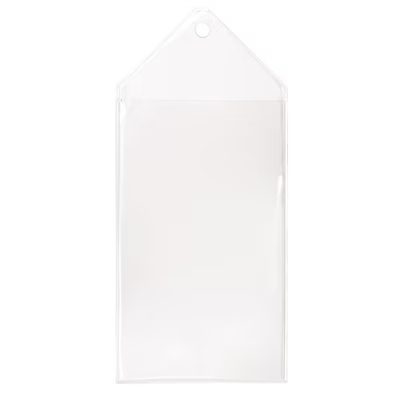
Heavy Duty Vinyl Hanging Price Tag or Bo... |

Lot Rent, Lunacy & Life Threats: And Why... |
Iconic Albums - The Beatles Sgt Peppers ... |
|
|---|---|---|---|---|
| Price | $39.00 | $44.10 | $14.99 | $17.05 |
| Brand | Rositsa Genovska | ClearBags | Jason Ramshaw | Richard Ward |
| Merchant | Amazon | clearbags | Amazon | Amazon |
| Availability | In Stock | In Stock | In Stock | In Stock |