
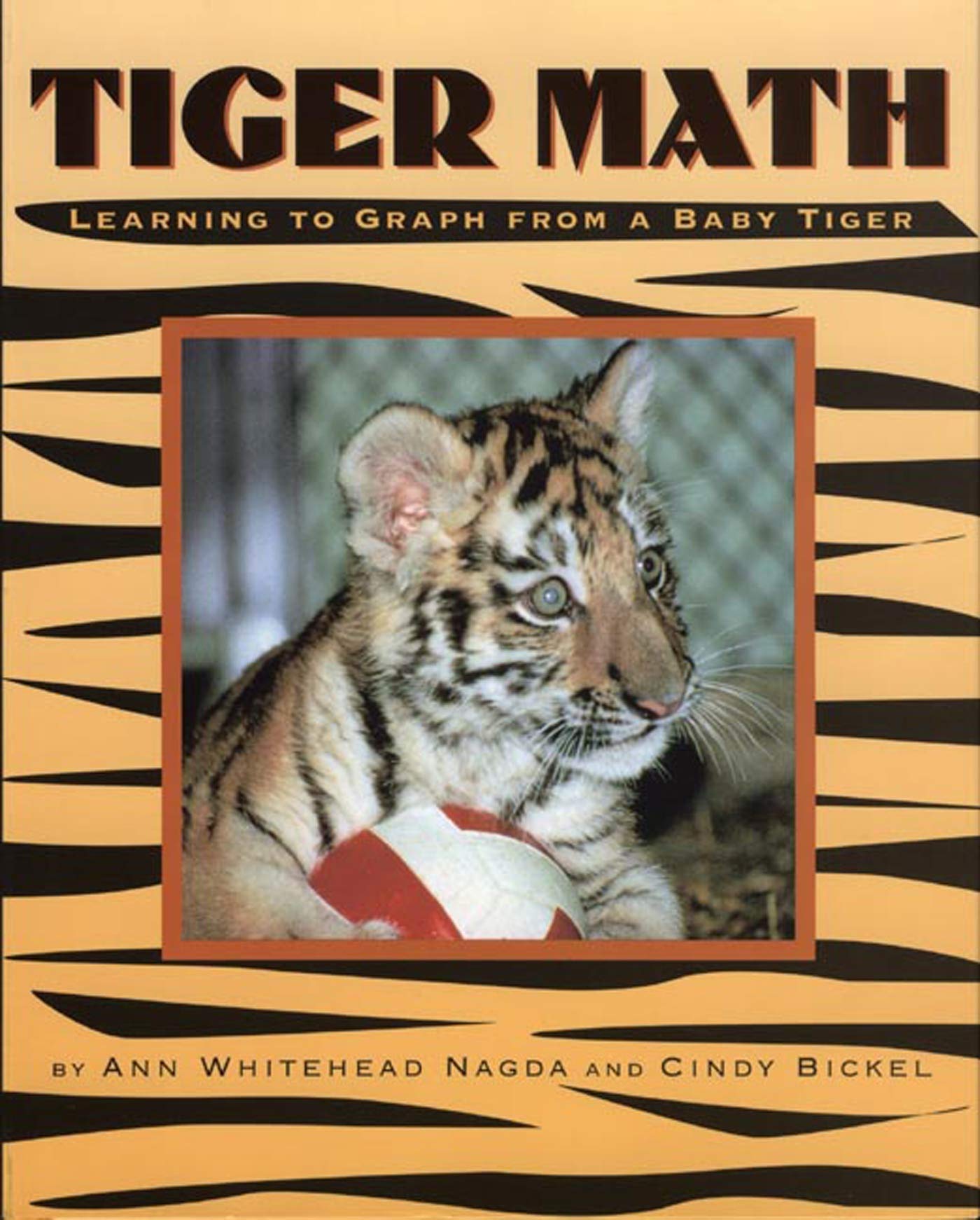
Tiger Math: Learning to Graph from a Baby Tiger
$9.99
| Brand | Ann Whitehead Nagda |
| Merchant | Amazon |
| Category | Books |
| Availability | In Stock Scarce |
| SKU | 080507161X |
| Age Group | ADULT |
| Condition | NEW |
| Gender | UNISEX |
| Google Product Category | Media > Books |
| Product Type | Books > Subjects > Science & Math > Mathematics > Applied > Graph Theory |
About this item
Tiger Math: Learning to Graph from a Baby Tiger
Children learn to graph as they follow the growth of an orphaned Siberian tiger cub. A Siberian tiger cub born at the Denver Zoo is orphaned when he is just a few weeks old. At first T. J. refuses to eat his new food, and it requires the full attention of the zoo staff to ensure that he grows into a huge, beautiful, and very healthy tiger. Through photographs, narrative, and graphs, young readers follow T.J. as he grows from a tiny newborn into a five-hundred-pound adult. A heartwarming story about one tiger's fight for survival that also introduces a basic math skill. “A delightful way to learn math.” ― Kirkus Reviews “An innovative approach to teaching math.” ― School Library Journal “Nagda has paved an inviting path to the skill of graph interpretation, and T.J.'s story will beckon even the math-reluctant to follow.” ― Bulletin of the Center for Children's Books Ann Whitehead Nagda is the author of math picture books about baby zoo animals, including Panda Math and Cheetah Math , as well as several other books about wildlife. She lives in Boulder, Colorado. Cindy Bickel has worked at the Denver Zoo for more than thirty years, where she has helped raise many baby animals, including the polar bears Klondike and Snow. She lives in Boulder, Colorado. Tiger Math Learning to Graph from a Baby Tiger By Ann Whitehead Nagda, Cindy Bickel Henry Holt and Company Copyright © 2000 Ann Whitehead Nagda All rights reserved. ISBN: 978-0-8050-7161-0 Contents Cover, Title Page, Copyright Notice, Dedication, Introduction, Tiger Math, Copyright, CHAPTER 1 Buhkra, the Siberian tiger, was going to have a baby. The keepers at the Denver Zoo had already placed a video camera in her den, so they could check on the mother tiger without disturbing her. When the cub was born, they watched Buhkra and her baby on a TV screen. Buhkra was a good mother, licking, nuzzling, and nursing her new baby. The cub, named T.J., weighed only three pounds and looked tiny next to his mother, who weighed 250 pounds. T.J.'s father, Matthew, was even bigger than Buhkra. He weighed 350 pounds. T.J. would have to gain a lot of weight to be as big as his father. Another way to show how many tigers are left in the wild is to use a circle graph. A circle graph, or pie chart, shows what part of a whole something is. The whole circle represents all the tigers left in the world. This graph makes it easy to see that there are a lot of Bengal tigers and very few South China tigers. There are so few South China tigers left that they couldn't be shown on the picture graph — they would have been just a small piece of a tiger picture. When T.J. was six weeks old, the zoo veterinarian gave him shots and weighed him. The cub weighed ten pounds. When T.J.'s father was six weeks old, he weighed fourteen pounds, four pounds more than T.J. Even so, the little tiger was healthy and strong. Sheila, the tiger keeper, had trouble holding him still while the vet examined him. The feisty little cub never stopped wriggling until Sheila brought him back to his mother. A picture graph can be used to show T.J.'s weight. This is a picture graph like the one here. On this graph, blocks are used instead of pictures of tigers. Each block is equal to one pound. Each column shows T.J.'s weight at a particular age. Every day when Sheila came to the zoo, the first thing she did was check on the tigers. Buhkra, protecting her cub, always snarled, spit, and bared her teeth at Sheila. T.J. snarled just like his mother. One morning, Buhkra didn't snarl at Sheila. The mother tiger lay on her side, completely still. T.J. was mewing and pushing his mother and trying to nurse, but Buhkra didn't move. Without any warning, she had died. The zoo veterinarian examined Buhkra and discovered she'd died from cancer. Now who would raise this special baby? Most of the time, mother tigers take care of their cubs alone. Matthew couldn't take care of his son — he didn't know how. Another way to graph T.J.'s weight is with a bar graph. This bar graph of T.J.'s weight looks a lot like the picture graph. Each colored square equals one pound, just like the blocks in the picture graph. To read the bar graph, choose an age from the numbers along the bottom. Then follow the colored bar up until it stops at a line. Follow that line to the left to find out how much T.J. weighed at the age you have chosen. Sheila took T.J. to be raised by the staff at the animal hospital. The vet was worried when he examined the cub. T.J. was not as big as he should have been. The cub was ten weeks old and he weighed only thirteen pounds. Because Buhkra had been sick, she hadn't been able to feed her cub enough. Cindy, a veterinary assistant at the hospital, put T.J. in a cage and gave him a bowl of ground meat mixed with milk. Ignoring the food, T.J. walked to a corner of the cage, curled into a ball, and didn't move for hours. The next day he was still curled up in the same spot. He
| Brand | Ann Whitehead Nagda |
| Merchant | Amazon |
| Category | Books |
| Availability | In Stock Scarce |
| SKU | 080507161X |
| Age Group | ADULT |
| Condition | NEW |
| Gender | UNISEX |
| Google Product Category | Media > Books |
| Product Type | Books > Subjects > Science & Math > Mathematics > Applied > Graph Theory |
Similar Products






Compare with similar items

Why Should I Go to Mass?: The Basics... |

Selected Poetry (Oxford World's Classics... |

Waves of Destiny (Loving You Series)... |

Thankful Treats - Cute Bold & Easy Color... |
|
|---|---|---|---|---|
| Price | $3.99 | $11.95 | $11.99 | $8.99 |
| Brand | Deacon Conrad Wojnar | Thomas Hardy | Marcelina Nóbrega Courtney | Sui Sui |
| Merchant | Amazon | Amazon | Amazon | Amazon |
| Availability | In Stock | In Stock Scarce | In Stock | In Stock |


![FM 1‑0 Human Resources Support: [Annotated] The Definitive U.S. Army Doctrine for Human Resources Strategy, Personnel Readiness & Command Support](https://m.media-amazon.com/images/I/71SEB9uR2CL.jpg)