
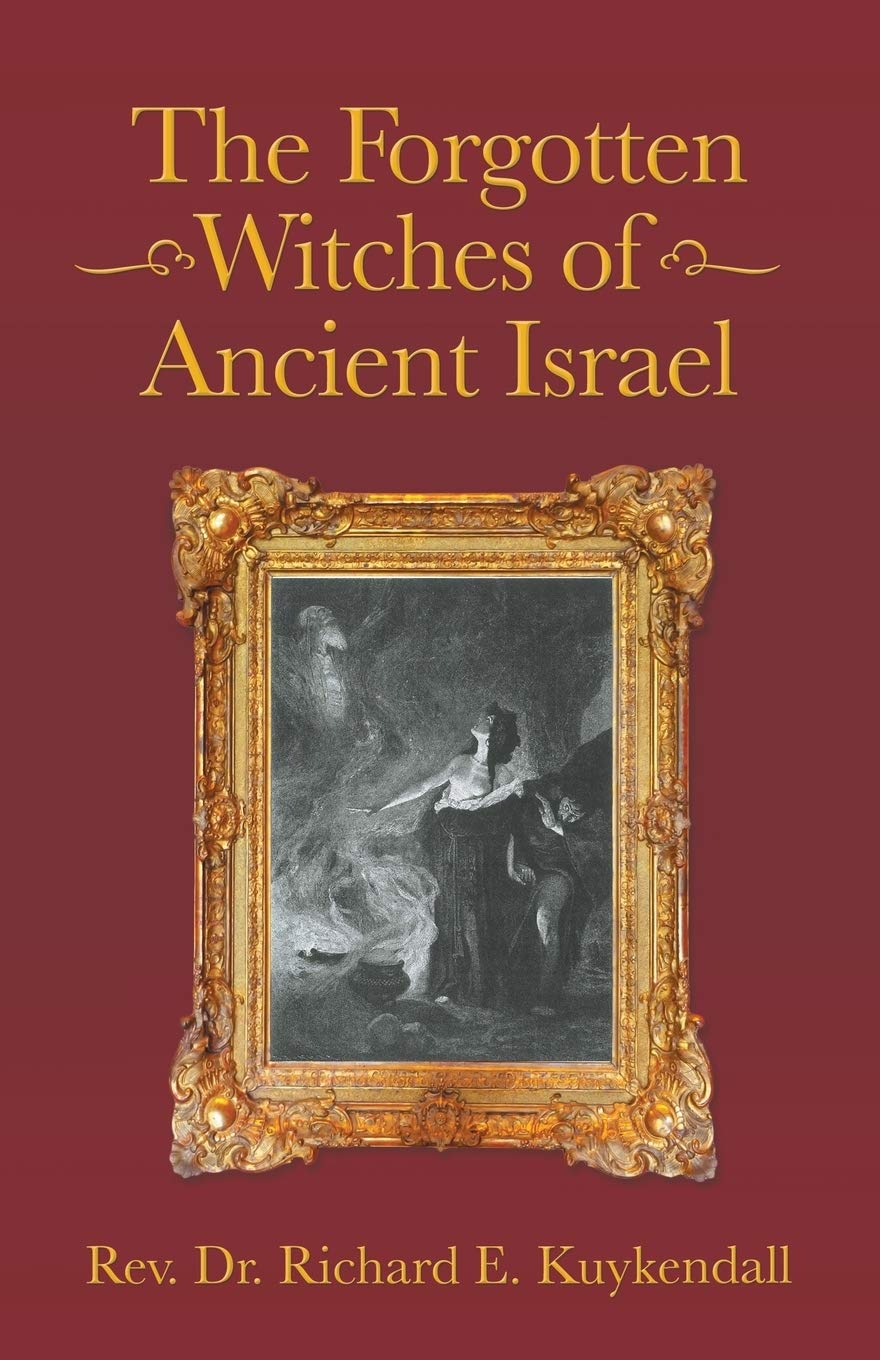
The Forgotten Witches of Ancient Israel
$13.99
| Brand | Richard E. Kuykendall |
| Merchant | Amazon |
| Category | Books |
| Availability | In Stock |
| SKU | 1490788301 |
| Age Group | ADULT |
| Condition | NEW |
| Gender | UNISEX |
About this item
The Forgotten Witches of Ancient Israel
The Forgotten Witches of Ancient Israel asks the question: Who were the witches in biblical times, and what did they do that was so horrible that Exodus 22:18 would give the commandment Thou shalt not allow a witch to live? These are the words that fueled the fires of the Burning Times, when witches were burned throughout Europe for a number of centuries. In this book, we will not only explore the Bible for answers of who they were and what they did, but we will also consider the Burning Times, as well as what modern witchcraft is today, for that we can truly know. Richard E. Kuykendall holds a Bachelors degree in Religious Studies, a Masters degree in Philosophy and World Relgions and a Doctoral degree in Spirituality. He founded Spiritiwnd: A Study Group for Spiritual Adventurers in 1990, where he leads those who attend into the exotic realms of the Spirit. Kuykendall is also the author of several other books, four of which are Prophetess of the Earth, Even Witches Have Names, A Curmudgeons Commentary on the Book of Revelation, If You Really Knew the God of the Bible You Wouldnt Like Him and more. The Forgotten Witches of Ancient Israel By Richard E. Kuykendall Trafford Publishing Copyright © 2018 Rev. Dr. Richard E. Reich All rights reserved. ISBN: 978-1-4907-8830-2 Contents Forword, xi, Acknowledgements, xvii, Introduction, xxiii, The Words "Witch" And "Witchcraft" In The Various Translations And Versions Of The Bible, 1, "In The Beginning", 9, What Were They Up To Back Then?, 17, The Jewish Priesthood And Witchcraft, 33, Satan And His Minions, 53, The Burning Times, 69, Modern Expressions Of Witchcraft, 77, Postscript, 87, Bibliography, 93, Endnotes, 99, CHAPTER 1 The Words "Witch" And "Witchcraft" In The Various Translations And Versions Of The Bible HERE IS THE first problem we come to. When the King James Bible was published in 1611 they used the words "witch" and "witchcraft" because they were printed during "The Burning Times." They took the Bible to be literal as well as the threat of witches and they felt that they were commanded by God "Himself" to kill them. The New Revised Standard Version of the Bible however does not use the words "witch" or "witchcraft" at all. Instead, it uses "a female sorcerer," "sorcery" and "sorceries." And the majority of all other modern translations or versions do not use the words "witch" or "witchcraft" either. And while the majority of all modern translations or versions have abandoned the use of the words "witch" and "witchcraft" a few modern versions have followed the lead of the King James Version or as it is often referred to as "The Authorized Version." Why has there been this change? Have the biblical translators delved deep into the history of witchcraft and determined that this was not what was being done in ancient Israel? Or in view of the horrors of the Burning Times are they trying to make amends by not using those words? Bruce M. Metzger in "To The Reader" tries to explain the reasons for many of the changes from the King James Version to the New Revised Standard Version. Let us now examine the words in the Hebrew and Greek that are translated "witch" or "witchcraft" in the King James Version as compared with how they are translated in the New Revised Standard Version. First there is the word "kasap" as found in Exodus 22:18 where we read in the King James Version, "Thou shalt not suffer a witch to live." In the New Revised Standard Version it translates this verse as "You shall not permit a female sorcerer to live." Bad news for the woman regardless of whether you call her a witch or a sorcerer — and we will never know the difference. The word "kasap" is also found in Deuteronomy 18:10 where the King James Version reads, "There shall not be found among you any one that makes his son or his daughter to pass through the fire, or that uses divination, or an observer of times, or an enchanter, or a witch. " While the New Revised Standard Version translates it like this: "No one shall be found among you who makes a son or daughter pass through fire, or who practices divination, or is a soothsayer, or an augur, or a sorcerer." Of course witches today would be totally against child sacrifice — something that God tested Abraham to do with his son Isaac and something that the so-called witches of the Burning Times were accused of. But what is the problem with divination or "observing times" and still what does a sorcerer do? And now for the last example of how "kasap" is translated. In 2 Chronicles 33:6 this is being said of King Manasseh of Judah: "And he caused his children to pass through the fire in the valley of the son of Hinnom: also he observed times, and used enchantments, and used witchcraft and dealt with a familiar spirit, and with wizards; he wrought much evil in the sight of the LORD, to provoke him to anger." Then when we look at the New Revised Standard Version we read that he "used sorcery"
| Brand | Richard E. Kuykendall |
| Merchant | Amazon |
| Category | Books |
| Availability | In Stock |
| SKU | 1490788301 |
| Age Group | ADULT |
| Condition | NEW |
| Gender | UNISEX |
Similar Products








Compare with similar items

Guide de l'enseignant certifié Ocean Lov... |

Self - Love Journal and Planner... |

Mom, Dad, Me, and Classic TV - Growing U... |

The Sandhill Crane Adventures: Journey o... |
|
|---|---|---|---|---|
| Price | $10.83 | $29.99 | $38.00 | $11.95 |
| Brand | Genevieve Young | Victrisa K Green | Peter K. Ackerman | Cindy Hadley |
| Merchant | Amazon | Amazon | Amazon | Amazon |
| Availability | In Stock | In Stock | In Stock | In Stock |