
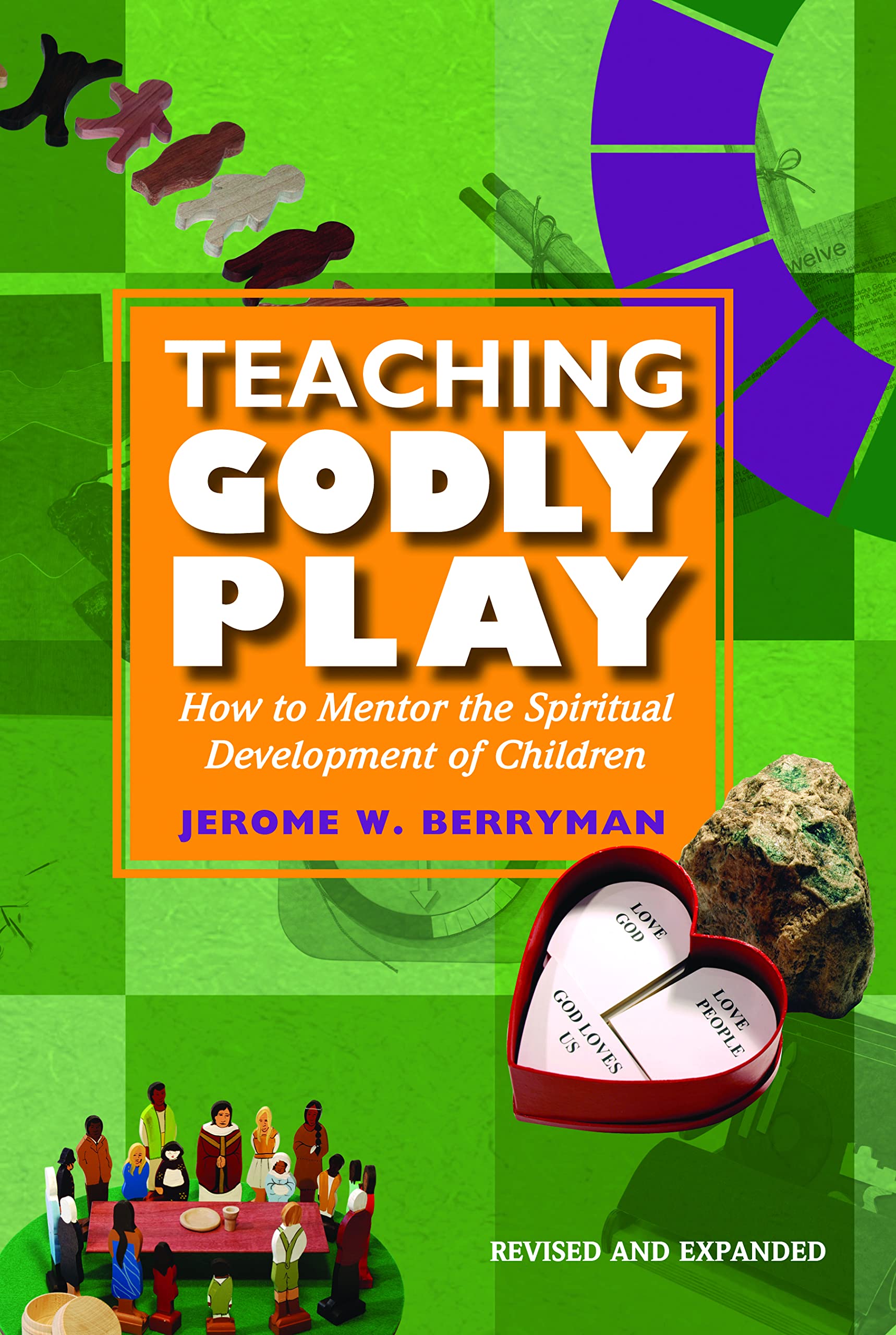
Teaching Godly Play: How to Mentor the Spiritual Development of Children
$17.46
| Brand | Jerome W. Berryman |
| Merchant | Amazon |
| Category | Books |
| Availability | In Stock Scarce |
| SKU | 1606740482 |
| Age Group | ADULT |
| Condition | NEW |
| Gender | UNISEX |
| Google Product Category | Media > Books |
| Product Type | Books > Subjects > Religion & Spirituality > Christian Books & Bibles > Education > Children & Teens |
About this item
Teaching Godly Play: How to Mentor the Spiritual Development of Children
An internationally recognized Christian formation program. This revised and expanded version has been redesigned to complement the eight volumes in The Complete Guide to Godly Play series. Illustrations have also been updated, and the text now better reflects the playful spirit of Godly Play. Up-to-date research in childhood development and instruction has also been incorporated in this comprehensive volume. "Jerome Berryman's work helps children internalize the Christian tradition, and then offers them the opportunity to use that tradition in their daily living." ― Rev. Jim Carr, Methodist Minister, San Antonio "Jerome Berryman's work helps children internalize the Christian tradition, and then offers them the opportunity to use that tradition in their daily living." ― Rev. Jim Carr, Methodist Minister, San Antonio The late Jerome W. Berryman was the founder of Godly Play and had years of experience working with children ages 2–18. Priest, writer, lecturer, and workshop leader, Berryman was, for years, Senior Fellow of the Center for the Theology of Childhood. He was the author of The Complete Guide to Godly Play, Teaching Godly Play, Children and the Theologians, The Spiritual Guidance of Children, and Stories of God at Home. Teaching Godly Play How to Mentor the Spiritual Development of Children By Jerome W. Berryman, Brian C. Dumm, Leslie Dunlap Church Publishing Copyright © 2009 Morehouse Education Resources All rights reserved. ISBN: 978-1-60674-048-4 Contents Dedication: Celebrating Thea (1941 - 2009)Chapter 1: Why Play?Chapter 2: ThresholdsChapter 3: The CircleChapter 4: ResponsesChapter 5: The FeastChapter 6: LeavingChapter 7: How do You Know Godly Play When You See it?Chapter 8: How to Grow as a Godly Play Teacher: Staying Close to ChildrenAppendixA Brief History of Godly Play's foundational research.The Creative Process and the Personality Preferences that Can Block Its FlowA Glossary of Godly Play "Jargon"References CHAPTER 1 WHY PLAY? This book invites you to come and play . Why? Well for one thing, it's fun! Thepleasure of play is one of the big reasons we mammals have continued to playover the millennia. This self-reinforcing quality is only one of play'smystifying and delightful characteristics. We also play for the experience ofplay itself rather than any product the action might produce. During play thereis also deep concentration. Sometimes the action appears to speed up so timepasses quickly. Other times it slows down so movements appear to be in slowmotion when compared to ordinary time. It is also voluntary. You can't make people play. Play contributes to creativity, the learning of languages andpreparing for social roles. It seems to be everywhere because it can't beconfined to one kind of activity. Anything that can be done—even one's work—canbe done in a playful way. Everyone knows what play is when they do it, but no one knows exactly how to putwhat they do into words. Perhaps the biggest reason for this is that play issignaled nonverbally. When people say, "Let's play," they may not mean it, butthe signal—a twinkle in the eye, a shrug of the shoulders, a grin or some otheraction— shows what is intended and can't be faked. What follows after the "playsignal" becomes set aside in a different framework than the everyday world andtherefore has a kind of "as-if" quality to it. For example when dogs are playfighting they know not to bite all the way down and that the "fight" can bebroken off at any time with both parties wagging their tails. In this sense playis considered by some to not be real. On the other hand, there is somethingabout play that is more real than ordinary experience. It helps us work out newsolutions to old problems and become re-created—which is very real. Books about play are seldom playful. When I re-read the first edition of thisbook after about thirteen years I was surprised how dry it was. What Iremembered was not what had been written, but the fifteen years of fun it wasbased on. The classes with children and the workshops with adults were full oflaughter and playful give-and-take. Only a little of that got transferred to thewritten page. Still, this book is intended to be as light-hearted as it isserious. The way it all began still makes me laugh out loud after almost fiftyyears! HOW THIS BOOK BEGAN In 1960 I was in my middle year at Princeton Theological Seminary. Something wasmissing in my theological training. What was it? Slowly I began to realize thatchildren played no part in our theological studies. Hadn't Jesus said that weneed to welcome children to know God and that we need to become like them toenter the Kingdom? My own childhood had included experiences of God's presence,which set me on the path to Princeton. How could children be left out after Igot there? This vague sense of something missing snapped sharply into focus when it wastime to take the required religious education class. At last, chi
| Brand | Jerome W. Berryman |
| Merchant | Amazon |
| Category | Books |
| Availability | In Stock Scarce |
| SKU | 1606740482 |
| Age Group | ADULT |
| Condition | NEW |
| Gender | UNISEX |
| Google Product Category | Media > Books |
| Product Type | Books > Subjects > Religion & Spirituality > Christian Books & Bibles > Education > Children & Teens |
Similar Products






Compare with similar items

Time to Shine: A Daily Journal... |

Exploring Civics and Economics, Student ... |

VHS Tape Notebook | Fun Retro Journal: M... |

Linux for Beginners: Master Linux from S... |
|
|---|---|---|---|---|
| Price | $15.00 | $77.53 | $7.77 | $16.99 |
| Brand | Tara Williams | McGraw Hill | J. James | Logan Barrell |
| Merchant | Amazon | Amazon | Amazon | Amazon |
| Availability | In Stock | In Stock Scarce | In Stock | In Stock |