
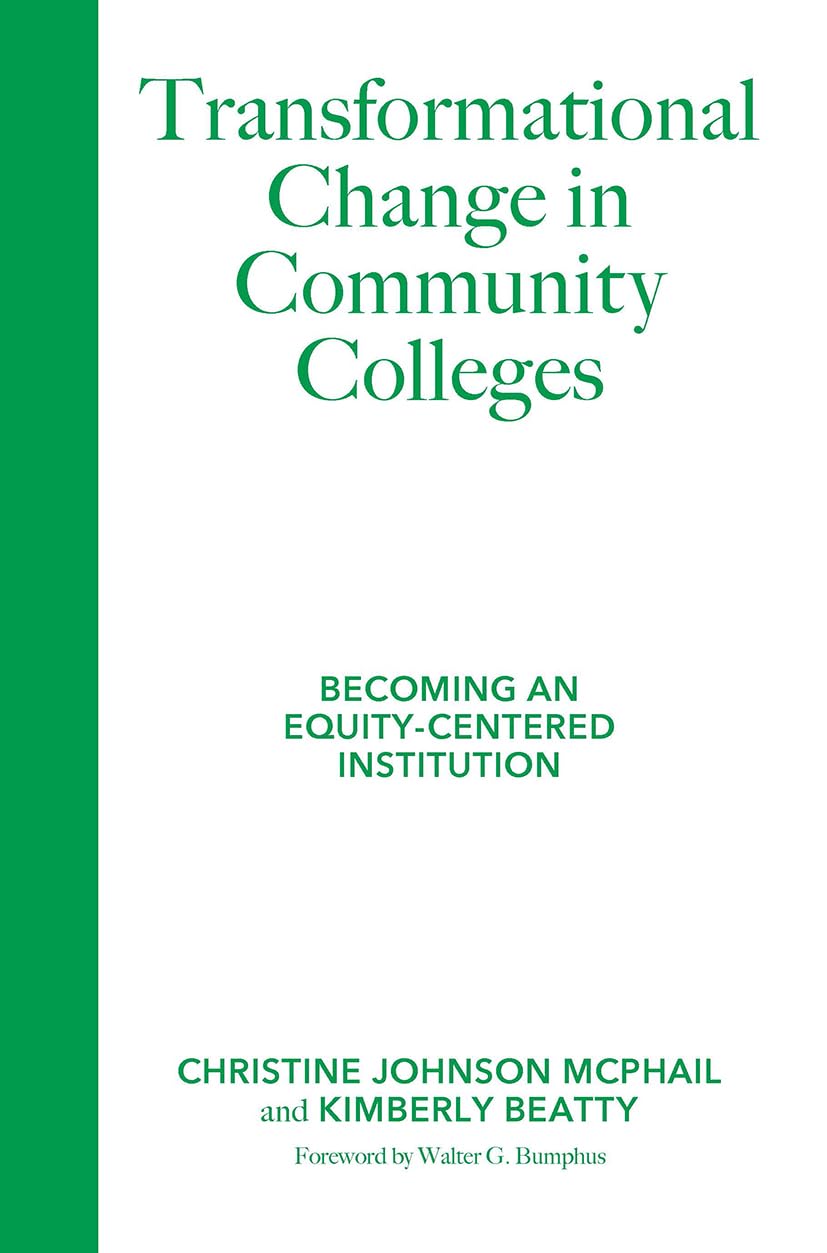
Transformational Change in Community Colleges: Becoming an Equity-Centered Institution
$170.00
| Brand | Christine Johnson McPhail |
| Merchant | Amazon |
| Category | Books |
| Availability | In Stock |
| SKU | 1620369664 |
| Age Group | ADULT |
| Condition | NEW |
| Gender | UNISEX |
About this item
Transformational Change in Community Colleges: Becoming an Equity-Centered Institution
From the foreword by Walter G. Bumphus, President & CEO of AACC: “Becoming an Equity-Centered Higher Education Institution is a significant contribution to the on-going struggle to find practical approaches to implementing an equity agenda in higher education.” The authors had three main goals for this text: Relevance: This book is the result of many years of teaching, leading, researching, and coaching individuals and institutions about equity inside higher education. The authors place a clear emphasis on awareness and teaching skills first, but also ensure that those skills are based on practical application in the field. Practical Application: To describe and explain equity and transformational change concepts, this book provides step-by-step implementation approaches that can be used to integrate equity-centered principles into practices and policies to implement or improve equity work into the organizational culture. A Purposeful Approach: The authors defined the act of becoming an equity-centered institution in terms of a transformational change approach using Kotter’s Eight-Stage Process. Kotter’s Model and AACC’s Leadership Competencies for Community College Leaders are introduced in Chapter 1 and integrated throughout the book. This integrated framework allows practitioners to place the intersectionality of equity, transformational change, and requisite leadership competencies into the larger context of higher education. While using Kotter’s 8-Step Change Model, the authors emphasize that operations and situations inside higher educational institutions are not linear as implied in Kotter’s model. They show how the stages of change may occur at different times and different situations at different institutions, and demonstrate what leadership competencies are recommended for each stage in the change process. "The pursuit of equitable outcomes at community colleges is no longer optional. As community college personnel become more and more adept at collecting, storing, analyzing, disaggregating, interpreting, and acting on data, equity gaps come into focus and require concerted attention. While no longer optional, identifying, addressing, and redressing equity gaps is no easy task for today’s community college leaders. Thankfully, McPhail and Beatty’s (2021) book, Transformational Change in Community Colleges: Becoming an Equity-Centered Institution, provides readers with a steady guide through the process of bringing equity into the core of the institution’s culture. New and seasoned community college leaders alike will find familiarity within the book’s introduction, as the authors leverage the works of Estella Bensimon (2005), John Kotter (1996), and the American Association of Community Colleges (AACC) (2018) to frame the text. Bensimon’s work on equity and equity-mindedness is used to establish working definitions. Kotter’s change model is used to map out the steps toward becoming equity-centered. And, finally, the AACC leadership competencies are used to show how individual competencies can be deployed in service of Kotter’s eight steps. McPhail and Beatty―both with rich experience as community college CEOs―interweave Kotter’s eight-step change model and the AACC competencies together to create a vehicle for moving equity to the institutional core. Chapter 1 includes an overview of the text and lays down the theoretical foundation. An “Equity-Centered Transformational Change Framework” is presented visually on page 10, and its eight steps are the focal points of chapters 2 through 9. Early on, the authors argue that equity is taken as a fundamental characteristic of value within (public) higher education. Yet they note the pursuit of equitable outcomes―even coupled with a strong presence of equity-mindedness―does not mean any given institution is equity-centered. Moving equity to the institution’s center is the overarching purpose of the framework they explicate in the next eight chapters. To be sure, we enjoyed and appreciated this text. This book is practical and immediately useful. It is a must-read for current and aspirant community college leaders. The book could be used within graduate courses, as part of a grow-your-own leadership program, and by any community college leader charged with spearheading an EOT (not an exhaustive list). McPhail and Beatty have added a critical equity-focused text to the community college leadership canon. Their insights and experience make this book shine with relevance and applicability." Teachers College Record "The pursuit of equitable outcomes at community colleges is no longer optional. As community college personnel become more and more adept at collecting, storing, analyzing, disaggregating, interpreting, and acting on data, equity gaps come into focus and require concerted attention. While no longer optional, identifying, addressing, and redressing equity gaps is no easy task for today’s community college leaders. Thankfully, McPhail and Beatty’s (2
| Brand | Christine Johnson McPhail |
| Merchant | Amazon |
| Category | Books |
| Availability | In Stock |
| SKU | 1620369664 |
| Age Group | ADULT |
| Condition | NEW |
| Gender | UNISEX |
Similar Products

![Encyclopedia of Decoding DNA Sequence.: A Definitive Guide (Thoughts to Word or Audio [Brain Code])](https://m.media-amazon.com/images/I/71ujCvo4F6L.jpg)








Compare with similar items

The Psalms of David: Imitated in the Lan... |

When the Rose Briar Blooms... |

How to Solve a Rubik’s Cube for Kids: Th... |

M is for Molly: A Personalized Children'... |
|
|---|---|---|---|---|
| Price | $21.99 | $12.99 | $11.99 | $14.99 |
| Brand | Isaac Watts | Kerry Crisley | Gabriel Nedelcu | R.S.M Publishing |
| Merchant | Amazon | Amazon | Amazon | Amazon |
| Availability | In Stock | In Stock | In Stock | In Stock |