
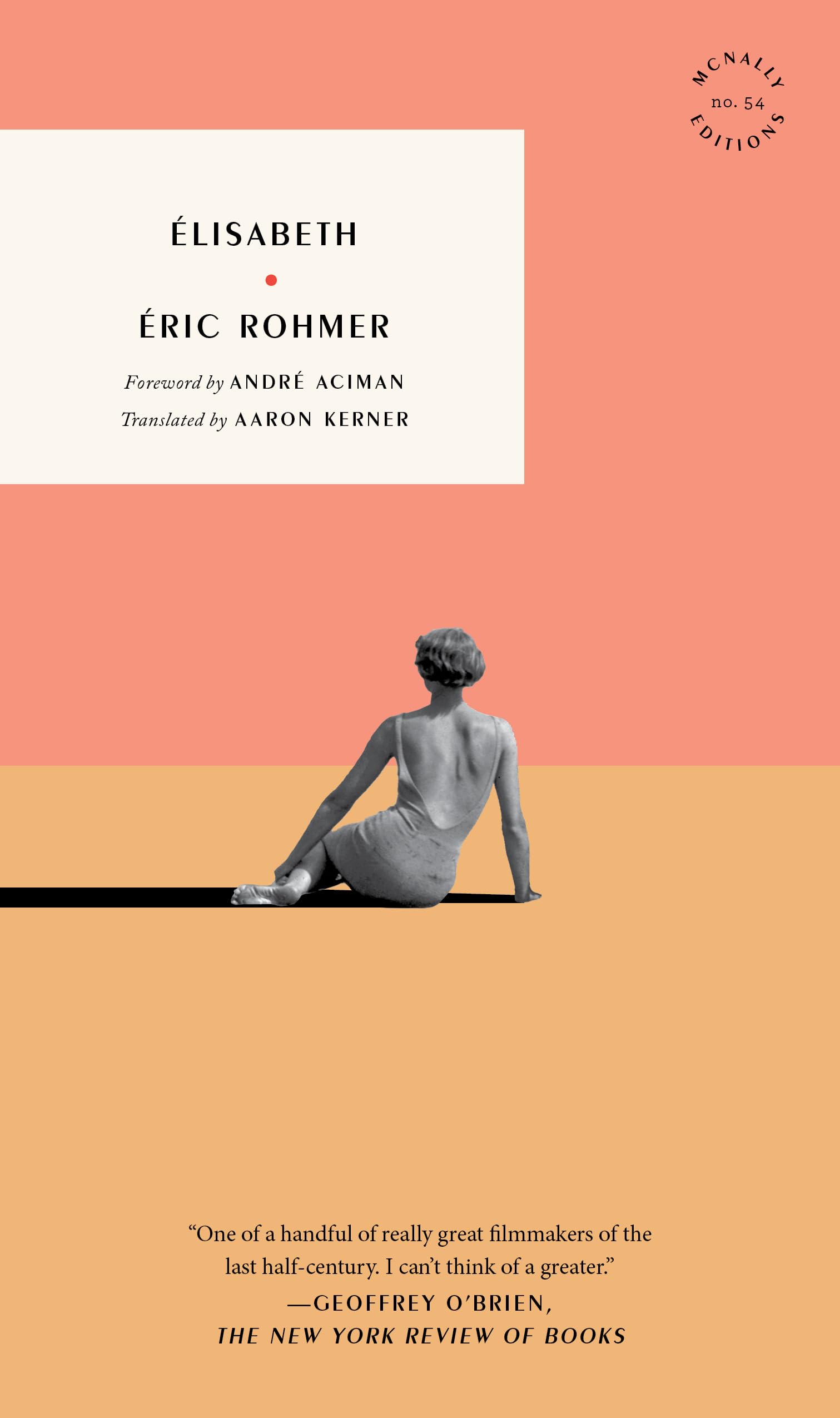
Élisabeth
$19.00
| Brand | Eric Rohmer |
| Merchant | Amazon |
| Category | Books |
| Availability | Preorder |
| SKU | 1968671005 |
| Age Group | ADULT |
| Condition | NEW |
| Gender | UNISEX |
| Google Product Category | Media > Books |
| Product Type | Books > Subjects > Literature & Fiction > Genre Fiction > Historical > 20th Century > World War II & Holocaust |
About this item
Élisabeth
Witty banter, lust, ennui, and an undercurrent of violence percolate beneath a seemingly paradisiacal summer on the eve of World War II, in this landmark translation of the first and only novel by Éric Rohmer, the French New Wave’s most prolific and beloved filmmaker. Fifteen years before completing his first feature film—and ten before beginning a transformative editorial stint at Cahiers du cinéma that would usher the journal, and French cinema, into a new era—the man who would become known worldwide as Éric Rohmer published a single novel. Released by Éditions Gallimard alongside the early works of Claude Simon and Marguérite Duras, Élisabeth was part of the first flowering of what would come to be known as the nouveau roman —and was also the “matrix,” as Rohmer himself later put it, of the images, ideas, and formal concerns of his first sequence of films, Six Moral Tales . Set in the sunstruck countryside east of Paris during the summer of 1939, a year ahead of the German invasion, where the upper-middle-class Roby family and its eponymous matriarch are spending a listless summer, Élisabeth is a war-novel awaiting a war. While the teenage Roby children and their friends swim, flirt, and lie to one another among the baking fields and icy meanders of the Marne, the novel becomes the scene of an anticipatory haunting. The simmering paranoia, calculated blankness, and potential violence of the coming Occupation are already present—as it were, in mufti. With a cool, kaleidoscopic eye, Rohmer lays out his protagonists and their precarious peace—their restlessness, their desperate boredom, their petty romantic agonies—with the unsettling chilliness and the sinister exactitude of details on a tactical map. “My heroes, a little like Don Quixote, take themselves for characters in a novel, but perhaps there is no novel.” —Éric Rohmer “Rohmer was one of a handful of really great filmmakers of the last half-century. I can’t think of a greater.” —Geoffrey O’Brien, The New York Review of Books “Rohmer, as critic, editor, and friend, through his writings, activities, and personal influence, was the father of the French New Wave . . . In his youth, he had little interest in movies at all, but he was a gifted student and was good at philosophy, literature, drawing, music, and theatre . . . He had already started sketching Élisabeth at age nineteen . . . Rohmer’s surfaces aren’t placid but taut; they’re smooth because of their almost unbearably high tension, and their tautness is like that of a membrane that could, with a prick, be definitively burst, giving way to an unpredictably chaotic eruption of pent-up passion.” —Richard Brody, The New Yorker “Rohmer-world [is] an enchanted and yet peculiarly unsentimental place in which both words and actions, minds and bodies, matter absolutely . . . A Rohmer movie doesn’t clobber you with its smarts; it generously furnishes you a space in which to think for yourself . . . To find other artists besides Rohmer who can see this deeply into a character’s humanity and make us love him anyway—that is to say, who can ironize with this degree of gentleness—you have to reach up to a pretty high shelf: Shakespeare? Tolstoy?” —Dana Stevens, Slate “As in so many of Rohmer’s films, his characters are young and on holiday, free to enjoy the beach or the countryside . . . It’s a world where ‘everything just devolves into flirtation.’ That the Second World War is merely a month away is the furthest thing from their thoughts . . . Rohmer is still very young . . . but these highly discerning insights into conflicting emotions and human psychology will end up appearing in all of his films . . . Rohmer’s people can be embarrassingly intimate. Yet, despite their embarrassment, they retain a touch of eloquence in their speech that leaves them highly formal and at the same time highly vulnerable. In that sense, formality does not vitiate desire; it forces it to spell itself out. It’s also how intimacy turns into art.” —André Aciman, from the Foreword “Rohmer’s novel evokes suffocating human and natural atmospheres, shifting between interiors—a cramped apartment; a dentist’s office; the inside of a car–and sun-scorched backyards and village streets. It then releases the tension in a torrential summer storm, which is made immediate in finely etched details . . . Paradoxically, his novel is a marvel of cinematic showing, a closely observed engagement with nature and ordinary life.” —Trevor Cribben Merrill, The University Bookman “The elder statesman of the Nouvelle Vague, born a decade before Truffaut and Godard, Rohmer also served as the New Wave’s sage, resisting aesthetic and political fashion to maintain his chastely ironic vision of amorous folly . . . Rohmer’s films feel miraculously fresh, contemporary, lightly sprung.) His characters search for happiness, truth, self-knowledge, but mostly they seek love, and for all the cool classicism of Rohmer’s mise-en-scène, they
| Brand | Eric Rohmer |
| Merchant | Amazon |
| Category | Books |
| Availability | Preorder |
| SKU | 1968671005 |
| Age Group | ADULT |
| Condition | NEW |
| Gender | UNISEX |
| Google Product Category | Media > Books |
| Product Type | Books > Subjects > Literature & Fiction > Genre Fiction > Historical > 20th Century > World War II & Holocaust |
Similar Products






Compare with similar items

Collins Scotland Film and TV Location Ma... |

Davidoff Nicaragua... |

Ask the Animals: Spiritual Wisdom from A... |

Condensed Matter Physics: A Very Short I... |
|
|---|---|---|---|---|
| Price | $6.99 | $230.40 | $19.95 | $12.99 |
| Brand | Collins | Davidoff | Elizabeth Canham | Ross H. McKenzie |
| Merchant | Amazon | Cigora | Amazon | Amazon |
| Availability | Unknown Availability | In Stock | In Stock Scarce | In Stock Scarce |