
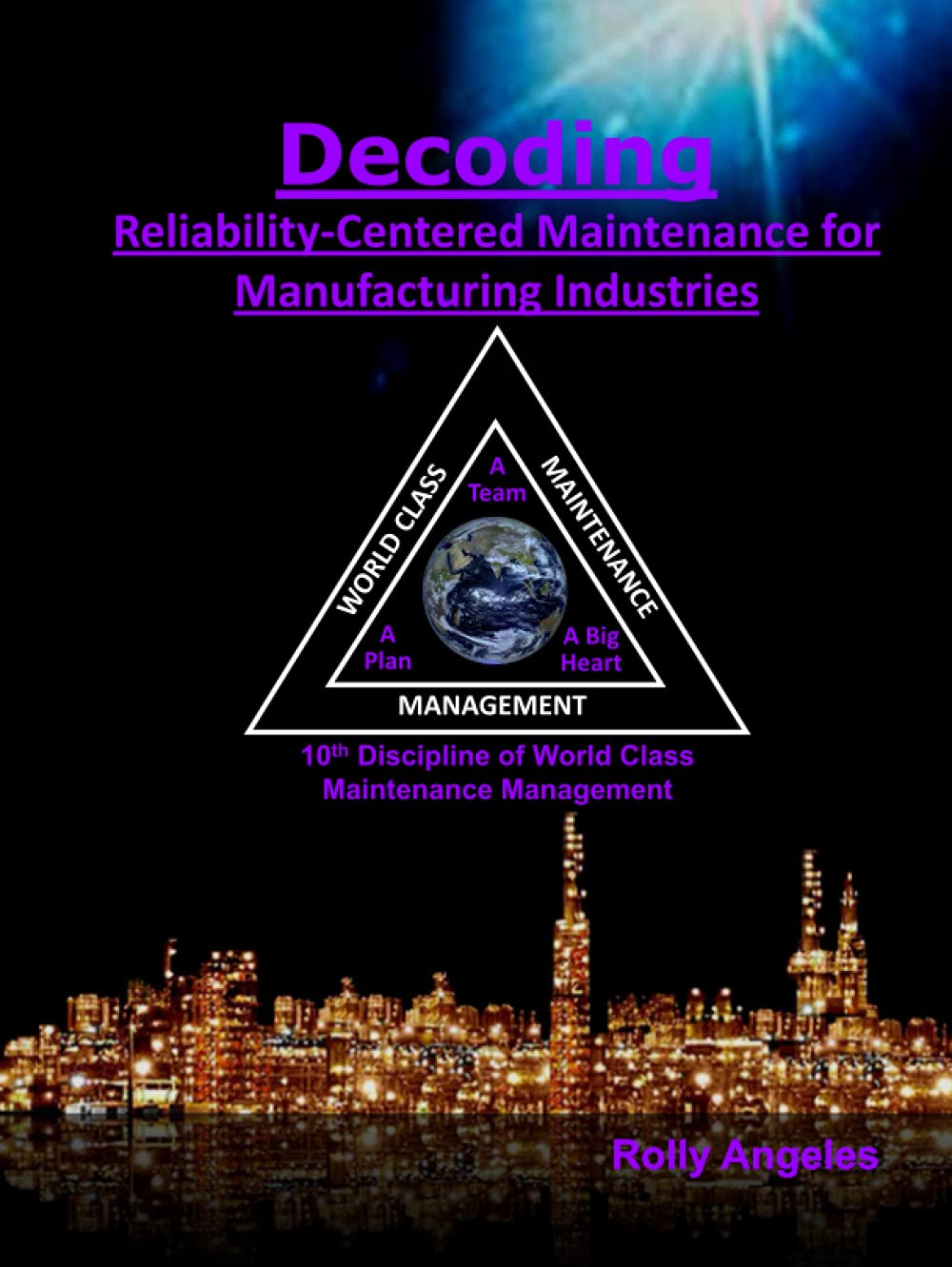
Decoding Reliability-Centered Maintenance Process for Manufacturing Industries: 10th Discipline of World Class Maintenance Management – The 12
$75.99
| Brand | Rolly Angeles |
| Merchant | Amazon |
| Category | Books |
| Availability | In Stock |
| SKU | B093RS7KY3 |
| Age Group | ADULT |
| Condition | NEW |
| Gender | UNISEX |
| Google Product Category | Media > Books |
| Product Type | Books > Subjects > Engineering & Transportation > Engineering > Industrial, Manufacturing & Operational Systems > Manufacturing |
About this item
Decoding Reliability-Centered Maintenance Process for Manufacturing Industries: 10th Discipline of World Class Maintenance Management – The 12
Although RCM is a popular maintenance strategy, many manufacturing industries are still not implementing this process and continue to remain stuck in their current PM tasks. The main reason for writing this book is that doing RCM in a manufacturing plant is a bit different from doing RCM in oil and gas, power plants, and other similar plants because their equipment losses are different. There are many cases when breakdowns and failures are not the primary cause of equipment downtime. Although the process of how RCM is done will be the same. If you worked in a semiconductor plant, breakdowns and failures are not the main problems on the machines, but minor stoppages, changeover, and quality problems are. What is important is to know thy boundaries between what RCM can address and what it cannot. RCM will address failures and breakdowns by proposing maintenance tasks. RCM is not designed to address every possible equipment loss since failures and breakdowns are just a subset of the entire equipment loss. Suppose you have chronic quality problems caused by the equipment, RCM can address some of them, but not all, since Quality problems and defects are much broader than breakdowns and failures. I have a detailed explanation of what particular losses RCM can and cannot address in Chapter 3.3.2 of this book. This book is written to help provide detailed guidelines in implementing RCM for manufacturing industries on their machines, equipment, and assets. Some of the highlights of this book include: - 27 Frequently Asked Questions (FAQ) on RCM - 22 Tips on Implementing RCM- 15 Don'ts About RCM - Why the RCM Preparatory Stage is Important - Detailed Guidelines in Doing the RCM Preparatory Step - Can RCM Address All Equipment Losses? - Actual Case Study on RCM: Air Handling Unit Case - Role of Operators in the RCM Analysis - How to Integrate RCM into the TPM Process - Bonus: RCM Forms in Excel Format - The RCM and TPM Crossroads – Do they have different or the same paths - Strengthening the SAE JA1011 Criteria - Addressing MRO Spare Parts after Implementing RCM - How to Determine the Correct Interval for PM, PdM, FFT, and Switching Standby Components - MRO Decision Diagram on Whether to Stock or Not to Stock - Difference Between a Failure Mode and a Root Cause - Secondary Tasks for Doing On-Condition Tasks - Detailed Guidelines in Writing the RCM Decision Worksheet Explained - Detailed Guidelines in Writing the RCM Information Worksheet Explained - Detailed Guidelines in performing Horizontal Replication for Similar Equipment with a similar Operating Context - Detailed Guidelines in Conducting the RCM Audit and more . . . RCM can be explained in two folds, on the equipment side, and on the human side. From an equipment perspective, Reliability-Centered Maintenance is a process used to determine any physical asset's maintenance tasks, decisions, and requirements in its current or present operating context. It is also a process used to determine what must be done to ensure that any physical assets continue to do whatever their users want them to do in their present operating context. From the human perspective, RCM is a way or process of capturing and extracting the knowledge, experience, and wisdom of the most experienced people in the plant and transforming it into a living document and their legacy. I appreciate the various types of failure modes, maintenance strategies used, and how RCM compares with other methods. I have also seen why RCM is simple to understand and straightforward. It had also helped me to see the difference between RCM and RRM. The benefits of RCM are clear to all. From Oyoyo David, SPDC / Mechanical Supervisor, Nigeria The RCM training was conducted so that the participants can confidently carry out the RCM study on critical equipment. I think the study will help the company solve most of their maintenance problems. The facilitator training style shows he has in-depth knowledge of RCM as a maintenance strategy. From Casmir U. Chierelle, QSHE Coordinator / Hermann and Cross, Nigeria Transfer of RCM concept was flowing in a logically coherent manner. The course was interactive, and all the participants were carried along during the training. With his wealth of experience, the trainer ensured that he provided adequate training materials to transfer the participants' RCM knowledge. From Chukwuma C. Lawrence, Saipem / Information and Materials. Coordinator, Nigeria RCM is a different tool and technique in maintenance that can be adapted in different industries. This approach can reduce and define the job in maintenance to eliminate failures or reduce the frequency of equipment failures. From John John Azarcon, Maintenance Supervisor, Philippines I came to know about the limitations of Preventive Maintenance, which we have been following religiously over the years. The difference between the classifications of maintenance strategies was clearly understood during the program. From Manne
| Brand | Rolly Angeles |
| Merchant | Amazon |
| Category | Books |
| Availability | In Stock |
| SKU | B093RS7KY3 |
| Age Group | ADULT |
| Condition | NEW |
| Gender | UNISEX |
| Google Product Category | Media > Books |
| Product Type | Books > Subjects > Engineering & Transportation > Engineering > Industrial, Manufacturing & Operational Systems > Manufacturing |
Similar Products







Compare with similar items

The Ultimate Superhero Trivia Quiz: Chal... |

Your Next Act: The Six Growth Accelerato... |

Becoming Him: The Real-World Guide for T... |

The Maze Cutter... |
|
|---|---|---|---|---|
| Price | $9.99 | $19.99 | $9.99 | $17.43 |
| Brand | Jasmine Godson | Mike Koenigs | Ambrose Dmax | James Dashner |
| Merchant | Amazon | Amazon | Amazon | Amazon |
| Availability | In Stock | In Stock | In Stock | In Stock |