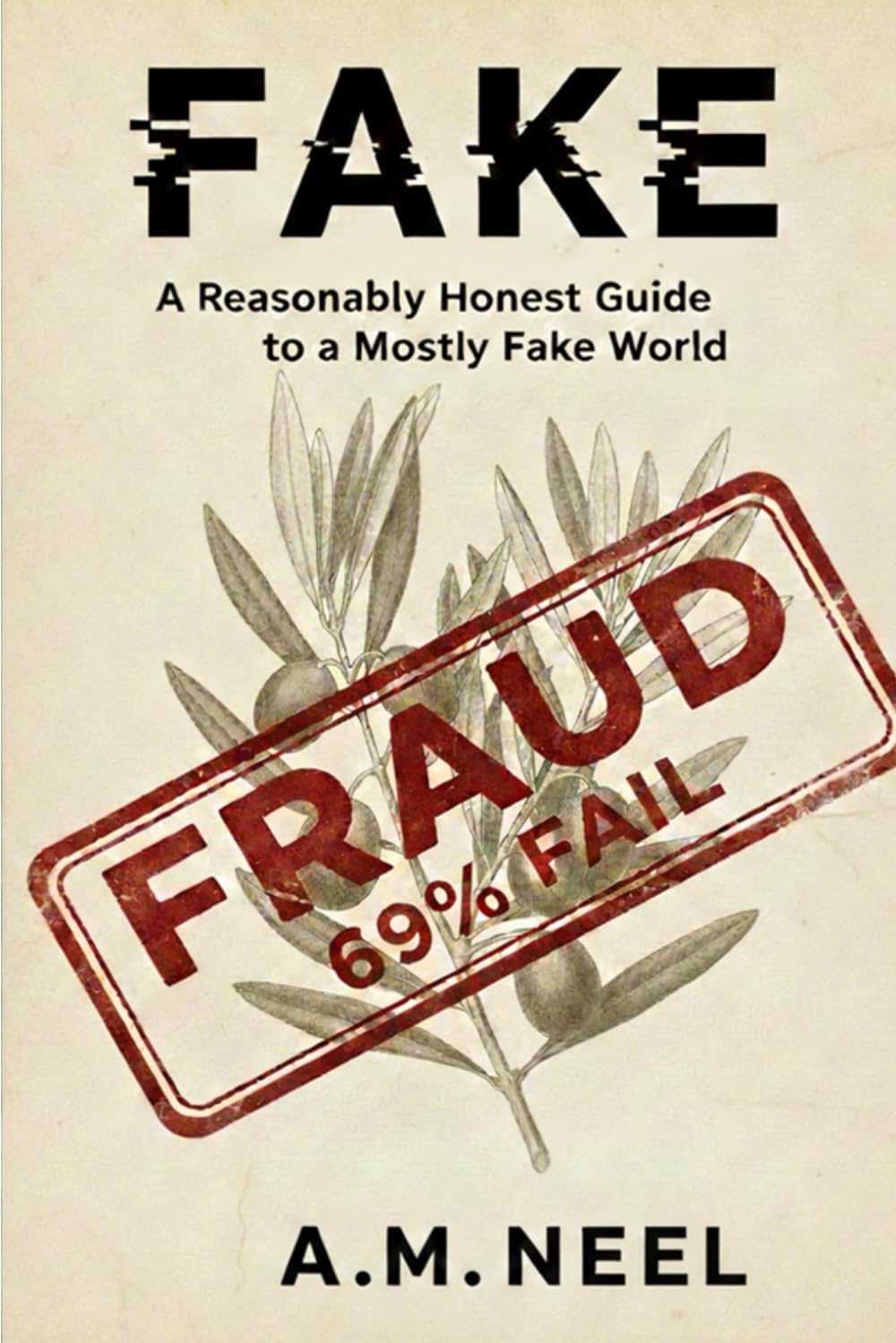
FAKE: A Reasonably Honest Guide to a Mostly Fake World
$14.99
| Brand | A.M. Neel |
| Merchant | Amazon |
| Category | Books |
| Availability | In Stock |
| SKU | B0GR9SBS6F |
| Age Group | ADULT |
| Condition | NEW |
| Gender | UNISEX |
| Google Product Category | Media > Books |
| Product Type | Books > Subjects > Humor & Entertainment > Humor > Political |
About this item
FAKE: A Reasonably Honest Guide to a Mostly Fake World
The wine you drink. The pills you take. The painting on the wall. The study your doctor cited last Tuesday. Standing in a grocery store in Ketchum, Idaho, holding a fourteen-dollar bottle of imported olive oil, writer A.M. Neel had a problem. He had just read a UC Davis study finding that roughly 69 percent of olive oils labeled "extra virgin" fail to meet the standard. The Tuscan farmhouse on the label looked very convincing. He bought it anyway — not because he didn't believe the study, but because there was no way to know which bottle was the lie. FAKE is the book that came from putting that bottle down and asking a harder question: not why people fake things, but how the fakes survive. How they get through the systems we built to catch them. How those systems became, in many cases, the primary reason we don't know what we're buying. The answer spans three thousand years. The Romans sweetened wine with lead acetate, knew it was poisonous, and did it anyway. Medieval merchants sold sawdust as pepper and crushed bark as cinnamon. Victorian manufacturers put chalk in flour and lead in candy while the government asked them politely to stop. In 1906, the United States passed landmark food safety legislation after a century of documented horror — and built an agency that theoretically could act after the damage was done, if it could prove the damage, if it had the budget, which it mostly did not. The playbook has never changed. It just gets more sophisticated. FAKE moves across every domain where humans exchange things of value: food fraud from ancient Rome to your current honey supply; the patent medicine industry and its direct descendants in the modern supplement aisle; art forgery from Han van Meegeren to Wolfgang Beltracchi and the AI deepfakes that have made every previous authentication problem look quaint; the reproducibility crisis in peer-reviewed science; the spectacular career-ending fraud cases that should have been impossible; a global counterfeiting market worth half a trillion dollars; and the regulatory ratchet — the forty-years-too-late pattern that repeats so reliably across every domain that at some point it stops looking like coincidence. This is not a book about bad people. It is a book about bad systems. And bad systems are considerably more interesting than bad people, because bad people at least have the decency to know they're doing something wrong. A.M. Neel is the author of six previous books on intelligence testing, happiness research, immigration restriction, the history of measurement, housing economics, and the psychology of manufactured fear. He writes with dark humor, builds his arguments from primary sources and court records rather than expert opinion, and does not offer conclusions more satisfying than the evidence supports. The farmhouse on the label is a very nice farmhouse. That's the problem.
| Brand | A.M. Neel |
| Merchant | Amazon |
| Category | Books |
| Availability | In Stock |
| SKU | B0GR9SBS6F |
| Age Group | ADULT |
| Condition | NEW |
| Gender | UNISEX |
| Google Product Category | Media > Books |
| Product Type | Books > Subjects > Humor & Entertainment > Humor > Political |
Similar Products








Compare with similar items

La Cité engloutie... |

African Fat-Tailed Geckos Care Bible: Th... |

Mind-Shift Positive Affirmations for Bla... |

L is for Lola: A Personalized Children's... |
|
|---|---|---|---|---|
| Price | $17.02 | $14.00 | $13.99 | $14.99 |
| Brand | Ferry | DR. ELIAS MONTGOMERY | Samuel Dante | R.S.M Publishing |
| Merchant | Amazon | Amazon | Amazon | Amazon |
| Availability | Leadtime | In Stock | In Stock | In Stock |