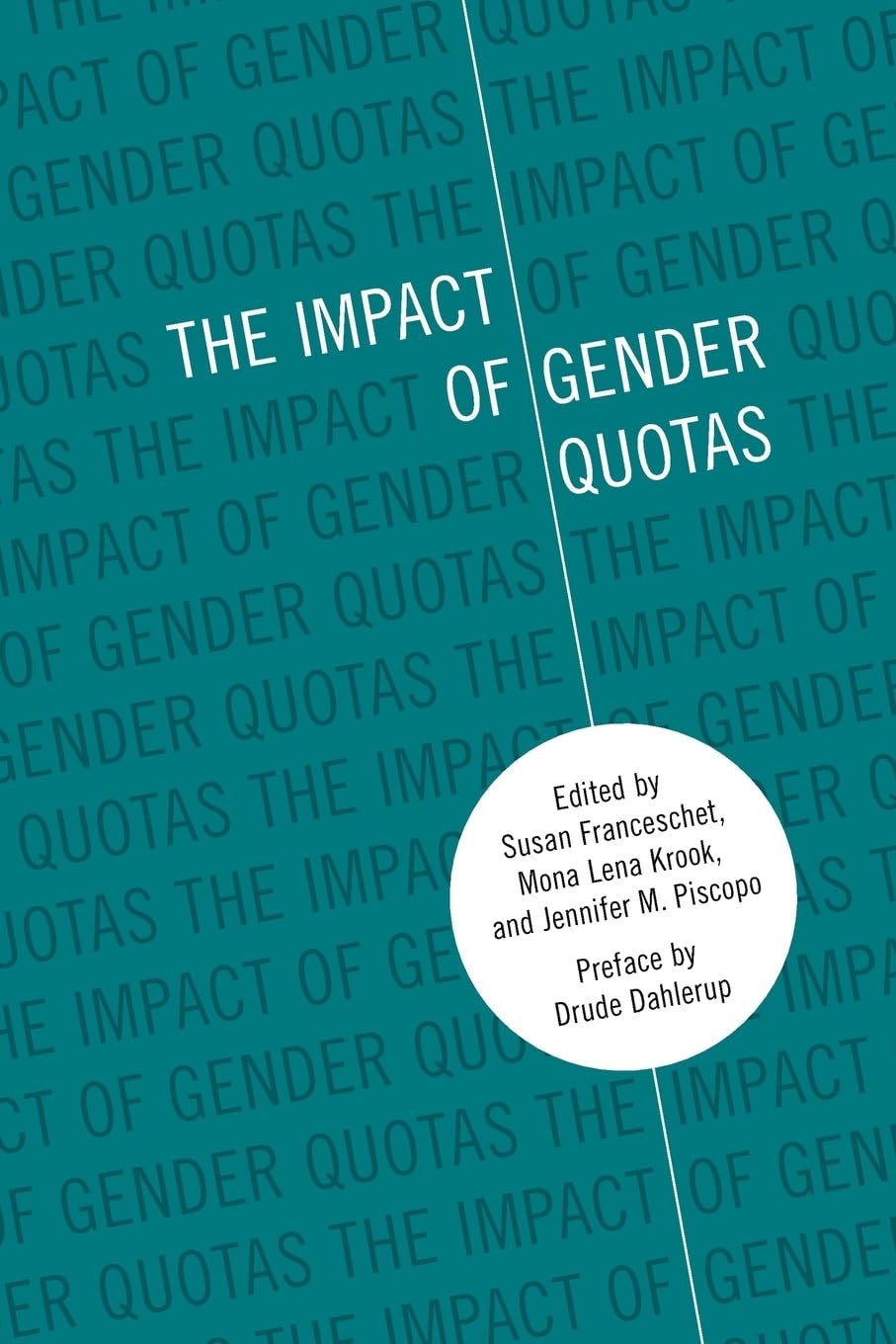
The Impact of Gender Quotas
$28.75
| Brand | Susan Franceschet |
| Merchant | Amazon |
| Category | Books |
| Availability | In Stock |
| SKU | 0199830088 |
| Age Group | ADULT |
| Condition | NEW |
| Gender | UNISEX |
| Google Product Category | Media > Books |
| Product Type | Books > Subjects > Politics & Social Sciences > Social Sciences > Gender Studies > General |
About this item
The Impact of Gender Quotas
The introduction of electoral gender quotas in diverse contexts around the globe has attracted a great deal of scholarly and political interest. To date, research on these measures has focused primarily on quota design, adoption, and effects on the numbers of women elected. While this remains a crucial focus, quotas are not simply about changing the proportion of women in political office. Both supporters and opponents of quotas suggest, albeit from different perspectives, that positive action for women as candidates will influence the kinds of women elected, the policy-making process as it concerns women's issues, the way citizens view women in public life, and the relationship between female voters and the political process. Seeking to initiate a "second generation" of research on quotas, this volume is an effort to inspire a new literature focused on theorizing and studying the broader impact of quotas on politics and society. The book is structured in relation to three facets of political representation: the attributes of officeholders (descriptive representation); the promotion of group interests during the legislative process (substantive representation); and the broader cultural meanings and social consequences of political incorporation (symbolic representation). Within each section, the chapters include case studies from four regions of the world: Western Europe, Latin America, Sub-Saharan Africa, and Asia and the Middle East. This approach recognizes that quotas are a global phenomenon and that research on quotas and representation benefits from a comparative, cross-national approach. The Impact of Gender Quotas is a theory-building and comparative exercise in elaborating concepts commonly used to analyze the broad impacts of gender quotas. The book begins with the argument that the means by which women enter politics may influence how, why and to what extent their presence affects political representation. Following a preface by Drude Dahlerup, one of the pioneers of gender quota research, the editors introduce the book with a conceptual framework for analyzing the impact of quotas, based upon descriptive, substantive and symbolic dimensions of representation. The book is subsequently organized into three sections, each devoted to analyzing one of the dimensions of representation, and each of these sections contains a chapter case study from one of four regions of the world (Western Europe, Latin America, Sub-Saharan Africa, and Asia). Each of the chapters follows a basic format instituted by the editors, with the goal of facilitating cross-case comparisons and broad theory-building. The editors conclude the book by summarizing the main themes and implications for future research on gender quotas. "The editors have united leading experts on quotas and representation in different regions of the world within a superbly crafted common theoretical framework to create an outstanding volume that is both theoretically and substantively enriching. The Impact of Gender Quotas expands our understanding of the effect of electoral gender quotas on descriptive, substantive, and symbolic representation while simultaneously providing an innovative guide for future research in this crucial area of scholarly inquiry."-- Mark P. Jones, Joseph D. Jamail Chair in Latin American Studies & Chair of the Department of Political Science, Rice University "This impressive edited collection greatly advances the field of electoral quota research. The unmistakable conclusion is that gender quotas will not work to shift the quality of public decision-making towards advancing women's interests unless grounded in two crucial political evolutions. The first is the emergence of a political constituency with the commitment and capacity to hold politicians of whatever gender to account for performance on women's rights. The second is political party leadership willing to make women's participation and gender equality principles non-negotiable in public decision-making. Though sobering, the authors are right. There are two clear paths for realizing women's rights: strengthening women's autonomous organizing, and building the accountability and transparency of decision-making in political parties."-- Anne-Marie Goetz, Chief Advisor of Governance, Peace and Security, United Nations Entity for Gender Equality and the Empowerment of Women "A fine collection … Highly recommended." -- CHOICE A theory-building and comparative exercise in elaborating concepts commonly used to analyze the broad impacts of gender quotas Susan Franceschet is Associate Professor of Political Science at the University of Calgary; Mona Lena Krook is Assistant Professor of Political Science at Washington University in St. Louis; and Jennifer M. Piscopo is Assistant Professor of Public Policy at Salem College.
| Brand | Susan Franceschet |
| Merchant | Amazon |
| Category | Books |
| Availability | In Stock |
| SKU | 0199830088 |
| Age Group | ADULT |
| Condition | NEW |
| Gender | UNISEX |
| Google Product Category | Media > Books |
| Product Type | Books > Subjects > Politics & Social Sciences > Social Sciences > Gender Studies > General |
Similar Products










Compare with similar items

El Diego: The Autobiography of the World... |

The Flying Tree - A Árvore Voadora: Bili... |

Première rhapsodie (First Rhapsody): Pou... |

HOW TO GROW PSILOCYBIN MUSHROOMS: An exp... |
|
|---|---|---|---|---|
| Price | $22.37 | $14.95 | $9.99 | $8.99 |
| Brand | Diego Maradona | Ingo Blum | Claude Debussy | James Wallace |
| Merchant | Amazon | Amazon | Amazon | Amazon |
| Availability | Leadtime | In Stock | In Stock | In Stock |