
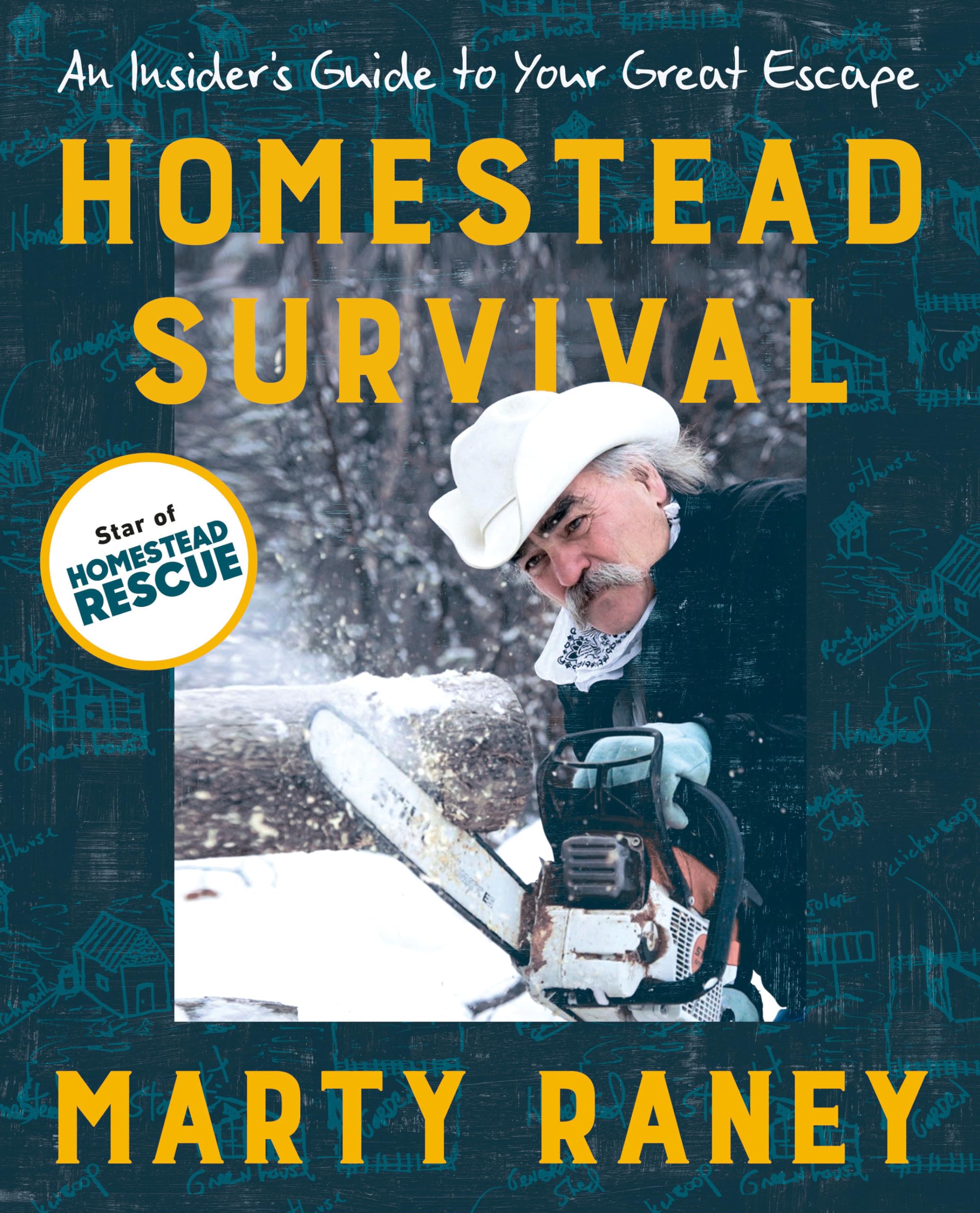
Homestead Survival: An Insider's Guide to Your Great Escape
$17.65
| Brand | Marty Raney |
| Merchant | Amazon |
| Category | Books |
| Availability | In Stock |
| SKU | 0593420683 |
| Color | Multicolor |
| Age Group | ADULT |
| Condition | NEW |
| Gender | UNISEX |
About this item
Homestead Survival: An Insider's Guide to Your Great Escape
A practical guide to self-sufficient and sustainable living from the star of Homestead Rescue . Do you wish for a more resilient, sustainable, and empowered way of providing for your family in uncertain times? Are you worried about unreliable power grids, uncertain water supplies, or overly complex food chains? Veteran homesteader and star of Discovery's Homestead Rescue Marty Raney shares a big-picture vision of how ordinary families can become radically resilient homesteaders: powering, feeding, and caring for themselves through their own efforts, and on their own land. This book will guide you to: • buy land with the natural resources to build and feed a homestead • go off grid with your own power and water systems • design a greenhouse that will keep growing even when it’s snowing • confidently defend your home against all threats—grizzlies, forest fires, flash floods, and financial challenges Resources are only going to get more scarce. Raney will teach you to find food where others see dirt, and to build a home where others see empty land. He will inspire you to forge your own homestead dream and strengthen your family for all challenges to come. Marty Raney is the host and producer of Discovery's Homestead Rescue and Raney Ranch. A former Denali mountain guide and life-long Alaskan survivalist, Marty has made his life off the grid, and in the mountains, in one of the most extreme environments on the planet. He was featured on every season of National Geographic Channel’s Ultimate Survival Alaska. He lives off the grid with his family in Southcentral Alaska. - One - The Homesteader Mentality The desire to live freely, deliberately, and simply under the banner of homesteading is alive and well As I travel from homestead to homestead, the plane's window becomes a wide lens into the past, focusing on the vast North American landscape below. And, at thirty-five thousand feet, I watch a historical documentary unfold in geographic increments: cities surrounded by suburbs, suburbs blended away to occasional rural villages, and then, there they are. The indelible survey section gridlines-now visible as roads or fence lines-carving out the homesteads and farmlands that can be traced to the Civil Warera Homestead Act of 1862, an act that allowed any American, whether rich or poor, to receive a 160-acre plot of land for a filing fee of eighteen dollars. Abraham Lincoln believed that the role of government should be "to elevate the condition of men, to lift artificial burdens from all shoulders and to give everyone an unfettered start and a fair chance in the race of life." And for a period of time lasting well over a century, Americans were able to claim their lot in life. It wasn't a perfect system, and looking back we have to acknowledge the bad as well as the good: Although newly freed Black Americans were technically able to claim land this way, few successfully did. Indigenous tribes were forcibly removed from their homelands, causing generational despair and great loss of life. People abused the system too, with wealthy homesteaders figuring out ways to claim multiple homesteads in good locations. Lincoln's actions reshaped this country, and by the close of the act, over four million homestead claims were filed in more than thirty states, with the last being claimed by a man named Ken Deardorff, along the Stony River in Alaska in 1976. Those dreamers carved a legacy of self-sufficient homesteads, farms, ranches, and orchards, all the way to the Pacific Ocean and then north to Alaska. From my window seat, I can easily see the fenced, bordered sections of land, each section representing 640 acres, or one square mile. The patchwork of squared farmland is a timeless reminder of where we came from, and where our food still comes from. Two hundred years later, however, the migration has reversed, with young people going from the farm, to the factory, to the office. Many of the original "square mile" farms have been broken down to smaller tracts of 320, 160, 80, or 40 acres, and so on. The first subdivision was most likely built on an old homestead, since a two-acre homesite is worth five times more than a two-acre potato field. The transition of family farms to factories was exacerbated as World War II came and went. Interestingly, the subdivisions we see everywhere were actually "invented" during that era-an amazing, novel idea at the time. The original two-, four-, six-, and eightplexes evolved into apartment and condominium housing en masse. Homesteads were surveyed, and developers greedily carved them into one-acre lots, and boom: We planted houses in the fields, resulting in the first fruits of shiny, sprawling suburbia. And, just like the rows of corn planted by the farmer as close together as possible to yield maximum profit, the concrete and wood bumper crop planted by developers has left us all living as close as we possibly can to each other-for the same reaso
| Brand | Marty Raney |
| Merchant | Amazon |
| Category | Books |
| Availability | In Stock |
| SKU | 0593420683 |
| Color | Multicolor |
| Age Group | ADULT |
| Condition | NEW |
| Gender | UNISEX |
Similar Products







Compare with similar items

MICROSOFT PROJECT FOR BEGINNERS: A Funda... |

Sight Words: Word Search Book for Kids... |

Side by Side (Sports Series)... |

Puerto Rico History: The Borinqueneers: ... |
|
|---|---|---|---|---|
| Price | $9.99 | $6.95 | $21.99 | $21.99 |
| Brand | BONIFACE BENEDICT | Clever Panda Press | Nicole Pyland | Alex Alicea |
| Merchant | Amazon | Amazon | Amazon | Amazon |
| Availability | In Stock | In Stock | In Stock | In Stock |